


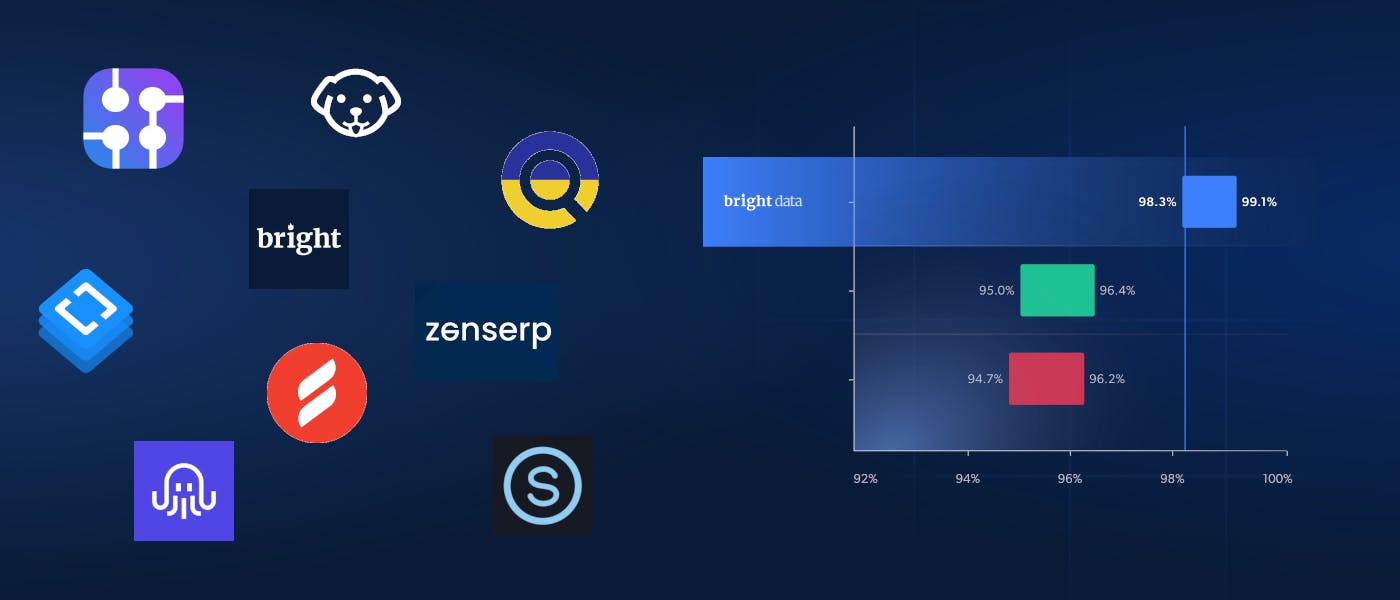
The SERP API market is crowded, but not every provider delivers the integrations, reliability, and speed needed to power AI agents, deep research workflows, and large-scale scraping pipelines.
So we put nine Google Search API providers to the test:
- Bright Data 🏆
- SerpApi
- HasData
- Scrapingdog
- Serper
- SearchApi
- DataForSEO
- Zenserp
- Serply
In the benchmarks below, we measure latency ⏱️ and success rate 📊 to see which SERP APIs actually hold up in real-world conditions. This will help you quickly identify the best option for production workloads!
SERP Benchmarks: Comparing the Best SERP API Solutions
Before diving into the SERP benchmarks for AI agents and deep-research workflows, it’s better to first explain how we selected these SERP APIs and what exactly we tested.
SERP API Selection Methodology
These are the criteria used to select the SERP APIs for benchmarking:
- Geolocation options: Ability to query results from specific countries, regions, or cities.
- Language options: Support for retrieving search results in multiple languages.
- Device simulation: Possibility to switch between mobile and desktop SERP results.
- Pagination options: Flexibility to fetch multiple result pages.
- Error handling: Support for mechanisms to manage failed requests, retries, and general debugging.
- SDKs: Availability of official libraries that simplify SERP API integration and reduce development overhead.
- MCP: Compatibility with the Model Context Protocol to enable AI agents to call the SERP API directly.
- AI integrations: Support for tools, platforms, libraries, and frameworks used for building AI agents, LLM workflows, and AI pipelines.
SERP APIs Under Benchmark
Applying the criteria presented earlier, these are the SERP APIs chosen for benchmarking:
|
SERP API |
Geolocation options |
Language options |
Device simulation |
Pagination options |
Error handling |
MCP |
AI integrations |
|---|---|---|---|---|---|---|---|
|
City-level geolocation with routing across 195 countries via proxies for optimal performance |
All languages supported by Google |
Desktop, mobile, tablet (with support for both iOS and Android mobile and tablet simulation |
|
Custom error codes + Dedicated debug mode |
✅ |
Make, n8n, Zapier, Vertex AI, AWS Bedrock, Dify, LangChain, LlamaIndex, CrewAI, and 50+ others |
|
|
SerpApi |
City-level geolocation |
All languages supported by Google |
Desktop, mobile, tablet |
Up to 10 results with a single API call + Pagination arguments |
Basic custom error codes |
✅ |
LangChain |
|
HasData |
City-level geolocation |
All languages supported by Google |
Desktop, mobile, tablet |
Up to 100 results with a single API call |
Basic custom error codes |
❌ |
n8n, Zapier, Make, LangChain, LlamaIndex |
|
Scrapingdog |
City-level geolocation |
All languages supported by Google |
Desktop, mobile |
Up to 100 results with a single API call + Pagination arguments |
Basic custom error codes |
❌ |
n8n |
|
Serper |
City-level geolocation |
All languages supported by Google |
Desktop, mobile |
Up to 10 results with a single API call + Pagination arguments |
Basic custom error codes |
➖ (unofficial) |
Haystack, JenAI, CrewAI, LangChain |
|
SearchApi |
City-level geolocation |
All languages supported by Google |
Desktop, mobile, tablet |
Up to 100 results with a single API call + Pagination arguments |
Basic custom error codes |
➖ (unofficial, with the official coming soon) |
n8n, Dify, LibreChat, Composio, AnythingLLM, LangChain, CrewAI, and others |
|
DataForSEO |
Country-level geolocation |
All languages supported by Google |
Desktop, mobile |
Up to 100 results with a single API call, or 10 requests in parallel |
Custom error codes + Dedicated API for debugging |
✅ |
n8n, Zapier, Make, LangChain |
|
Zenserp |
City-level geolocation, with support for coordinates |
All languages supported by Google |
Desktop, mobile |
Up to 100 results with a single API call + Pagination arguments |
Basic custom error codes |
➖ (only via Pipedream) |
❌ |
|
Serply |
Country-level geolocation, with proxies in 13 countries |
All languages supported by Google |
Desktop, mobile |
Up to 10 results with a single API call + Pagination arguments |
Basic custom error codes |
➖ (only via Pipedream) |
Via public OpenAPI specs |
Benchmark Tests We Will Perform
To plug SERP data into AI agents or run scraping pipelines at scale, you need an API that is both fast and reliable. A SERP API is only production-ready if it can consistently deliver low latency and a high success rate, even under heavy workloads.
That is why we focused on the following benchmarks:
- P95: The latency time such that 95% of requests are faster than this threshold (and only 5% of requests are slower).
- P50: Represents the median response time, showing how fast a typical request completes under normal circumstances.
- Success rate: The average percentage of successful requests measured across thousands of calls over 30 days of usage.
Note: To keep the comparison fair, we tested only Google SERP API performance. This ensures all providers are evaluated against the same data source. Some SERP APIs support multiple search engines (e.g, Bright Data, SerpApi, ScrapingDog, Zenserp, and others), but including them would introduce unnecessary variability into the results.
SERP Latency: Full Comparison
SERP API latency measures the time it takes for a search request to return results. Below, you’ll find benchmarks comparing latency across the selected SERP APIs.
P50: Average SERP latency
P50 is the 50th-percentile SERP latency, meaning half of all requests are faster, and half are slower. In simpler terms, it represents the typical or median response time. This information is important because it shows real-world performance under regular conditions.
|
SERP API |
P50 |
|---|---|
|
Bright Data |
2.61s (0.89s*) |
|
SerpApi |
2.53s (0.93s*) |
|
HasData |
2.58s |
|
Scrapingdog |
2.48s |
|
Serper |
2.23s |
|
SearchApi |
2.71s |
|
DataForSEO |
4.54s |
|
Zenserp |
3.92s |
|
Serply |
2.64s |
- Routing via dedicated premium infrastructure
Note that most SERP API providers fall within an average latency of around 2.5 seconds, while DataForSEO and Zenserp can reach or exceed 4 seconds.
Both Bright Data and SerpApi also offer options for routing through premium infrastructure, enabling enterprise-ready performance. In particular, Bright Data provides two options:
- Faster routing for the top 10 results (
roughly 2x the average latency ). Special premium routing capable of sub-1-second responses .
With an average recorded SERP latency of ~0.89 seconds, Bright Data stands out as the fastest SERP API in this category.
P95: Worst-Case SERP latency
P95 is the 95th-percentile latency, meaning 95% of requests are faster than this time and only 5% are slower. It reflects worst-case performance under heavy load or when something goes wrong. Basically, it reveals how the SERP API behaves during slow, stressful, or unstable conditions.
|
SERP API |
P95 |
|---|---|
|
Bright Data |
4.92s |
|
SerpApi |
5.27s |
|
HasData |
5.20s |
|
Scrapingdog |
6.82s |
|
Serper |
4.21s |
|
SearchApi |
8.28s |
|
DataForSEO |
10.73s |
|
Zenserp |
11.36s |
|
Serply |
4.73s |
Note how most SERP API providers manage to deliver the great majority of responses in under 8 seconds, with the top performers (Bright Data, Serper, and Serply) achieving times below 5 seconds. In contrast, DataForSEO and Zenserp tend to exhibit the longest response times in this category as well.
SERP Success Rate: Comparison Table
Great latency results mean little without a consistent SERP success rate, which is why this metric must also be benchmarked.
|
SERP API |
Success Rate |
|---|---|
|
Bright Data |
99.99% |
|
SerpApi |
99.71% |
|
HasData |
99.91% |
|
Scrapingdog |
99.03% |
|
Serper |
99.12% |
|
SearchApi |
99.92% |
|
DataForSEO |
99.95% |
|
Zenserp |
99.92% |
|
Serply |
99.23% |
Bright Data once again comes out on top, achieving a success rate of 99.99%, supported by both standard and custom SLAs. DataForSEO, HasData, Zenserp, and Serply are close behind, with success rates in the 99.9x% range, followed by SerpApi. Overall, all selected SERP APIs demonstrate Google SERP API performance above 99%.
At the time of testing, there were no significant global incidents or Google updates. Since the reliability of a SERP API provider must also be evaluated under rare or extreme circumstances, it’s worth examining what happened in January 2025, when
Thanks to a trusted web scraping infrastructure that goes beyond basic SERP scraping, Bright Data was among the few SERP API providers able to remain fully operational, experiencing only a decrease in success rate
SERP Benchmarks: Final Comparison
Compare all selected providers in the final table for SERP benchmarks:
|
SERP API |
P50 |
P95 |
Success Rate |
|---|---|---|---|
|
Bright Data |
2.61s (0.89s*) |
4.92s |
99.99% |
|
SerpApi |
2.53s (0.93s*) |
5.27s |
99.71% |
|
HasData |
2.58s |
5.20s |
99.91% |
|
Scrapingdog |
2.48s |
6.82s |
99.03% |
|
Serper |
2.23s |
4.21s |
99.12% |
|
SearchApi |
2.71s |
8.28s |
99.92% |
|
DataForSEO |
4.54s |
10.73s |
99.95% |
|
Zenserp |
3.92s |
11.36s |
99.92% |
|
Serply |
2.64s |
4.73s |
99.23% |
- Routing via dedicated premium infrastructure
Overall, aggregating the analyzed performance data, the podium for SERP API providers is:
- Bright Data 🥇
- SerpApi 🥈
- Serper 🥉
Beyond strong performance on Google thanks to two special SERP API modes for faster responses, Bright Data also supports multiple search engines, enabling AI agents and data pipelines to gather results from diverse sources to reduce bias.
HasData, ScrapingDog, and Serply also demonstrate strong Google SERP API performance for large-scale scraping, AI agent development, and deep research at scale.
Final Thoughts
In this comparison, we benchmarked some of the leading SERP API providers on the market. We selected them using a consistent methodology based on practical criteria like geolocation support, language coverage, device simulation, pagination controls, error handling, and AI integrations.
We then ran P50 and P95 latency tests ⏱️ together with success-rate measurements 📊 to identify the most robust and production-ready solution.
Overall, Bright Data emerged as the winner 🏆, delivering excellent performance in both average and worst-case scenarios, along with very high reliability.