


Introduction
How one of the world's largest e-commerce platforms handles billions in transactions without crumbling into a microservices mess. During Black Friday Cyber Monday (BFCM), Shopify’s infrastructure takes a beating that would vaporize most systems. We are talking about tens of millions of requests per minute and billions of dollars in sales processed over a weekend.
When engineers hear about this kind of scale, their first assumption is usually a sprawling, complex microservices architecture like Netflix or Uber. They imagine hundreds of tiny, independent services constantly chatting over a network. But Shopify is different. Famous among system designers, Shopify has doubled down on what they call the "Majestic Monolith." Instead of fracturing their system into pieces, they have managed complexity through strict organization and a unique scaling strategy called "Pods." Here is a technical breakdown of how Shopify structures its core platform and the massive app ecosystem that surrounds it.
The Core: A Modular Monolith
At the heart of Shopify sits a massive Ruby on Rails application.
In the early days of hyper-growth, "monolith" became a dirty word in tech. The trend was to break everything down into microservices to gain agility. Shopify realized that while microservices solve some problems, they introduce immense operational complexity—suddenly, you are managing network latency, distributed tracing, and service orchestration instead of building commerce features.
Shopify chose a different path: The Modular Monolith.
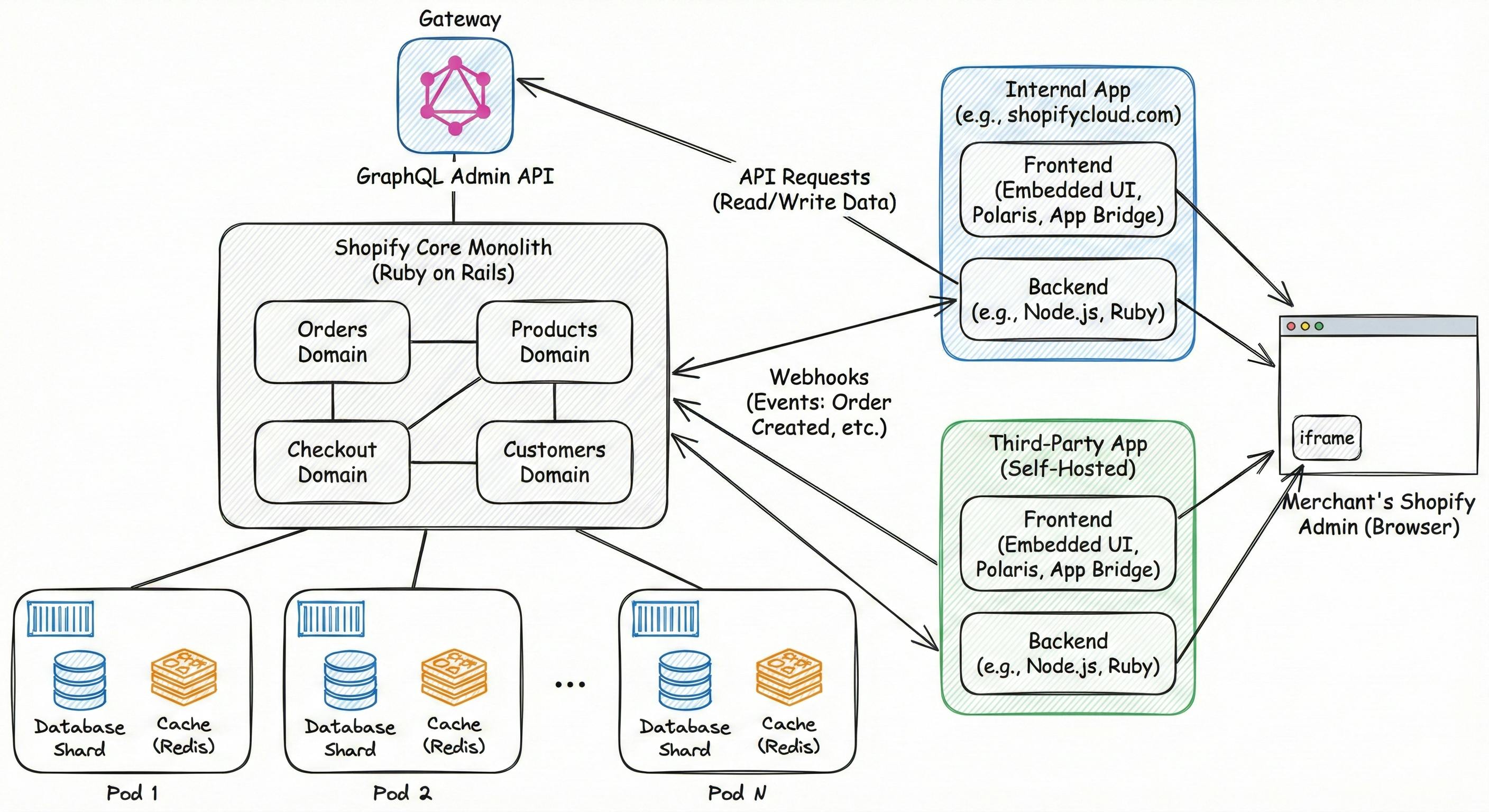
- One Codebase, Strict Boundaries: The entire core runs as a single deployable unit, but internally, it’s rigorously divided into logical "Domains" (e.g., Orders, Products, Checkout, Customers).
- Enforced Isolation: Code within the "Orders Domain" cannot just reach directly into the database tables of the "Products Domain." It must go through established public APIs within the codebase. This keeps the code organized without the network overhead of microservices.
The Secret to Scale: The "Pod" Architecture
A single monolith, no matter how well-organized, cannot run the entire world's e-commerce on one server. If that server goes down, millions of businesses go offline. To solve this, Shopify uses a sharding strategy known as Pods.
A Pod is essentially a fully self-contained unit of Shopify's infrastructure. As shown in the bottom left of the diagram above, a Pod contains:
- A slice of the application workers.
- Its own isolated database shards (containing data for specific stores).
- Its own caching layers (Redis).
The Concept of "Blast Radius"
Shopify groups stores and assigns them to specific Pods. Store A lives entirely on Pod 1. Store B lives on Pod 2.
This is crucial for fault isolation. If a bad database query or a traffic spike causes Pod 1 to crash, only the stores on Pod 1 are affected. The vast majority of the ecosystem on Pods 2 through N keeps running smoothly. This architecture turns potentially catastrophic, system-wide failures into manageable, isolated incidents.
The Ecosystem: How Apps Integrate
The brilliance of Shopify isn't just the core; it's the ecosystem. There are thousands of apps—both internal ones built by Shopify (like their fraud detection services) and public ones built by third-party developers.
How do you connect thousands of external applications to a secure core monolith?
As illustrated on the right side of the diagram, apps are treated as separate entities. They do not live inside Shopify's core servers; they are self-hosted (e.g., on AWS, Heroku, or Shopify's own cloud infrastructure).
They connect to the core using a standardized two-way bridge:
-
The API Bridge (Active)
When an app needs to read product data or update inventory, it makes a secure API call over HTTPS to Shopify’s gateway. Shopify heavily promotes GraphQL over REST for these interactions, allowing apps to fetch exactly the data they need in a single request, reducing load on the core.
-
The Webhook Bridge (Passive)
Apps shouldn't constantly poll Shopify asking, "Any new orders? How about now?" That does not scale. Instead, Shopify uses an event-driven architecture. When an event happens in the Core Monolith (e.g.,
Order Created), Shopify fires a Webhook—a JSON payload pushed immediately to an endpoint on the app's backend. This allows apps to react to business events in near real-time without hammering the API.
The Frontend Experience: The Seamless Illusion
If you have ever used the Shopify Admin, you know that clicking on an app feels like you are still inside Shopify. It doesn't feel like you've navigated away to a third-party website. This is achieved through the App Bridge and Polaris (Shopify’s own design system or in short UI library that has built in components).
When a merchant opens an app, Shopify renders an iframe within the admin dashboard. Inside that iframe, the app loads its own frontend. By using Shopify's Polaris design system (a React component library) and the App Bridge SDK for communication with the parent frame, the app looks, feels, and behaves exactly like a native part of Shopify.
Summary
Shopify’s architecture is a masterclass in pragmatic engineering. They ignored the microservices hype train and focused on a model that optimized for long-term maintainability and massive scale.
By combining a strictly organized monolithic codebase with physical isolation through Pods, they have built one of the most resilient platforms on the internet.