


Benjamin Franklin famously wrote that nothing is certain except death and taxes. For payroll service providers, another certainty has emerged: onboarding pressure and the persistent challenge of managing PDF-based data.
PDFs: A Business Standard with Limits
For professional payroll services, onboarding new clients remains one of the industry’s most operationally complex phases. Teams must migrate historical data, validate records and prepare systems for accurate processing - often under tight timelines tied to pay cycles and compliance requirements. Amid the pressure to get new clients up to speed quickly, payroll companies must frequently scale a mountain of Adobe PDF files, the most common universal, cross-platform file type.
PDF files, while universally accessible and widely adopted, frequently introduce friction when information is visually structured but not machine-readable. Complex documents containing embedded tables, legacy formatting or scanned images often require additional interpretation before data can be reused. This often applies to the large volume of PDF-based documents that payroll companies deal with, including prior payroll registers, tax forms, employee records and authorization paperwork.
For decades, entering data into an electronic payroll system accurately has required doing it manually – a slow, tedious and error-prone process. During the onboarding phase this slows implementation, introduces errors and delays time-to-first-payroll, straining operations at a critical juncture.
A New Era of Automated Data Integration
Automated data tools are an evolving solution, but many fall short. For extraction-heavy workflows like onboarding or payroll, accuracy and context matter more than raw automation, so tools that only convert files or struggle with scanned or poorly converted PDFs often create their own volume of cleanup work.
The rise of automation and AI-driven document processing has begun reshaping onboarding workflows. However, many solutions still struggle with context-heavy extraction scenarios common in payroll environments, where inconsistent layouts and legacy reports create accuracy challenges.
One company attempting to address these challenges is Cleveland-based NE2NE, founded in 2021. The company has been offering its technology solutions to empower small-to-midsized businesses with the same benefits of automated data integrations that have until now been the purview of only the biggest companies. The company positions its platform as an “Any to Any” integration solution designed to help small and mid-sized organizations automate complex data transformations without requiring specialized development resources.
No-code means that SMBs can finally compete with the big guns in their fields using self-service, easy-to-use tools that don’t require expensive developers. NE2NE is a leader in the multi-billion-dollar Integration Platform as a Service (iPaaS) industry, which helps clients seamlessly connect different applications, systems and data sources to automate workflows and share information.
Making PDFs More Flexible
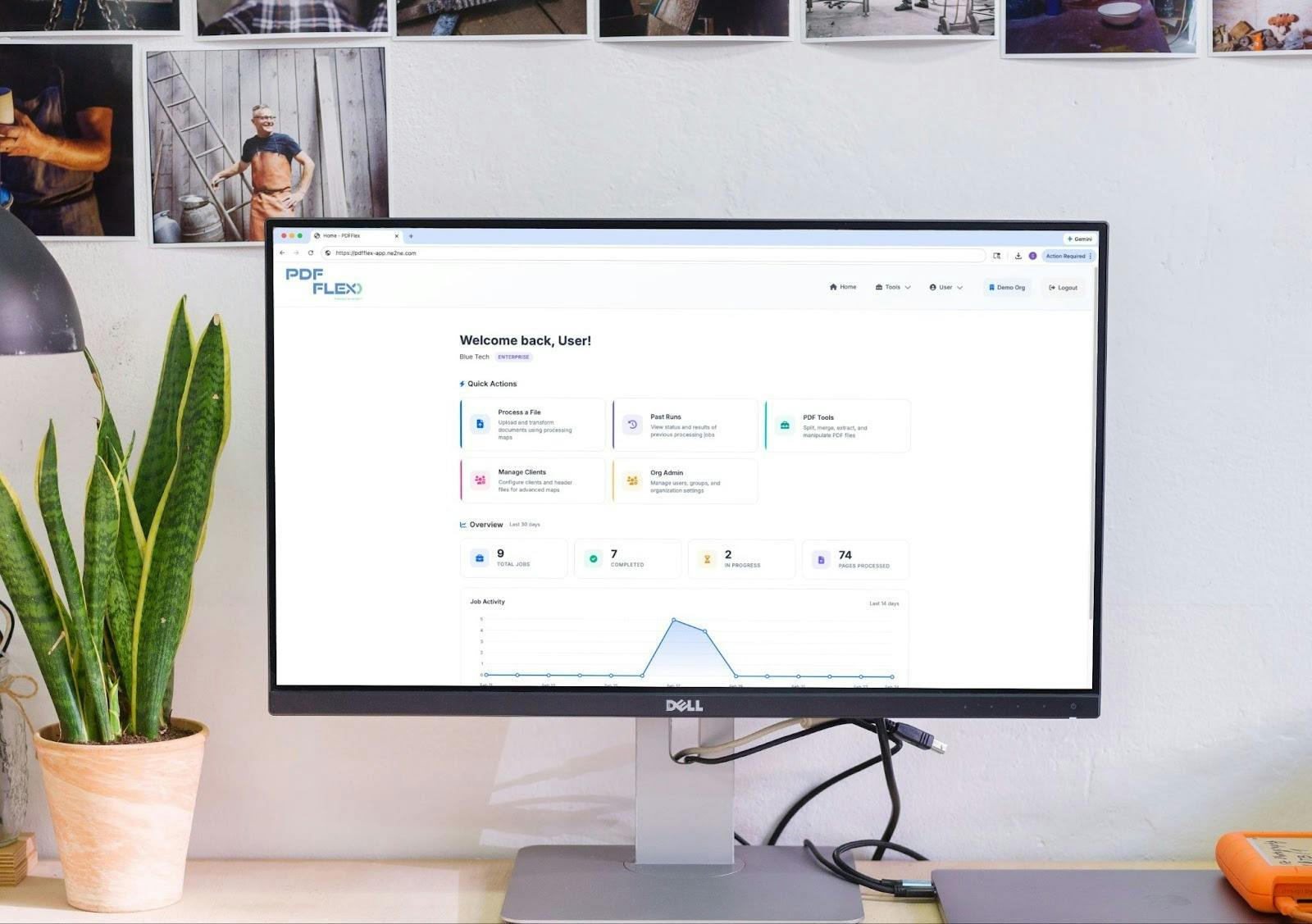
To supercharge data extraction from PDFs and save time, money and frustration for payroll service providers, especially during onboarding, NE2NE recently introduced PDFFlex. An AI-assisted tool that brings surgical precision to data extraction for even the most complex PDF files, PDFFlex is a purpose-built solution designed specifically for payroll workflows.
Nobody understands the challenges of data flow better than NE2NE Founder and CEO Steven Pappadakes, an enterprise software expert who has seen the nefarious underbelly of business. “There’s a tactic we call ‘data sabotage,’” says Pappadakes. “Vendors ‘give’ you your data, but in a nearly unusable form, one that makes it hard for customers to leave their ecosystem.”
Driven to make the unusable usable, Pappadakes introduced PDFFlex to unshackle information, a welcome boon for the data-dependent payroll industry.
With PDFFlex, the excruciating process of manually entering data can literally be reduced to minutes. Powered by leading, security-compliant AI tools, PDFFlex extracts accurate data from even the most complicated PDFs, including payroll registers issued by systems such as ADP, Paychex or QuickBooks, documents that can frequently span hundreds or thousands of pages.
The Gold Standard for Data Extraction
PDFFlex is designed to decode the toughest PDFs with the ability to understand categories and information; to extract all data and transform it into usable formats like Excel spreadsheets, XML or JSON; and to validate extracted data for errors and inconsistencies compared with the original PDF. It also issues a report requesting any human review when needed.
Since the launch of PDFFlex, NE2NE has received kudos from myriad customers whose client onboarding experience has been transformed. “Before NE2NE, we would have to spend weeks onboarding clients. It was costly, time consuming and filled with human error. Now that we have PDFFlex, we can onboard new clients in minutes,” said Tony Chiviles, founder/president of Paybridge, a cloud-based payroll and human capital management platform used by employers and payroll professionals.
While the PDF format has allowed large and diverse files to be shared, Pappadakes explains, its strength has been in visual fidelity, not structure. “PDFs can be wonderfully useful in crushing language, information and images into flat files that can be easily transmitted across platforms. Unfortunately, the same can’t always be said about the data in them.”
While PDFs remain valuable for visual fidelity, their limitations as structured data sources continue to drive innovation in automated extraction technologies, according to Pappadakes. As automation tools mature, payroll providers may find competitive advantage not only in processing payroll accurately, but in how quickly they can bring new clients online.
This story was distributed as a release by Jon Stojan under HackerNoon’s Business Blogging Program.