Welcome to the Proof of Usefulness Hackathon spotlight, curated by HackerNoon’s editors to showcase noteworthy tech solutions to real-world problems. Whether you’re a solopreneur, part of an early-stage startup, or a developer building something that truly matters, the Proof of Usefulness Hackathon is your chance to test your product’s utility, get featured on HackerNoon, and compete for $150k+ in prizes. Submit your project to get started!
In this interview, we talk to Saurabh Sugandh, the creator behind SudoDocs. SudoDocs addresses the chronic issue of documentation drift by acting as an automated "unit test" that connects Git repositories with documentation to ensure accuracy.
What does SudoDocs do? And why is now the time for it to exist?
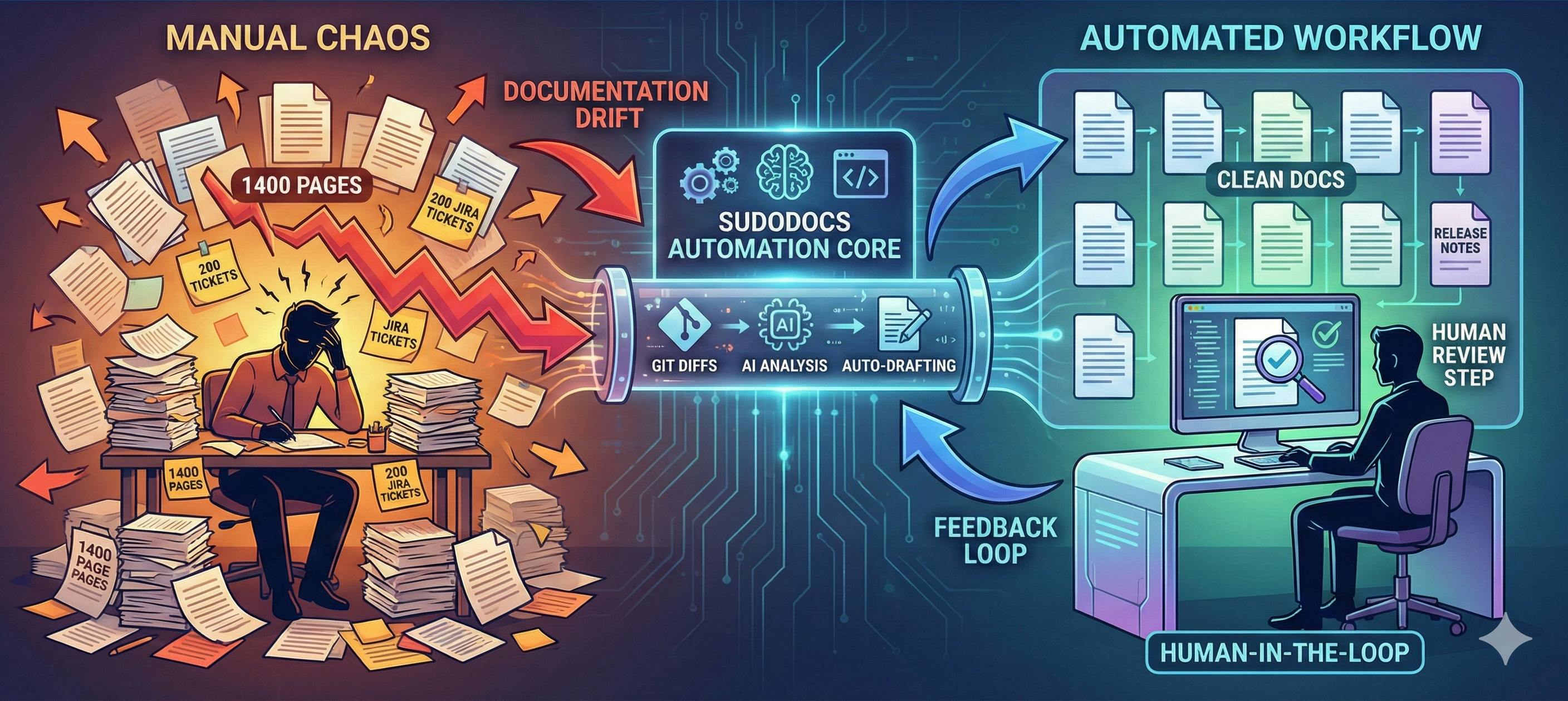
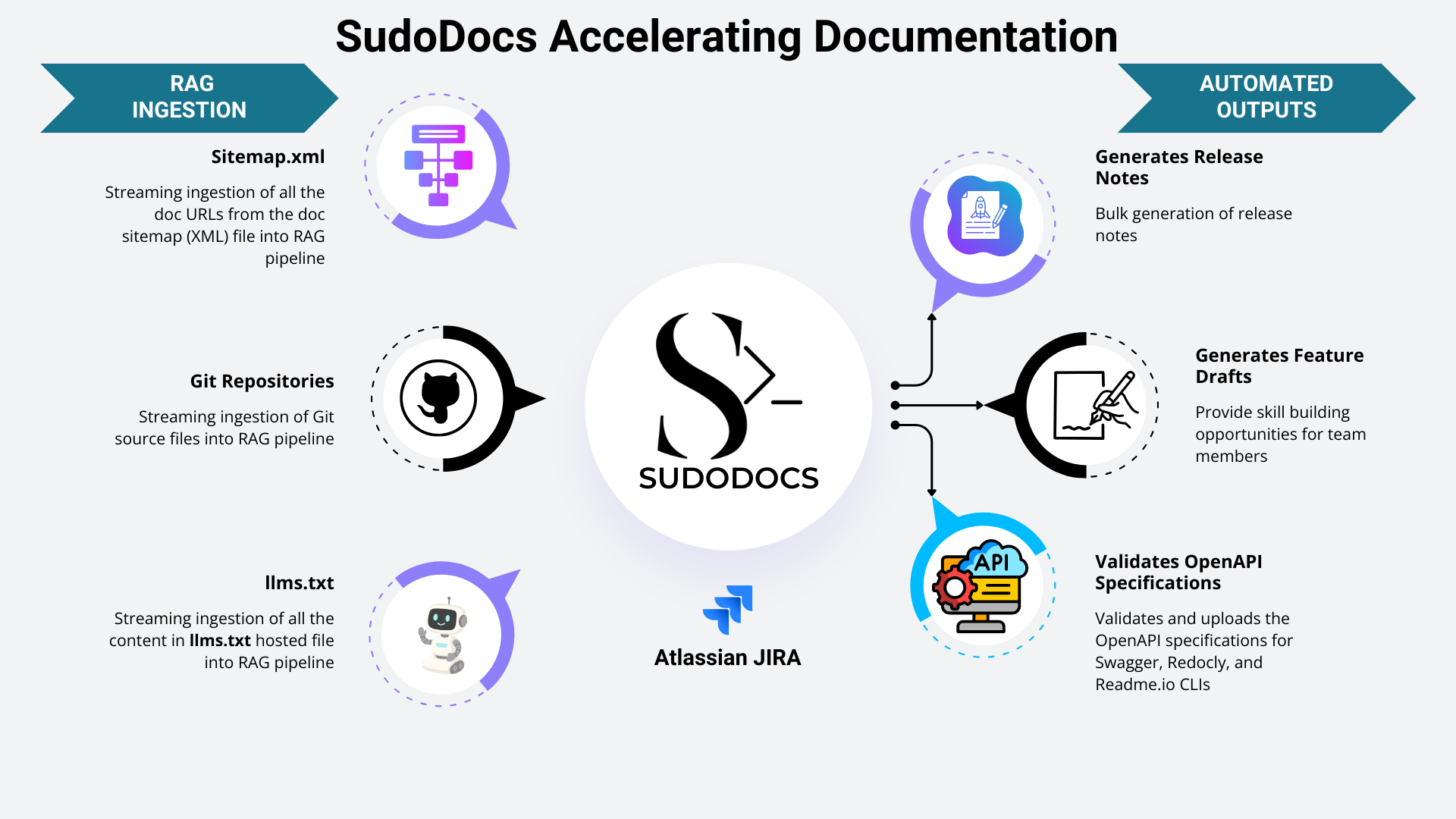
SudoDocs acts as a "unit test" for documentation by connecting to Git repositories and Jira to detect when code changes differ from existing docs. It uses Google Vertex AI (Gemini) to analyze semantic drift in code diffs and automatically drafts accurate updates, ensuring your documentation never lags behind production code. But, SudoDocs is much more than this. With SudoDocs, you create your own RAG vector database and leverage a built-in chat assistant that is not limited to synthesize docs but also your codebase. It doesn't stop there, it then gives you a project workspace to quickly compose release notes and draft features from Jira details while simultaneously validate it against the engineering pull or merge requests. Moreover, SudoDocs serves product teams to quickly validate OpenAPI specifications and automatically correct the mistakes in it. This wholesome package allows technical writers, product owners, and software developers leverage the best documentation for your product. Now’s a good time for SudoDocs to exist because rapid release cycles are outpacing manual documentation updates, creating a critical need for automated solutions that treat documentation as code.
What is your traction to date? How many people does SudoDocs reach?
Between my open-source Streamlit tools (OAS Validator, Release Notes Assistant) and the SudoDocs pre-launch waitlist, the project ecosystem currently reaches a targeted audience of developers and technical writers. Additionally, my articles on 'Docs-as-Code' on HackerNoon have established a readership interested in documentation automation. During the initial response to the waitlist, SudoDocs hit at about 100 user requests and its growing.
Who does SudoDocs serve? What’s exciting about your users and customers?
- Primary: Technical Writers overwhelmed by rapid release cycles who need to automate diff analysis.
- Secondary: Solo Founders and Engineering Leads who need to maintain accurate documentation without hiring a dedicated documentation team.
Notable use cases: Teams practicing 'Docs-as-Code' who suffer from documentation drift, Product teams looking for bulk release notes (or changelog) generation, and Technical writers looking for a quick feature draft with an autogenerated architectural diagrams.
What technologies were used in the making of SudoDocs? And why did you choose ones most essential to your techstack?
The core logic relies on Python (Flask) hosted on Google Cloud Run for a serverless architecture, while Google Vertex AI (Gemini Pro Models) powers the semantic analysis of code diffs. The original scripts that existed before SudoDocs were natively in Python written by me and thus choosing Python (Flask) became an obvious choice. Since the project intended to use Google Docs for an interim review process for the generated drafts, I leveraged Google Authentication for the app usage and deploying it on Google Cloud Run was an obvious choice to bring in all the benefits of Google ecosystem. Currently, SudoDocs is supported with Google Startups for Cloud program that offers free Google Credits to run the project. The updated pricing for the SaaS offering has been slashed down to pass on benefits to the users too. The frontend is built with Tailwind CSS for speed. The ecosystem is also supported by Streamlit for auxiliary open-source modules and Git integrations via GitHub/GitLab APIs.
What is traction to date for SudoDocs? Around the web, who’s been noticing?
While the main SaaS platform is accessible at sudodocs.com, the project has established a footprint through three active open-source utility tools: an OAS Validator, a Release Notes Assistant, and an Intelligent Content Mapper. These public-facing tools serve as practical entry points for the broader "Docs-as-Code" community. We are at about 100 users who are constantly trying the product. Users have shown interest in a self-hosted version too. A community edition will soon be released and is currently under heavy development. My LinkedIn connections get early announcements for any new developments.
SudoDocs scored a 70 proof of usefulness score (https://proofofusefulness.com/reports/sudodocs)
What excites you about this SudoDocs's potential usefulness?
Though SudoDocs offers many great features from having a great built-in product assistant to generating feature drafts and composing release notes, I am most excited about finally solving 'Documentation Drift'— the silent failure where code updates but docs don't. By treating documentation like a unit test that runs against Git diffs, SudoDocs has the potential to save technical writers hundreds of hours of manual auditing and serve product teams to release product at a faster rate. SudoDocs basically transforms technical writers from 'maintenance janitors' into 'documentation architects,' ensuring that the 'Source of Truth' never becomes a lie.
Walk us through your most concrete evidence of usefulness
The strongest signal isn't just the 100+ waitlist signups, but the nature of those signups. They aren't generic users; they are specifically technical writers and engineering leads searching for "documentation drift" solutions.
Furthermore, the sustained daily usage of my standalone open-source tools (like the OAS Validator) proves that the specific pain points like manually validating OpenAPI specs, are acute and daily problems for this demographic. The market is actively looking for automation in this specific niche.
How do you measure genuine user adoption vs. "tourists"? What's your retention story?
We distinguish "tourists" from "adopters" by the Integration Depth.
- A "Tourist" might use the chat interface to summarize a PDF.
- A "Genuine User" connects a Git Repository and a Jira Project.
My retention story is built around the "Drift Scan Frequency." Users who set up the automated "Drift Inspector" to run on every Pull Request are the ones who stick, because SudoDocs becomes part of their CI/CD pipeline rather than just a tool they visit occasionally.
If we re-score your project in 12 months, which criterion will show the biggest improvement?
The "Community & Open Source" criterion. Right now, SudoDocs is primarily a SaaS. In 12 months, with the release of the Self-Hosted Community Edition, I expect the ecosystem to shift from a single-vendor tool to a community-driven protocol. The concept of "Bring Your Own AI Key" will allow organizations to run these audits on their own infrastructure, massively increasing the "Usefulness" score for privacy-conscious enterprises.
How did you hear about HackerNoon?
I’ve been a long-time reader and contributor! I’ve written extensively on HackerNoon about "Docs-as-Code" and infrastructure. It’s one of the few platforms that respects the engineering complexity behind technical writing, which makes it the perfect home for SudoDocs' launch story.
How are you converting users of the OAS Validator/Release Notes Assistant into SaaS waitlist signups?
The open-source tools act as "Feature Magnets." For example, the OAS Validator fixes syntax errors, but it can’t fix logic errors (e.g., "Does this API param match the Python code?"). Inside the free tools, we bridge the gap: "Syntax looks good. Want to check if this spec actually matches your codebase? Try the SudoDocs Drift Inspector." This effectively upsells users from solving a surface-level problem (Validation) to a deep-level problem (Drift).
Open source links:
- OAS Validator: https://validate-oas-refactored.streamlit.app/
- Release Notes Generator: https://release-notes-assistant.streamlit.app/
You mentioned targeting both technical writers and solo founders. Since these two groups have very different budgets and workflows, how do you plan to structure your growth strategy to accommodate both enterprise-level "Docs-as-Code" teams and individual developers?
We use a "Bottom-Up" adoption strategy:
- For Individuals (B2C): SudoDocs is positioned as a Productivity Tool (Feature Author, Release Notes Assistant). The low price point (recently dropped to $8.99/mo) makes it accessible for solo dev-writers to move faster.
- For Enterprise (B2B): It is positioned as a Compliance Tool (Drift Inspector).
- The Bridge: The individual writer uses it to draft features faster. Once they prove the value, the team adopts the "Drift Inspector" to ensure the entire product release cycle is accurate.
How does SudoDocs ensure "unit test" reliability against AI hallucinations?
We treat the AI as a "Junior Analyst," not a "Publisher."
- Deterministic Diffing: The "Drift Inspector" uses deterministic code analysis to find the location of the change, limiting the AI's scope to analyzing only that specific diff.
- Human-in-the-Loop: We do not push straight to production. SudoDocs generates a draft that must be reviewed often exporting to Google Docs first forcing a human validation step. The AI provides the evidence (the code snippet), but the human provides the judgment.
Meet our sponsors
Bright Data: Bright Data is the leading web data infrastructure company, empowering over 20,000 organizations with ethical, scalable access to real-time public web information. From startups to industry leaders, we deliver the datasets that fuel AI innovation and real-world impact. Ready to unlock the web? Learn more at brightdata.com.
Neo4j: GraphRAG combines retrieval-augmented generation with graph-native context, allowing LLMs to reason over structured relationships instead of just documents. With Neo4j, you can build GraphRAG pipelines that connect your data and surface clearer insights. Learn more.
Storyblok: Storyblok is a headless CMS built for developers who want clean architecture and full control. Structure your content once, connect it anywhere, and keep your front end truly independent. API-first. AI-ready. Framework-agnostic. Future-proof. Start for free.
Algolia: Algolia provides a managed retrieval layer that lets developers quickly build web search and intelligent AI agents. Learn more.
[story continues]
tags