


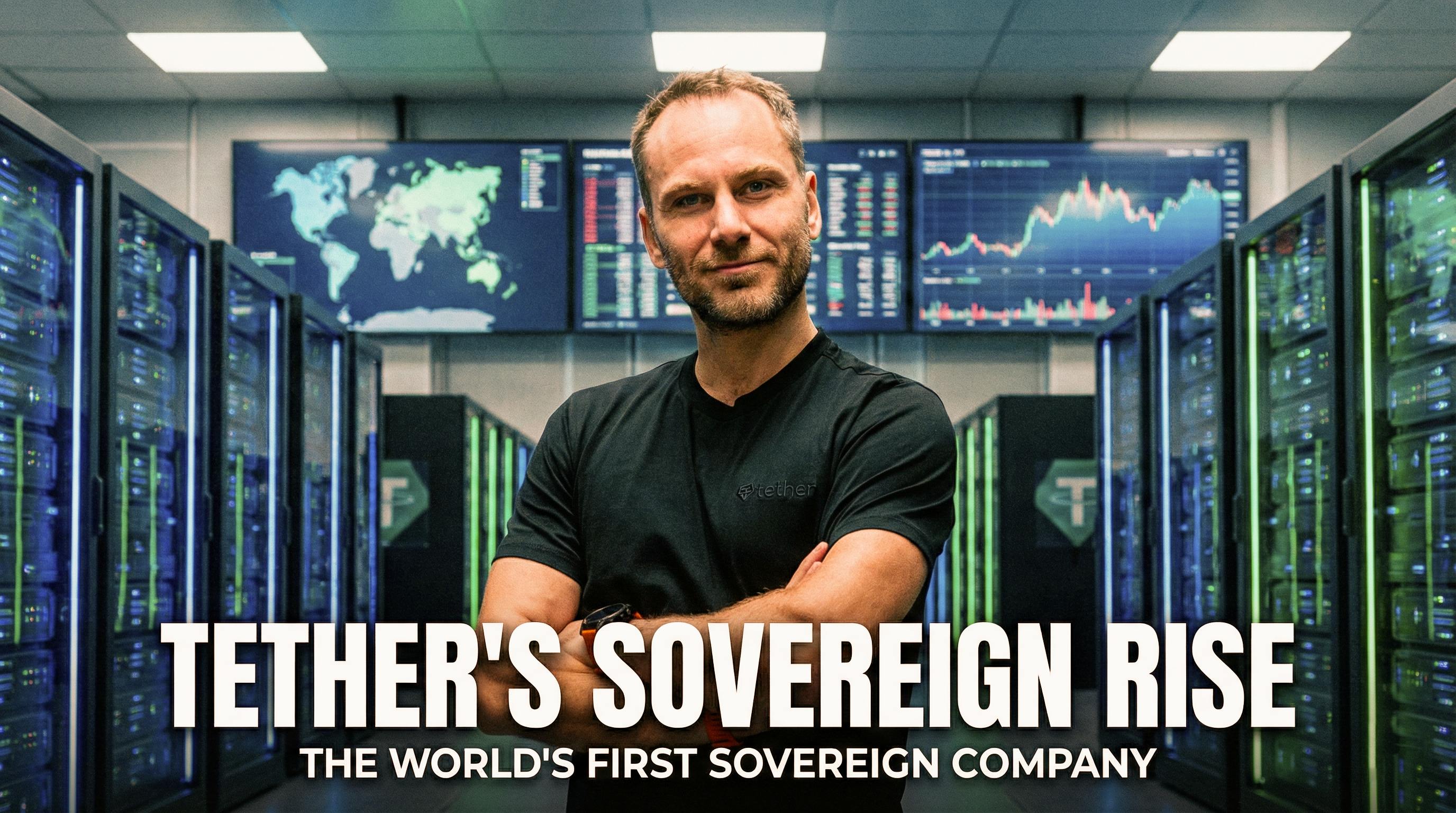
It's becoming the world's first sovereign company
In February, I wrote that Tether may become America's new strategic reserve buyer. Paolo Ardoino shared the piece. But I was thinking too small.
What I described as a stablecoin company with interesting Treasury implications has revealed itself to be something without precedent, an entity that combines the monetary reach of a central bank, the asset base of a sovereign wealth fund, the infrastructure ambitions of a tech giant, and the efficiency of the leanest startup on Earth.
Tether isn't becoming a bigger stablecoin company. It's becoming the world's first sovereign company.
What is a sovereign company?
Traditional categories fail here.
A bank takes deposits and makes loans. Tether maintains 100%+ reserves and doesn't lend to consumers.
A money market fund manages assets. It doesn't issue tokens that circulate as currency across 200 countries.
A tech company builds products. It doesn't control 210,000 hectares of farmland and 116 tons of physical gold.
A sovereign wealth fund invests national resources. It doesn't have 500 million users relying on its tokens for daily survival.
A government issues currency and builds infrastructure. But governments can't generate $10 billion in profit with 100 employees.
Tether does all of this simultaneously. It issues the world's most widely held dollar-denominated asset outside the U.S. banking system. It holds more Treasuries than most countries. It's building AI infrastructure, acquiring agricultural land, mining Bitcoin at scale, and constructing media distribution networks.
This is what a sovereign company looks like: an entity that performs the functions of a state, monetary stability, infrastructure development, financial inclusion, while operating with the speed and profitability of a private enterprise.
The numbers behind a sovereign balance sheet
Tether's Q3 2025 attestation reads like a small nation's reserve report:
$135 billion in U.S. Treasury exposure, ranking 17th globally, ahead of Germany, South Korea, and Saudi Arabia. If Tether were a country, it would sit between Spain and the UAE in Treasury holdings.
$10.5 billion in profit through three quarters, approaching Goldman Sachs, surpassing Bank of America. Full-year projections hit $15 billion.
100,000+ Bitcoin held directly (~$10 billion), plus 116 tons of physical gold.
$6.8 billion in excess reserves beyond full backing of all circulating USDT.
500 million users across 200+ countries.
Roughly 100 employees.
Ardoino claims a 99% profit margin. No corporation in history has operated at this scale with this efficiency.
The sovereign functions Tether now performs
1. Monetary authority for the unbanked
In Argentina, 61.8% of crypto transactions involve stablecoins, the highest ratio globally. The Province of Mendoza accepts tax payments in USDT and USDC. Despite recent stabilization efforts, Argentines have learned not to trust the peso. They trust Tether.
In Nigeria, 25.9 million people hold digital assets, with $22 billion in stablecoin transactions annually. Sub-Saharan Africa's 9.3% stablecoin adoption rate leads the world.
In Turkey, the lira's collapse pushed crypto ownership to roughly half the population. USDT/TRY became Binance's largest trading pair globally.
These aren't speculators. These are people using Tether as their monetary system, for savings, payments, remittances, commerce. Tether provides what their governments couldn't: a stable unit of account accessible via a smartphone.
The IMF and World Bank have spent decades trying to expand financial inclusion. Tether did it with an app and a token.
2. Strategic Treasury buyer at a critical moment
The U.S. faces a $9+ trillion refinancing wall in 2025-2026. One-third of all marketable debt needs new buyers. National debt hit $38.4 trillion in December, growing $6.12 billion daily. Net interest costs exceeded $1 trillion for the first time, now 15% of federal spending.
Meanwhile, traditional foreign buyers are retreating. China's holdings dropped to $700.5 billion, down $84 billion this year alone. Japan holds firm at $1.13 trillion but has signaled willingness to use holdings as leverage in trade disputes.
Into this gap steps Tether, buying Treasuries not as a policy decision but as a mechanical function of its business model. Every USDT minted creates automatic Treasury demand. Unlike China or Japan, Tether can't weaponize its holdings for geopolitical leverage. It's the ideal buyer, price-insensitive, apolitical, growing.
Treasury Secretary Scott Bessent now says the quiet part loud, calling stablecoins "a future pillar of US debt financing" and projecting a $3 trillion market by 2030. David Sacks, Trump's crypto czar, described "potentially trillions of dollars of demand for US Treasuries" from stablecoins.
When the Treasury Secretary publicly identifies a crypto company as a solution to America's debt problem, something fundamental has shifted.
3. Physical and digital infrastructure builder
Sovereign entities build infrastructure. So does Tether.
In April, the company completed a 70% stake in Adecoagro, a NYSE-listed agricultural giant with 210,400 hectares across Brazil, Argentina, and Uruguay generating $1.5 billion annually. This is real farmland producing real commodities: soybeans, sugar, dairy, rice.
Tether operates 15 Bitcoin mining sites across Latin America with $2+ billion invested. Ardoino declared at Bitcoin 2025: "It's very realistic that by the end of the year, Tether will be the biggest Bitcoin miner in the world."
Hadron, launched November 2024, provides enterprise infrastructure for tokenizing real-world assets, stocks, bonds, real estate, commodities. The RWA market hit $24 billion in 2025 with projections reaching $30 trillion by 2034. Tether is building the rails.
QVAC offers decentralized AI that runs on consumer devices without cloud dependency. In October, they released a 41-billion-token synthetic dataset for AI training. In December, QVAC Health launched for privacy-focused wellness. Investments in Blackrock Neurotech ($200 million for brain-computer interfaces) and Generative Bionics (humanoid robotics) extend the thesis further.
$775 million into Rumble plus $150 million in GPU infrastructure creates a media and cloud computing footprint. This isn't diversification for diversification's sake, Rumble becomes a distribution channel for USAT, Tether's U.S.-compliant stablecoin launching with plans to reach 100 million Americans.
Agriculture. Mining. AI. Media. Tokenization. Financial infrastructure. This is the portfolio of a sovereign entity, not a fintech startup.
The GENIUS Act: Washington's acknowledgment
The GENIUS Act, signed July 2025, created America's first federal stablecoin framework. The legislation matters less than what it represents: official recognition that stablecoins are permanent infrastructure, not a regulatory problem to be solved.
The law requires 1:1 liquid reserve backing, monthly public disclosure, and establishes stablecoin holders as priority creditors in bankruptcy. Foreign issuers like Tether have 18 months to comply.
But the rhetoric matters more than the rules.
Bessent called the law "a historic milestone" and projected stablecoins could "lower government borrowing costs and help rein in the national debt."
Sacks declared: "The golden age has begun. The war on crypto is over."
This is the U.S. government welcoming Tether's Treasury-buying function into the official financial architecture. The sovereign company just received sovereign recognition.
The uncomfortable truth
Here's what critics miss when they demand audits and warn of collapse:
While BRICS nations debate de-dollarization at summits, their citizens are re-dollarizing through USDT. The grassroots dollar adoption that Tether enables does more for American monetary hegemony than decades of State Department soft power.
While central banks issue reports about stablecoin risks, 500 million people have already decided Tether is safer than their local currency. They're not waiting for regulatory clarity.
While banks with 200,000 employees generate $8 billion in profit, Tether with 100 people generates $10 billion. The efficiency gap isn't marginal, it's existential.
The uncomfortable question: What happens when a private company performs sovereign functions better than sovereigns do?
The competition awakens
The sovereign company concept isn't lost on others.
Circle went public in June 2025, raising $1.05 billion at an $8 billion valuation. USDC reached $78 billion in circulation.
JPMorgan launched JPM Coin on Coinbase's Base blockchain, processing $2 billion in daily institutional transactions.
A Wall Street Journal report revealed JPMorgan, Bank of America, Citigroup, and Wells Fargo exploring a joint stablecoin through Early Warning Services.
PayPal's PYUSD hit $4 billion market cap. YouTube now pays creators in PYUSD. CEO Alex Chriss stated in December: "If you were to build the payments ecosystem from scratch today, it would probably look a lot like stablecoins."
Ardoino's response: "We are going to hit the ground running, and we're going to start taking away market share from our competitors that were the ones that tried to kill us in the first place."
The sovereign company has attracted challengers. But network effects, distribution, and four years of emerging market penetration aren't easily replicated. Tether's 500 million users aren't switching to JPMorgan's token.
What comes next
In December, Ardoino submitted a €1 billion binding proposal to acquire Juventus Football Club, full takeover of Exor's 65.4% stake plus €1 billion in development capital. Majority shareholder Exor rejected the bid, but the attempt revealed something important: Tether has the financial firepower and ambition to acquire iconic global assets.
"For me, Juventus has always been part of my life," Ardoino said. "I grew up with this team."
This is a CEO thinking in terms of legacy, not quarterly earnings. Sovereign entities think this way.
USAT launches soon with Bo Hines, former executive director of Trump's Presidential Council of Advisers for Digital Assets, as CEO. The U.S. market, previously off-limits, opens for direct competition with Circle and the banks.
Hadron continues onboarding institutional clients for asset tokenization. QVAC expands its decentralized AI stack. Mining operations scale toward Ardoino's goal of global dominance. Agricultural assets generate steady cash flows independent of crypto cycles.
The first sovereign company
I wrote in February that Tether might become a strategic reserve buyer. That was accurate but incomplete.
Tether has become something new, an entity that issues currency, holds sovereign-level reserves, builds infrastructure across continents, provides financial services to half a billion people, and operates with an efficiency that makes both governments and corporations look obsolete.
Is this good? That depends on your priors.
If you believe monetary functions should remain with states, Tether represents dangerous privatization of sovereign authority.
If you believe competition improves outcomes, Tether represents the most successful challenge to government monetary monopoly in modern history.
If you believe financial inclusion matters more than institutional turf, Tether has done more in a decade than the World Bank did in 80 years.
What's undeniable is that Tether is no longer just a stablecoin company. It's no longer even primarily a stablecoin company. It's an entity performing sovereign functions at scale, issuing money, buying government debt, building infrastructure, providing financial services to underserved populations, while generating profits that dwarf traditional institutions.
The world's first sovereign company exists. It has 500 million users, $135 billion in Treasury holdings, investments spanning agriculture to AI, and the explicit acknowledgment of the U.S. Treasury Secretary that its growth serves American interests.
The only question is whether the rest of the world is ready for what that means.