
When you google “crypto trends for 2026”, you usually find the same set of predictions. AI tokens will explode even more, stablecoins entering a new era, ETFs becoming a new institutional gateway. These themes are often discussed, get a lot of attention and will likely keep influencing the industry.
Instead of repeating familiar forecasts, let’s look at the trends which are quietly happening behind the scenes.
Perpetual DEXs
Recently, the crypto market went through one of its most chaotic days yet. Prices whipsawed, synthetic collateral depegged, and order books thinned to the point where even large exchanges struggled to function. By the end of the day, more than $19 billion in leveraged trades had been wiped out and over 1.6 million traders were liquidated.
No platform felt the pressure more than Binance. Users reported failed orders, API freezes, withdrawal delays, and liquidation prices that didn’t match what was displayed on-screen. Critics blamed broken internal oracles and mispriced collateral for triggering forced liquidations that shouldn’t have happened. Hyperliquid co-founder
So, CEX: 0, DEX: 1, and the trend keeps growing. Perpetual DEXs have quietly become one of crypto’s strongest narratives. Platforms like Hyperliquid, Aster, Lighter, edgeX went from niche products to serious competitors in less than two years.
The numbers
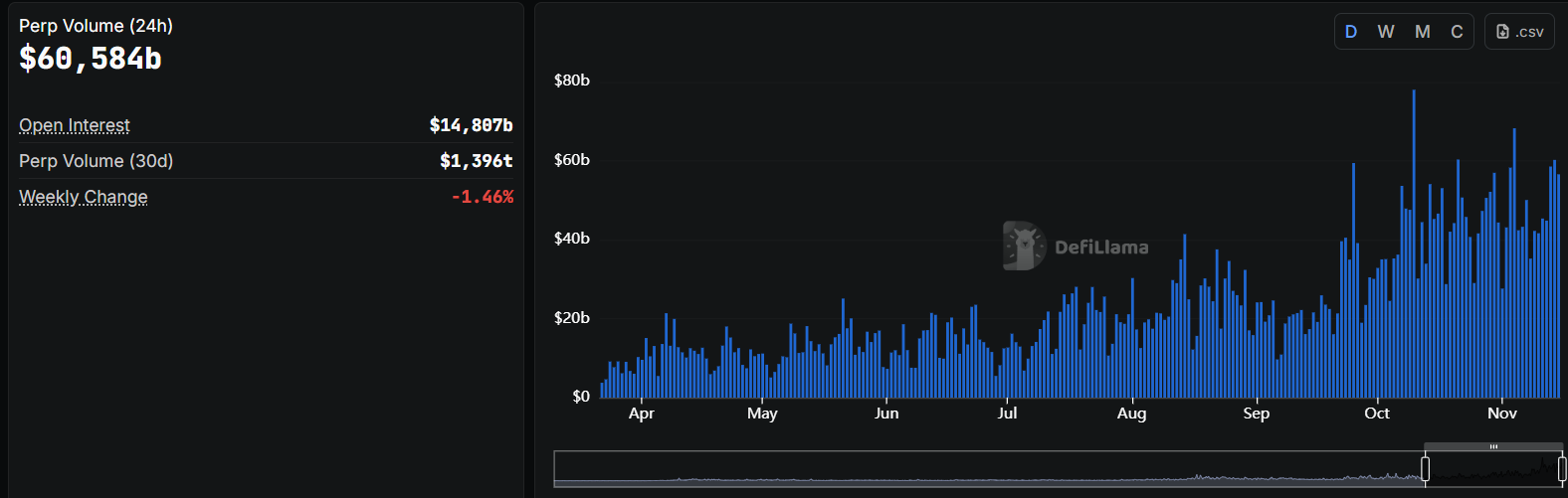
Moreover, perp DEX user metrics show real adoption behind the numbers. Hyperliquid’s traffic
So, perp DEXs are quickly becoming traders’ go-to choice, thanks to their transparency, control, and liquidity that increasingly rivals (and sometimes even surpasses) centralized competitors.
Privacy
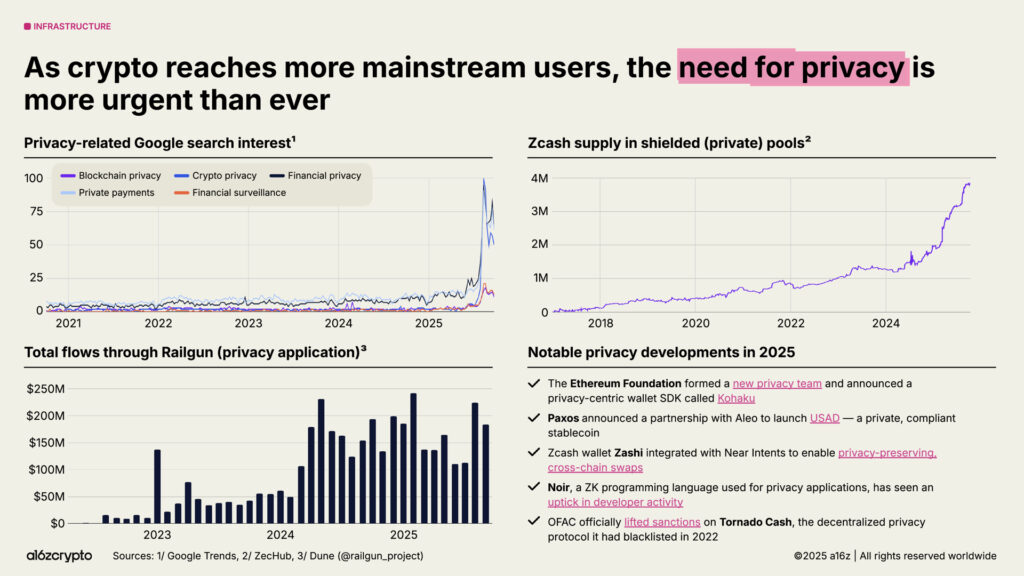
Crypto has always served three main purposes: store of value, markets, and privacy. The first two already have their champions. Privacy, however, is still searching for its moment, and that moment may finally be arriving.
As governments move toward CBDCs and tighter financial control, the need for private transactions is rising. Andreessen Horowitz’s a16z
__  __
__
A few standout projects show how privacy is shifting from a niche obsession to a mainstream experimentation.
Take Zcash. Its shielded supply has more than
At the same time, major networks are weaving privacy deeper into their infrastructure. Ethereum
The demand for private transactions is likely to grow not just as a preference, but as a principle. This shift won’t just affect individual wallets; it will reshape how networks are built, what developers create, and how we judge innovation.
Prediction Markets
Prediction markets have clearly evolved from a niche experiment into a fast-growing sector, and recently
It is gaining serious institutional credibility too. The Intercontinental Exchange, which owns the NYSE, is
And things get even more interesting. Recently, Google
Looking ahead, prediction markets could evolve into a central way of measuring and monetizing conviction. They are starting to feel less like gambling venues and more like information engines, where collective wisdom can be priced, traded, and hedged.
Interoperability
We’ve got plenty of strong projects, smart teams, and genuinely impressive tech. But the industry is still stuck in a pretty awkward place: everything works, but it works separately.
Tokenized securities are growing, yet adoption remains limited due to regulatory uncertainty, custody requirements, and fragmented issuance (
So DeFi and TradFi are both actively searching for a bridge that can finally link their systems.
We can already see the shift happening. Cross‑chain communication is improving thanks to LayerZero, Axelar, Wormhole, and Chainlink CCIP. Payment‑oriented projects like Rain
Bottom line
Looking at crypto in 2026, the story isn’t about the loudest headlines. It’s about resilience, adaptation, and infrastructure quietly taking shape.
The most significant opportunities won’t come from the next viral token, but from understanding the underlying currents shaping the market. In other words, the real signal lies not in the noise, but in the structures quietly building the future.
[story continues]
tags