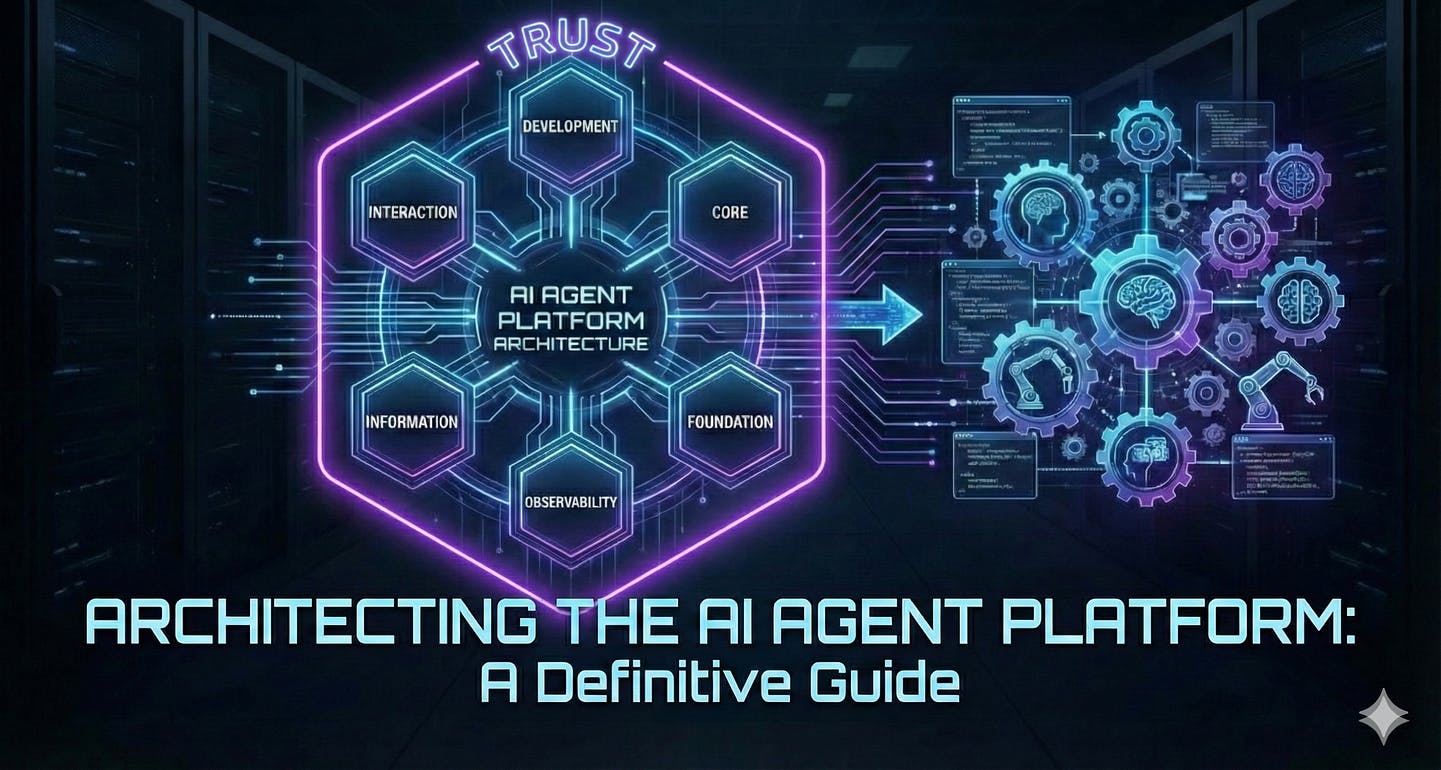
The velocity of Generative AI has been nothing short of relentless. In the span of just 24 months, the industry has shifted paradigms three times. We started with the raw capability of LLMs (the “prompt engineering” era). We quickly moved to RAG (Retrieval-Augmented Generation) to ground those models in enterprise data. Now, we are at the era of AI Agents.
We are no longer asking models to simply talk or retrieve; we are asking them to do. We are building systems capable of reasoning, planning, and executing actions to change the state of the world.
Building a single agent in a notebook is easy. Building a system that serves, secures, and monitors thousands of autonomous agents across an enterprise is an entirely different engineering challenge. To deliver robust solutions with tangible ROI, you cannot rely on scattered Proofs of Concept. You need a factory. You need an AI Agent Platform.
In this guide, I will deconstruct the architecture of a production-grade AI Agent Platform, breaking it down into its system context, containers, and component layers.

System Context: The PaaS Approach
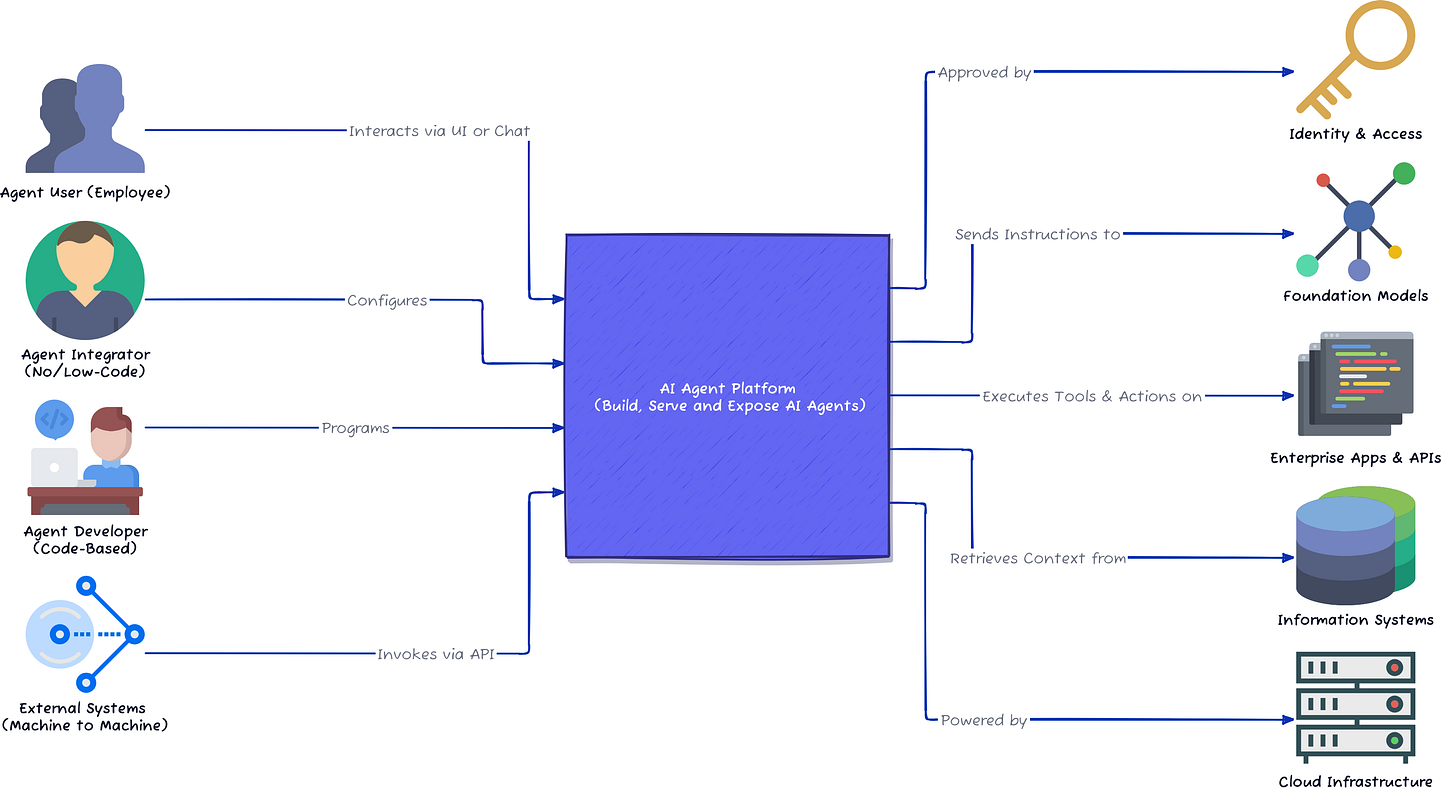
At its core, the AI Agent Platform is a Platform-as-a-Service (PaaS) designed to build, serve, and expose AI agents.
Unlike AI Agent SaaS solutions — which lock you into a closed ecosystem and a predefined set of integrations — an AI Agent Platform is designed for extensibility and control. SaaS solutions are excellent for quick wins, but they often lack the ability to support custom logic or complex enterprise workflows.
Crucially, an internal AI Agent Platform allows you to enforce SRE (Site Reliability Engineering) practices. If an agent fails, your Ops team can intervene. If an agent attempts an unauthorized action, your Security team has the audit trails to investigate and harden the perimeter.
The platform serves two distinct types of builders:
- The Programmer (Code-Based): Engineers requiring power and flexibility.
- The Integrator (No/Low-Code): Business analysts requiring speed and ease of configuration.
It must also be accessible to External Systems (Machine-to-Machine) via standard APIs like REST or gRPC. This allows other systems to offload cognitive tasks — like “analyze this log file” or “classify this ticket” — to your agent fleet programmatically.
To function, the AI Agent Platform relies on five high-level systems:
- Identity & Access: The gatekeeper for users, agents, and data.
- Foundation Models: The cognitive “brain” (reasoning, planning, and instruction following).
- Enterprise Apps & APIs: The “hands” of the agent (e.g., Jira, Salesforce, SAP, SQL, …).
- Information Systems: The context providers (Operational DBs, Data Lakes, Knowledge Bases).
- Cloud Infrastructure: The bedrock providing compute and reliability.
The Container Architecture
To manage complexity, we divide the AI Agent Platform into 7 Logical Containers. This separation of concerns is vital for security auditing and independent scaling.
- Interaction: The frontend where users meet agents.
- Development: The workbench for building and deploying.
- Core: The runtime engine that executes logic.
- Foundation: The infrastructure abstraction for models and compute.
- Information: The data layer managing context.
- Observability: The monitoring and evaluation stack.
- Trust: The security and governance control plane.

1. Interaction
The Interaction layer is the portal. It is where the carbon lifeforms (us) communicate with the silicon.
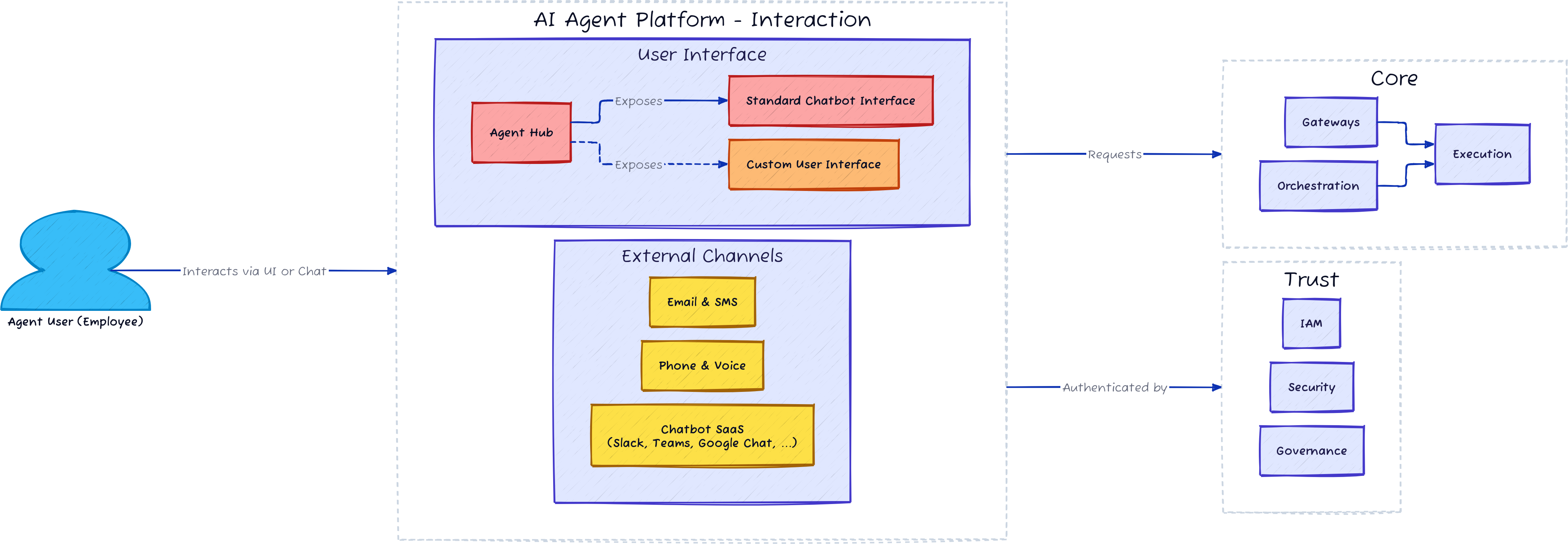
- Standard Chatbot: The familiar conversational interface. It is fast to ship and often requires zero frontend skills. However, it is a generic instrument; chat is not always the best interface for complex user experience.
- Custom User Interface: Bespoke web or mobile apps. This is where the power lies. As I’ve argued before, the UI is often the real bottleneck for agents. Custom UIs allow for rich interactions, but they come with a “frontend tax” — they are time-consuming to build.
- External Channels: Extending the platform to meet users where they are — SMS, Email, Voice, or Slack. This is critical for field workers or remote teams who don’t sit in front of a dashboard all day.
In the future, I expect Generative UI to take over by 2026. This is where the agent generates dynamic interface elements on the fly based on user intent (see Google Research). In the meantime, we must trade between options.
2. Development
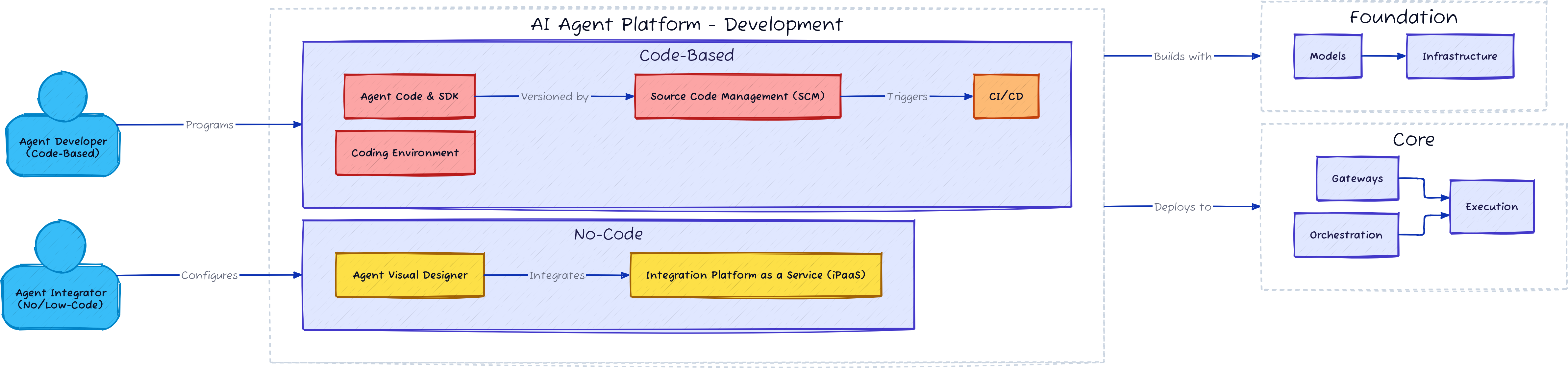
This is the factory floor. My experience shows a 50/50 split between developers (code-based) and integrators (no/low code), so your platform must support both paths to avoid limiting speed or flexibility.
Code-Based (The Developer Path)
This path is for engineers using frameworks like LangGraph, CrewAI, or Google ADK.
- The Stack: Code is versioned in SCM (Git), tested via CI/CD, and deployed as software artifacts.
- The Cost: Surprisingly low. With “Model-as-a-Service,” developers can build robust agents on a laptop or Cloud Workstation for pennies per day. You don’t need a local H100 cluster.
No-Code (The Integrator Path)
This path is for business analysts using Visual Builders and iPaaS (Integration Platform as a Service) tools.
- The Stack: Visual designers, drag-and-drop workflows, and pre-built connectors for building AI Agents.
- The Trade-off: Speed vs. Flexibility. It is the fastest way to prototype and connect to enterprise apps, but visual design can be less robust and more limiting than pure code.
3. Core
The Core is the heartbeat. It houses the Execution Engine, the runtime responsible for the agent’s cognitive loop.
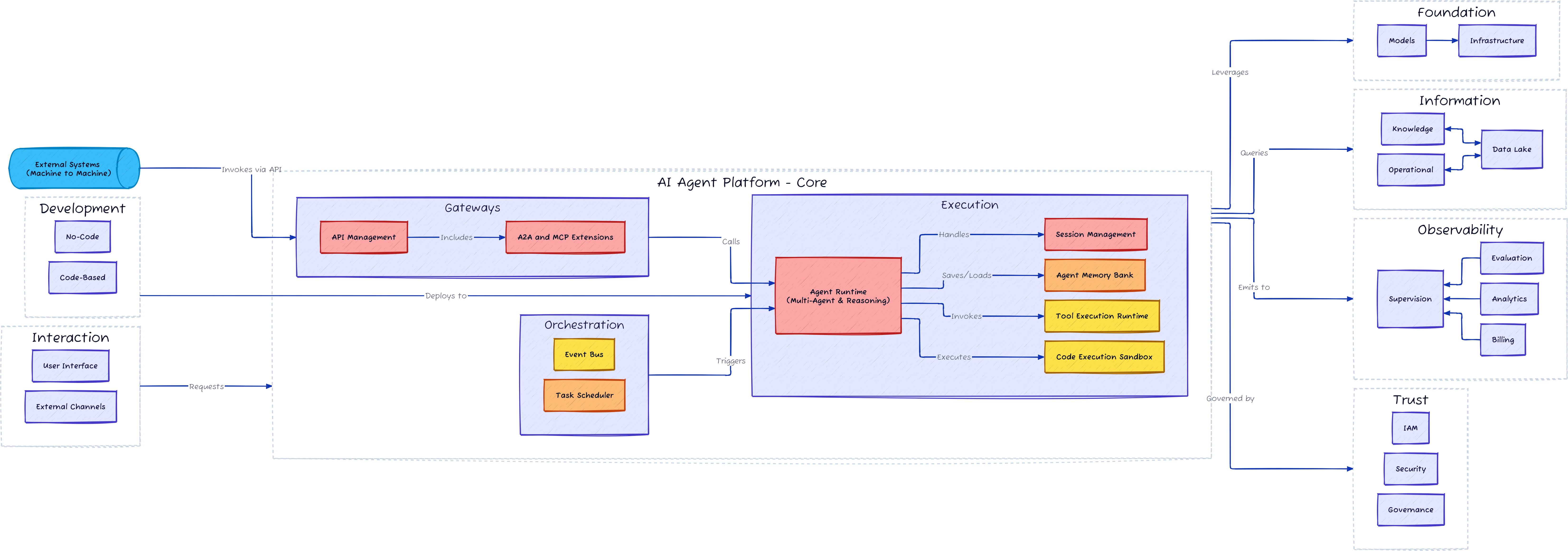
The Execution Engine
To be truly autonomous, the runtime needs specific capabilities that ease development:
- Session Management: Persisting state across conversational turns.
- Memory Bank: Handling short-term context and long-term recall.
- Code Sandbox: A secure environment (like a micro VM) where the agent can write and execute code safely to solve math or data problems.
Gateways & Orchestration
You don’t always need a heavy Airflow setup with DAGs, but you do need:
- Task Schedulers / Event Buses: To trigger agents asynchronously (e.g., “New Ticket Created” -> “Wake up Triage Agent”).
- API Management: Exposing agents via standard Gateways like Apigee or Gravitee.
Standardization is Key: Practitioners are heavily encouraged to adopt standards like MCP (Model Context Protocol) and A2A (Agent-to-Agent) interfaces. Your platform cannot be an island; it must act as a network where your agents can call tools or even other agents to complete complex tasks.
4. Foundation
The Foundation layer is the bedrock of the AI Agent Platforms, providing both Foundation Models and Infrastructure solutions to the agents.
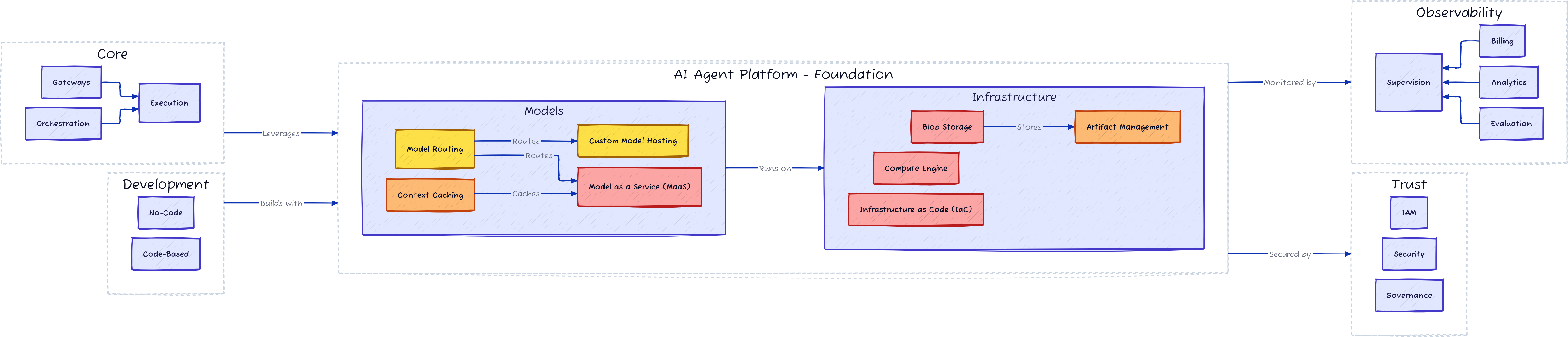
Model Strategy
- Serving: You will likely mix Model-as-a-Service (Vertex AI, Bedrock, …) for ease of use and scalability, and Custom Model Hosting for specific, fine-tuned, or private models that require more operational effort.
- Model Routing: Don’t default to the most expensive model. Use a router to dispatch simple queries to cheaper/faster models and complex reasoning to “smart” models (e.g., Gemini 1.5 Pro, Claude 3.5 Sonnet, GPT-4).
- Context Caching: A massive cost saver. Cache system instructions and heavy documents so you aren’t paying to re-tokenize your company handbook on every request.
Infrastructure
Standard cloud primitives apply here. Compute, Blob Storage, and Artifact Management (for abstracting the agent storage of input/output files) are essential. Treat your Agent Infrastructure as Code (IaC) to ensure reproducibility across environments (AWS, GCP, Azure, or on-premise).
5. Information
An agent without data is a hallucination machine. The Information layer feeds the context required for decision-making.
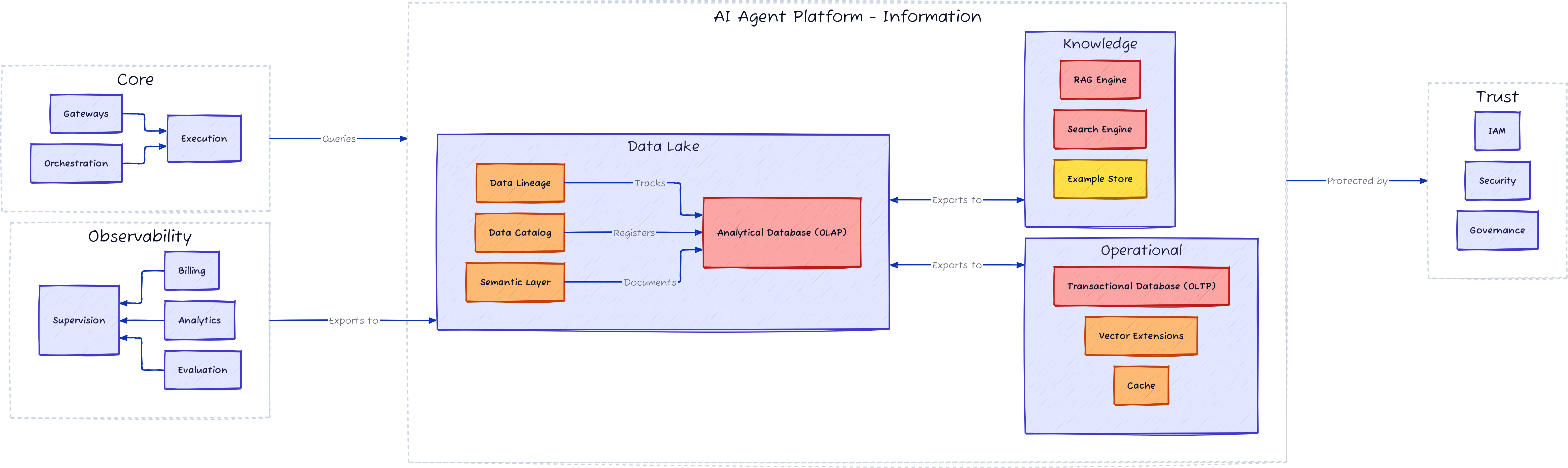
- Knowledge (Unstructured): Documentation and guidelines stored in shared drives or online websites. These are typically indexed by a RAG Engine or Search Engine to explain how the company works.
- Operational (Structured): Transactional data (SQL DBs) required to do work (e.g., update a CRM record). Builders should favor APIs over direct DB access here to ensure business logic integrity.
- Data Lake (Analytical): Historical data for insights and decision making. Requires a Semantic Layer and Data Catalog so the agent understands what “Revenue” actually means before running a query.
The Sync Problem: Syncing these systems is painful. Each sync risks data duplication and inconsistency. We are moving toward a convergence of OLAP and OLTP with systems like Google AlloyDB or Databricks Lakebase to eliminate the copy/desync nightmare.
6. Observability
If there is one thing humans must remain in control of, it is supervising the agents.
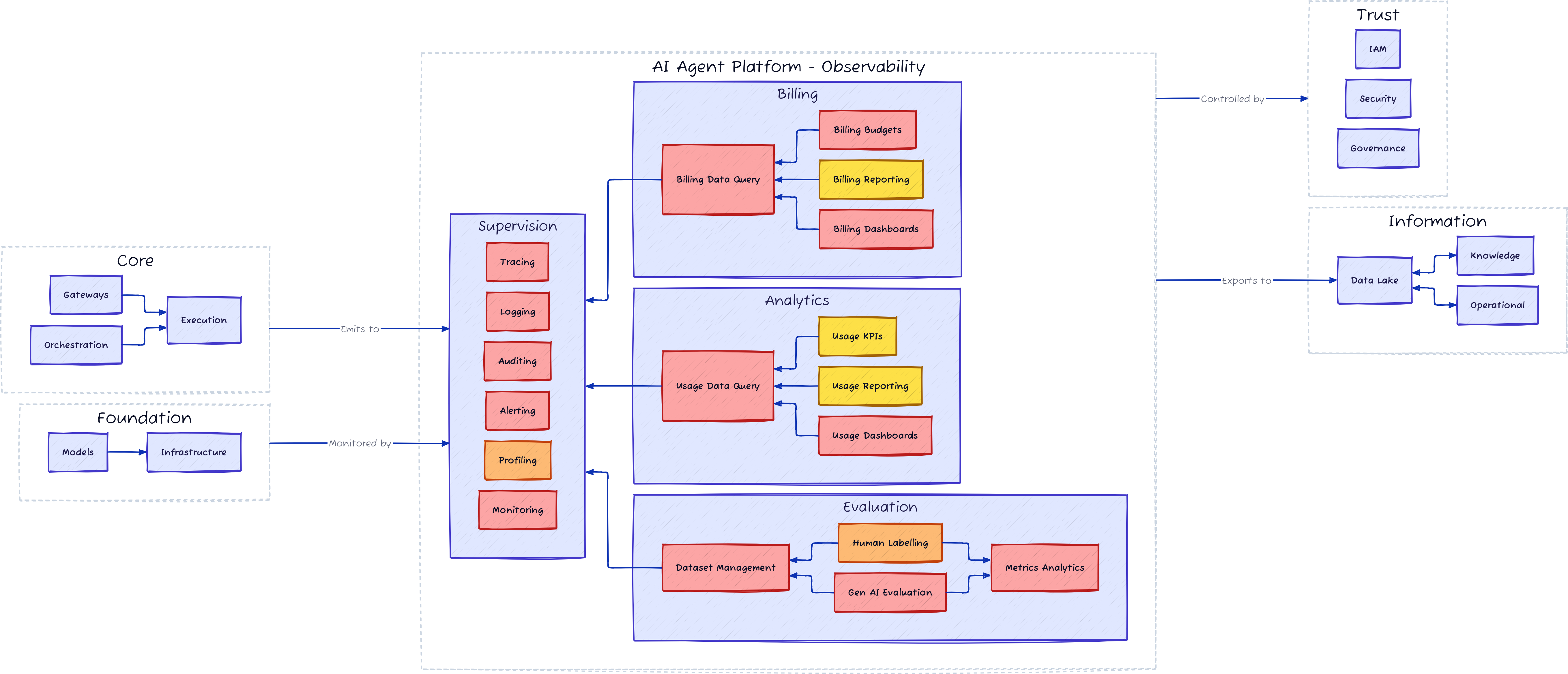
- Supervision: The entry point. You need to collect logs, traces, and audit trails. Alerts should notify operators immediately when an agent loops or fails.
- Evaluation: The hardest part. You need pipelines where Foundation Models (or humans) review agent traces to score them on metrics such as Factuality, Relevance, and Accuracy.
- Billing: FinOps for AI. Track token usage per department. This is especially important for new architectures with less familiar cost sinks.
- Analytics: Tracking adoption. Is the agent actually solving tickets, or are people ignoring it? This is key to reporting ROI to stakeholders.
7. Trust
Finally, the Trust layer. Agents are high-leverage tools; without governance, they are a liability that could create havoc.
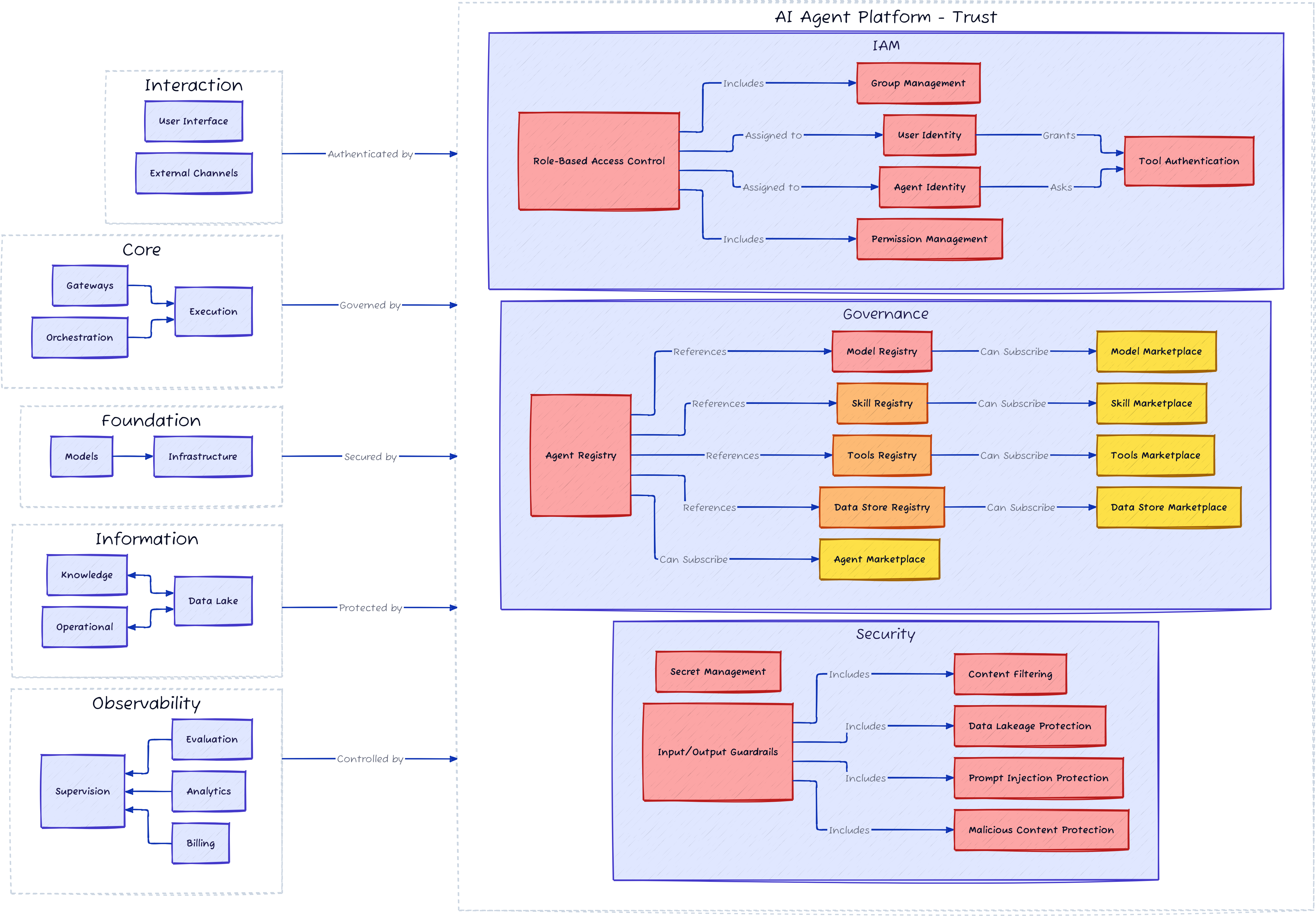
- IAM (Identity & Access Management): RBAC is mandatory. Furthermore, Tool Authentication (OIDC/OAuth) ensures the agent only takes actions the user is authorized to take (acting on behalf of the user).
- Security: Guardrails. You need to filter content, prevent Prompt Injection (jailbreaks), and detect malicious content before the LLM sees it. Secret Management is also critical to protect secrets like API keys.
- Governance: The Registry. You need a central catalog of authorized agents, models, and tools. You don’t want to be hunting through the org chart to find out who built the “Payroll Bot” or who is responsible for a rogue agent. This can extend to a Marketplace for buying assets from other vendors.
Conclusion
Building an AI Agent Platform is not just about stringing together a few API calls. It is about building a scalable, secure, and observable ecosystem where code and reasoning merge to drive real business impacts. I’m really excited to build these powerhouse of automation and intelligence!
Whether you are a developer writing complex orchestration logic or an integrator dragging and dropping workflows, the platform provides the stability you need to move from “demo” to “production”. The challenge will be immense, but if you have the right vision, roadmap and architecture, solutions will appear layer by layer to start addressing your use cases.
Start with the core, secure the trust layer, and never underestimate the importance of observability. The agents are coming — make sure you have the platform to manage them and give them both power and control.
[story continues]
tags