


Every day, millions of developers write code, create database architectures, and optimize engines. We are used to thinking that programming — is an artificial construct.
It was invented by humans for solving utilitarian tasks. But if one steps away from the monitor and looks at how tangible existence is built, a terrifying similarity can be noticed.
The Universe, perhaps, is not just "similar" to a computer. It fundamentally utilizes the same engineering principle on which the entire IT industry rests: the principle of abstraction and code reuse.
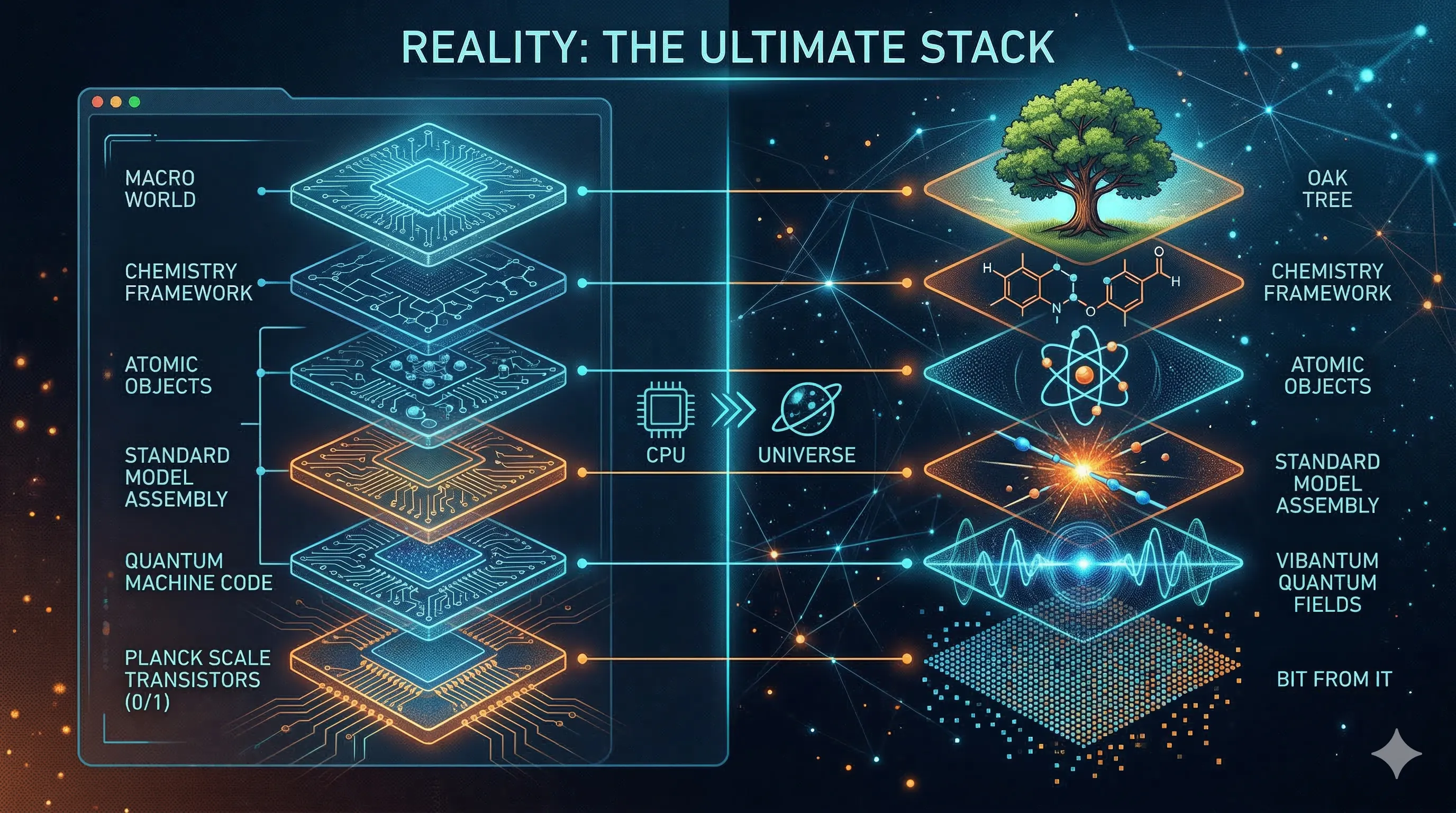
If we try to deconstruct the physical world into layers, just as we deconstruct software — from a beautiful UI down to harsh machine code — we will see practically perfect symmetry.
Let's descend this ladder from top to bottom. Let's see where the physics we are used to ends and the hardcore "Assembly of the Universe" begins.
Level 1. The Illusion of Complexity (Macro-world and "Frontend")
We start at the very top — with the interface we interact with every second.
- In IT: This is application software. Games with photorealistic graphics, browsers, mobile apps, neural networks. Absolute chaos and infinite variety reign here. Scenarios of use are in the billions. For the end user, a program looks like a whole, indivisible, and incredibly complex organism.
- In Physics: This is our macro-world. Trees, granite rocks, metal alloys, planets, and people. The variety of forms here also tends toward infinity. It seems that the world is unbearably complex and chaotic.
But this is only an illusion, the "frontend" of reality. At this level, nobody writes anything from scratch. All this endless complexity — is the result of a so-called combinatorial explosion. This happens when millions of unique systems are assembled from a limited number of ready-made blocks.
Level 2. Structural Patterns (Chemistry and Frameworks)
To create a complex macro-object, we need to descend one level of abstraction down. To where the ready-made libraries lie.
- In IT: This is the level of frameworks and game engines (React, Unreal Engine, Unity). A programmer creating a game no longer writes from scratch the physics of a ball bouncing off a wall or shadow calculation algorithms. He takes a ready-made "building block" from the engine. Elements at this level are no longer infinite, but only thousands of ready-made modules and scripts.
- In Physics: Welcome to chemistry. The Periodic Table of Mendeleev — is exactly the universal framework of the Universe.
There are only about 118 elements. In everyday reality, we actively use maybe a few dozen. Nature does not need to invent new matter to grow an oak or create an ocean. It simply takes ready-made modules (carbon, oxygen, hydrogen) and assembles complex macro-objects from them. Chemistry — is the API for creating the physical world.
Level 3. Basic Bricks (Atoms and High-Level Languages)
But who wrote the frameworks themselves? We go deeper.
- In IT: This is the level of high-level programming languages — Python, Java, C#. Here we operate with strict syntax rules, classes, and objects. The machine itself at this level takes care of memory allocation. Basic commands and concepts here are only a few hundred. This is that foundation on which all engines from Level 2 are written.
- In Physics: We dive into the atomic world. All 118 chemical elements (our framework) suddenly lose their uniqueness.
It turns out that gold, oxygen, and iron are made of the same "syntax." Protons, neutrons, and electrons. Only three basic components! Only their quantity in the cycle (on the orbit and in the nucleus) changes.
Exactly on the third level, we begin to understand the genius of the Universe's architecture. Instead of writing unique properties for billions of macro-world objects, nature simply set the rules of interaction for three basic particles.
Everything else — is just an automatic compilation of code, rising upward to the macro-world. But what happens if we try to look under the hood of protons and electrons themselves? On what is this language written?
The Boundary of Tangibility
We descended under the hood of chemistry and found there only three basic elements — protons, neutrons, and electrons. It seems this is the limit of simplicity.
But if we want to understand how the deepest architecture works, we need to descend to where the very concept of "matter" begins to blur.
Level 4. Manual Memory Management (C/C++ and Elementary Particles)
Below languages with automatic garbage collection (like Python or Java) lie the harsh low-level languages: C, C++, Rust.
- In IT: Here the programmer gets direct access to memory cells. He allocates and cleans resources himself. The code is still readable for a human, but it is already as close as possible to the "silicon." Concepts here — a couple of dozen. An error at this level is fatal and drops the whole system (hello, Blue Screen of Death).
- In Physics: We smash protons and neutrons and discover the Standard Model of elementary particles.
It turns out that the bricks of Level 3 consist of quarks. Here also reside leptons (for example, that very electron, which turned out to be indivisible) and bosons (force-carrier particles).
Science counts 17 fundamental particles in total. This is exactly the low-level code of the Universe. From these 17 concepts, everything is assembled: from black holes to neural connections in our brain. But even they — are only an interface for something deeper.
Level 5. Assembly and Hard Microcode
Welcome to the boundary of tangibility. We have reached the level where the languages and objects we are used to end.
- In IT: This is Assembly. A hard link to a specific processor. No beautiful functions and classes — only direct commands: MOV (move), ADD (add), JMP (jump). There are only a few dozen basic fundamental instructions here.
- In Physics: This is the level of fundamental interactions (strong, weak, electromagnetic, and, with certain reservations, gravity).
These are direct instructions ("attract," "repel," "decay") that dictate to quarks and electrons how to behave. The Big Bang was the moment of initialization for this processor.
In the first fractions of a second, the Universe "wrote" its microcode — particle masses, the speed of light, the Planck constant. This Assembly was compiled, debugged, and sealed 13.8 billion years ago.
Since then, the "backend" of reality has not been updated even once. The Universe does not invent new laws of physics; it simply generates an endless combinatorial explosion on macro-levels, using the old, reliable Assembly.
Level 6. Machine Code of Matter and the Universe without a "Processor"
We stopped at the edge of the abyss. But stand to take one more step down, and all this "objectivity" crumbles into dust. We fall into the territory of pure flow.
- In IT: Below Assembly, programming languages end. Only machine code remains. The processor does not read text or commands; it reads an endless, continuous tape of voltages. For a programmer, this is a solid wave of zeros and ones, a white noise of data running through buses.
- In Physics: We descend below particles and find ourselves in the world of Quantum Field Theory (QFT).
And here modern physics tells us a terrifying thing: no "balls" of matter exist. The whole world — is invisible, continuous fields that oscillate. And what we called an "electron" at Level 4 (Assembly) — is just a local excitation, a splash on this wave.
The field — is exactly the machine code of the Universe. The illusion of "solid matter" arises only at the moment of compilation of this machine code (quantum fields) into Assembly (particles). Below this level, matter in the usual sense simply isn't there — there is only naked information and the wave function.
The Inverted Pyramid: Programming as a Predictive Model
Up to this moment, we used IT as a beautiful retrospective — a way to explain what physicists have already discovered. But if the architecture of the Universe and the architecture of computing are truly symmetrical, we can use programming as a predictive model.
Let's look at how we descended this ladder. We moved along an inverted pyramid of complexity:
- Level 1 (Macro-world): Billions of unique objects.
- Level 2 (Chemistry): Hundreds of basic elements.
- Level 3 (Atoms): 3 components.
- Level 4 (Standard Model): 17 fundamental particles.
- Levels 5-6 (Quantum Fields): Continuous wave flow.
With every step down, the number of entities shrinks. The pyramid narrows. But for modern physics, quantum fields (the sixth level) — are the limit. Scientists hit this quantum "white noise" of probabilities and superpositions, considering it the bottom of reality.
And what does the IT industry tell us?
Level 7. Transistors of Reality and the Planck Scale
In programming, a solid flow of machine code does not hang in the air. For a data wave to run, it needs a physical carrier capable of switching states. We reach the absolute bottom of our architecture.
- In IT: This is hardware physics, logic gates, and transistors. They can be in only two states: they pass current (high voltage, Plus, 1) or they don't (low voltage, Minus, 0). This is the basic dualism. Point. There is nowhere deeper to dig. The pyramid narrowed to two objects.
- In Physics: Engineering logic is inexorable. If under the data wave in a computer lies a transistor, then under the "quantum noise" must also lie its own, as yet undiscovered by physicists, seventh level. "Transistors of reality."
When theorists try to look "under" quantum fields, they hit the Planck scale ($1.6 \times 10^{-35}$ meters). At this level, space-time probably ceases to be smooth and continuous. It becomes discrete, "grainy," like pixels on a monitor.
The concept of digital physics, pushed by the famous physicist John Wheeler with his principle "It from bit," states: at the most fundamental level, reality — is not energy and not matter. It is pure information. Every Planck "pixel" of space carries exactly one bit. It either exists (Plus, 1) or it doesn't (Minus, 0).
This means that at the very bottom of the Universe, there is no quantum chaos. There is an absolutely rigid, deterministic structure with a minimal number of interaction objects (1 and 0).
The Main Paradox: Code That Doesn't Need a Computer
And exactly here our analogy between IT and physics hits one colossal philosophical paradox. In programming, code is dead without hardware. You need a socket, a silicon crystal — some kind of "stage" (background) on which this code will execute.
Classical physicists for a long time thought that the Universe also has such an absolute stage — empty space-time. But modern quantum gravity says the opposite: no external processor exists. This principle is called background independence.
The Universe — is a self-executing code. It does not need an external carrier, because this basic information (the pluses and minuses of the 7th level) is itself the hardware. The interaction of these fundamental bits by itself weaves the geometry of space and time. The world is strictly determined from the bottom up exactly because it has nowhere to "fall out" beyond its own limits — it has no external housing.
Conclusion
We live in a world of consequences. Launching a beautiful game with complex graphics, we rarely think that all this magic — is just a fractal complication of primitive current switching in a silicon crystal.
Exactly in the same way, touching a piece of granite, we only interact with the "frontend" of reality. Behind this interface is hidden a multi-level, flawlessly debugged architecture: from the frameworks of chemistry and the hard Assembly of the Standard Model to the machine code of quantum fields.
And if the laws of this architecture are universal, then programming gives us a direct hint about what is hidden at the very bottom. There, in the unimaginable Planck void, there is no probabilistic chaos. There, basic bits of information are switching — the fundamental zeros and ones of the Universe — tirelessly compiling for us the illusion of this complex, tangible, and so understandable macro-world.
P.S. This article and the very logic of such a multi-level comparison, where IT-architecture acts as a predictive model for physics, were born from the concept I developed and described in my book — "The 35-Level Theory: The Architecture of Reality and the Physics of the Soul". Sometimes, to understand physics and complete the model of the universe, you just need to look at the Universe through the eyes of an engineer.