


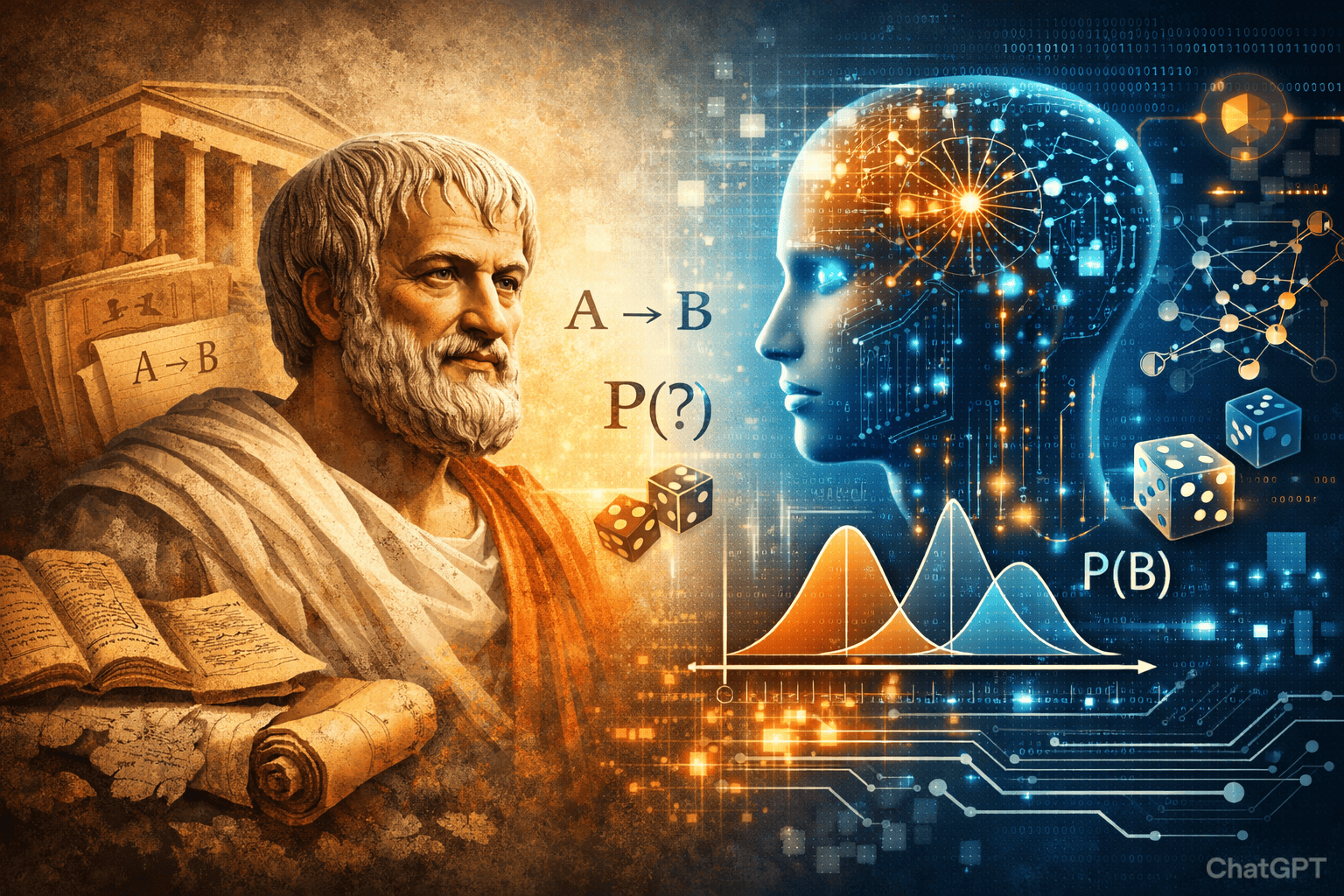
When most developers talk about large language models, the conversation usually starts with tokens, transformers, or GPU clusters. It feels modern, fast, and deeply technical. But here is the surprising truth. The intellectual roots of today’s AI are not new at all. They reach back thousands of years into philosophy, logic, and human attempts to understand how thinking itself works.
A recent episode from Stack Overflow featuring cognitive scientist Tom Griffiths explored this idea beautifully. It revealed something many engineers rarely consider. Your LLM is not just software. It is the latest chapter in humanity’s longest intellectual story.
Before Neural Networks There Was Aristotle
Long before computers existed, philosophers were already obsessed with a single question.
How does thinking actually happen? One of the earliest figures to tackle this was Aristotle. He believed reasoning followed structured patterns. If you know certain facts, you can logically derive new ones.
This idea became the foundation of formal logic. Centuries later it influenced mathematics, early computer science, and eventually AI.
In other words, the first attempts to model intelligence did not come from Silicon Valley.
They came from ancient philosophy.
The Shift From Rules to Probabilities
Early AI tried to mimic intelligence using strict logical rules.
If this then that. If A is true then B must be true. It seemed reasonable. After all, that is how classical logic works. But real human thinking does not behave like a rulebook. We deal with uncertainty constantly. We guess. We predict. We make decisions without having all the information. This is where modern AI took a radical turn. Instead of deterministic logic, systems began using probability.
Rather than deciding what is absolutely true, models estimate what is most likely true.
This shift is the secret behind why LLMs feel surprisingly human in conversation. They are not following rigid rules. They are navigating likelihoods.
Why LLMs Feel Smart But Are Not Conscious
One of the most important insights from the discussion is this. LLMs do not think like humans. They approximate patterns of language and reasoning through probability. This distinction matters. Humans build mental models of the world. We understand cause and effect. We experience emotions, intentions, and awareness. LLMs do none of these things.
They predict what word comes next based on statistical relationships. Yet because human language carries traces of reasoning, emotion, and culture, the predictions can look remarkably intelligent. It is not consciousness. It is extremely advanced pattern recognition.
The Hidden Philosophy Inside Modern AI
Here is what many engineers miss. Modern AI is not purely an engineering achievement. It is deeply philosophical. Questions that AI raises today are the same ones philosophers debated for centuries. What does it mean to think? Can intelligence exist without awareness? Is reasoning fundamentally logical or probabilistic? These questions have no easy answers. But understanding their history helps us avoid a major mistake. Mistaking impressive behavior for true understanding.
What This Means For Developers
For developers working with AI today, this perspective is powerful. It reminds us that building AI is not just about optimizing models or scaling infrastructure. It is also about understanding the nature of intelligence itself. When you design prompts, evaluate outputs, or interpret model behavior, you are engaging with ideas that philosophers have debated for millennia. And that realization changes how you approach AI entirely. Instead of seeing LLMs as mysterious black boxes, you begin to see them as tools built on a long tradition of human attempts to understand thinking.