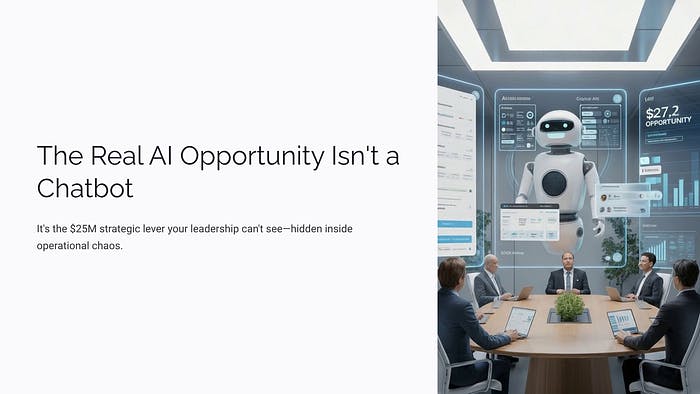
The most powerful computer project I ever helped lead was one that zero customers ever got to see.
It was important, not because it was a new tool for selling things, but because it solved a major, expensive headache for the people running the entire company. This kind of practical thinking is the difference between simply managing a product and leading a business that can grow a flagship SaaS product from 0-to-1 to over $25M ARR.
The Core Problem: A Crisis of Context and Wasted Time
Imagine you are trying to bake a huge cake, but you have thirty people telling you the temperature of the oven, the freshness of the eggs, and the market price of sugar, all at the same time. You can’t tell if the cake is burning or if the store is ripping you off. You have tons of information, but no clear picture.
In big companies, this is called a crisis of context. We operated with a huge mountain of details: the status of work-in-progress, the health of multiple product stacks, and a chaotic mix of information. Manually synthesizing this to track our department’s performance against core business objectives was incredibly time-consuming. We were drowning in data, starving for real-time clarity.
Why does this matter? Because the lack of clear context is what makes leaders waste time debating instead of making decisions. This confusion holds organizations back and prevents them from making the high-output decisions needed to secure over $5M in new funding for startups.
Most people try to fix this by making people work longer hours. I decided to use a structural remedy by fixing the system itself.
Press enter or click to view image in full size 
The Mindset Shift: Stop Chasing Shiny Objects
Before we built the system, we had to change how we thought. The product world is full of fluff and same old stuff. Too many leaders ask, “What can AI do for our users?” The better question is, “What critical operational failure is AI the only way to solve?”
My mindset is that of ruthless efficiency. If you want to build a high-performance culture, you must clear the roadblocks for your leaders and your team first. The core challenge was not a product feature problem; it was an internal strategic alignment problem. We decided that the single highest ROI would come from automating strategic performance tracking.
This change in thinking requires adaptability, accountability, and autonomy.
Press enter or click to view image in full size 
The Playbook: Building an Internal Strategy Engine
I decided to use the smart computer’s brain to fix this internal, operational complexity. My team and I built a strategic asset just for the leaders, transforming our vast operational data into a source of strategic insight. Our goal was simple: eliminate the delay between doing the work and knowing if the work was right.
Here is the operational clarity we built with the system:
- Eliminating Analysis Debt: The system was engineered to smartly look through the huge amount of data. It automatically extracted and processed the important numbers (key metrics) that told us if we were reaching our main objectives and goals (OKRs). This meant no more tedious manual reports, which freed up skilled team members for higher-value work.
- Finding the True Signals: The smart computer analyzed all the trends across our IT work. It figured out which little actions were the leading and lagging indicators for the health of our products and services. This was critical because it separated the useless chatter from the important messages that pointed toward the future.
- Real-Time Alignment: It provided a complete, up-to-date, and unfiltered view of how the entire department was keeping its promises to the business. Leadership gained near real-time visibility into OKR tracking and overall IT delivery.
Press enter or click to view image in full size 
The Strategic Win: Decisive Action and Leverage
This initiative delivered the one thing every executive needs: leverage and velocity.
- Reclaiming Talent and Cost Savings: We successfully automated analysis that previously took many manual hours each week. This is a core part of the efficiency mindset that allowed me to secure $5M+ in cost reductions through strategic cloud migration and vendor consolidation.
- Executive Velocity: Leadership could see the truth right away. They could track our goals instantly, which allowed them to make faster and much more informed strategic decisions.
- A Foundation for Legacy: The system was immediately adopted because it provided such clear value.
The most powerful way to use a smart computer is not to build a silly feature, but to resolve the crisis of context at the top of the organization. This is the difference between someone who just manages a backlog and a transformational product executive.
Before you chase the next public, neat idea, ask yourself:
Where is the biggest, most time-wasting thing my leaders and smart teams have to do manually to figure out if we are winning?
That is where the true ROI is hidden. Stop building things that make noise. Start building the intelligence system that helps you and your executive team lead with clarity and boldness.
Press enter or click to view image in full size 
Your Playbook for Real-World Product Wins:
What is the one job that takes your smart team the most hours every week? Tell me the dollar amount or the number of hours that manual job costs.
Press enter or click to view image in full size 
Your Playbook for Real-World Product Wins:
What is the one job that takes your smart team the most hours every week? Tell me the dollar amount or the number of hours that manual job costs.
[story continues]
tags