


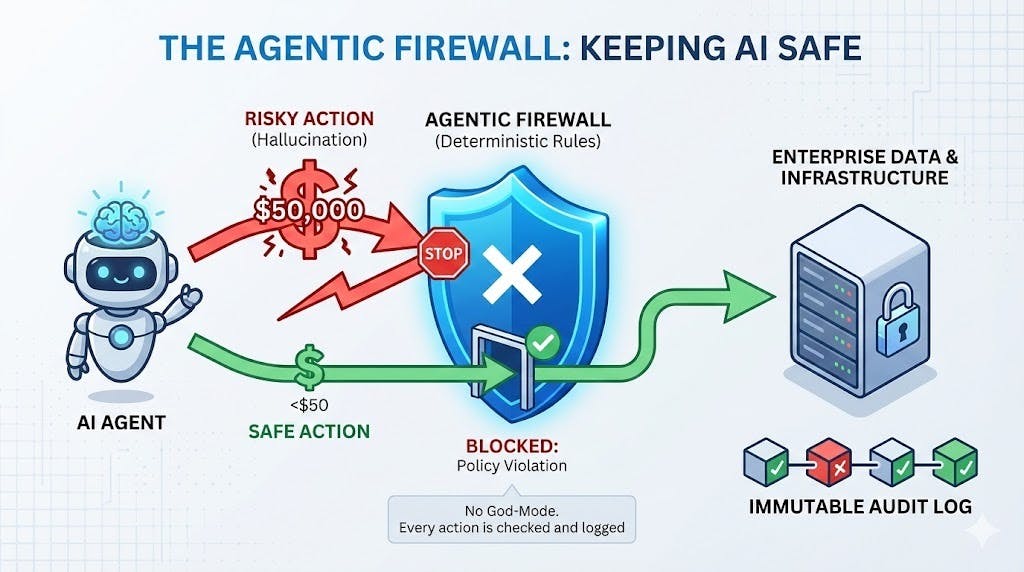
I’ve spent the last 10 years building enterprise data pipelines and infrastructure. If there is one thing I’ve learned about moving data at scale, it’s that giving any single entity "God-mode" access to a production infrastructure and resources is a resume-generating event.
Yet, as we transition from basic SaaS wrappers into the era of Agentic Workflows, where autonomous AI agents handle customer success, procurement, and infrastructure scaling, we are making a catastrophic architectural mistake.
We are giving probabilistic agents deterministic root-level API keys.
We are handing a LangChain orchestrator a production Stripe API key, pointing it at a customer, and relying on a polite system prompt ("Please do not refund more than $50") to prevent a financial disaster.
If you are a CTO, this should terrify you. A 99.9% compliance rate in your testing sandbox is meaningless when a single 0.1% hallucination in production drops your entire CRM database.
Why "Agentic CI/CD" is a Dead End
When software breaks, the engineering instinct is to build better CI/CD pipelines. We want to run the agent through 10,000 synthetic simulations before merging the PR. We want to measure its failure rate.
But here is the hard truth about LLMs: testing an agent 10,000 times in a sandbox does not mathematically guarantee it won't hallucinate on attempt 10,001 in the real world. You cannot use deterministic DevOps pipelines to validate non-deterministic software.
In enterprise infrastructure, if you cannot cryptographically prove an agent won't execute a destructive action, you cannot deploy it. The solution isn't better testing. The solution is hard, deterministic constraints at runtime.
The Agentic Firewall: IAM for Non-Human Identities
If AI agents are going to act as digital employees, they need their own Identity and Access Management (IAM) layer. They need an Agentic Firewall.
Instead of injecting your root API keys into the agent’s context environment, you issue the Agent a scoped, ephemeral "Proxy Token." When the agent makes a tool call, it hits an interceptor, a specialized reverse proxy sitting between the agent and the external world.
The Real-World Architecture
How do you actually build this without adding 2 seconds of latency to every LLM turn? You don't build it in Python. You build it at the network edge using a high-performance proxy like Envoy or Kong, augmented with a WebAssembly (Wasm) or Rust-based policy engine.
Here is what the architecture looks like in production:
-
The Interception Layer: The agent (running via LangGraph, CrewAI, or Agentforce) decides it needs to execute a tool call (e.g.,
POST /v1/refunds). It sends the HTTP request using itsAgent-Proxy-Token. -
The Edge Gateway (The Choke Point): The request hits your internal API Gateway (the Agentic Firewall). Before the payload is ever forwarded to Stripe or Salesforce, the gateway inspects the JSON body.
-
Deterministic Evaluation: The firewall evaluates the payload against a strict, human-defined policy graph. This isn't an LLM guessing if the action is safe, this is a deterministic rules engine executing in under 5 milliseconds.
-
The policy looks something like this:
agent_id: "customer_success_bot_01"
allowed_endpoints:
- path: "/v1/customers/*"
methods: ["GET"]
- path: "/v1/refunds"
methods: ["POST"]
constraints:
max_amount_usd: 50
require_human_approval_over: 20
- The firewall evaluates the intent:
- Rule 1: Is this Agent allowed to call
/refunds? (Yes). - Rule 2: Is the refund amount
< $50? (The hallucinated amount is $50,000. Violation).
- Rule 1: Is this Agent allowed to call
- The Rejection and Escalation: Because the constraint failed, the gateway drops the request immediately. It returns a
403 Forbidden: Policy Violationerror back to the agent. The agent is forced to rethink its strategy or, ideally, escalate the ticket to a human operator. The real Stripe API is never touched.
Solving the Latency Trade-Off: Semantic Intent
Basic API blocking (checking a JSON key for a dollar amount) is fast. But the main job of an Agentic Firewall is Semantic DLP (Data Loss Prevention) and intent evaluation.
What happens when an agent sends an email via the SendGrid API? The API endpoint (POST /mail/send) is valid, but the content of the email might contain unredacted PII, a catastrophic GDPR violation.
To solve this, the next generation of Agentic Firewalls will run parallel, hyper-fast "Guardrail Models" (like a quantized Llama-3 running locally or a specialized BERT model) that evaluate the semantic intent of outbound payloads.
Because it uses a proxy sidecar architecture, the deterministic rules execute instantly, while the semantic checks run asynchronously on the payload. If the firewall detects PII, it cryptographically masks it (replacing "John Doe" with "[ENTITY_1]") before it hits the wire, ensuring Sovereign Data Residency is never compromised, adding only 50-100ms of overhead.
The Audit Trail: Cryptographic Proof of Safety
Finally, this architecture solves the biggest legal hurdle blocking enterprise AI adoption: the audit trail.
When a human makes a mistake, you check the logs. When an AI makes a mistake, it’s a black box. By routing all agentic tool calls through a centralized firewall, you automatically generate an immutable ledger of every decision the agent made, the context it had when making it, and the payload it attempted to send.
If a regulatory body knocks on your door asking why an agent made a specific decision, you don't show them the LangChain code, you show them the cryptographic ledger from the firewall.
The Future of Autonomous Enterprise
Governments and regulatory bodies are not going to tolerate "black box" agentic deployments. They will demand immutable audit logs of every AI decision and strict, deterministic data residency controls.
The companies that win the next decade won't necessarily be the ones that build the smartest agents. They will be the ones that build the infrastructure that makes those agents safe enough to actually turn on.