


The digital space feels noisy lately. Every scroll you make screams the same headlines: "AI is the future", "AI will make you rich", "20 prompts to 10x your workflow." The overwhelming feeling you get listening to all this does not mean you are slow or left behind; it's your honest reaction to the surface-level noise the market is currently saturated with.
The truth behind this noise is that knowing how to talk to a language model is not a competitive advantage in 2026 and the people involved in it are either repeating what they heard from an influencer, mistaking syntax for a business strategy, or trying to sell their outdated tool or course whereas there is a fundamental architectural shift happening beneath the hype — the end of the Copilot era and the mergence of AI as a teammate.
The Legacy Phase: AI as a Sidekick
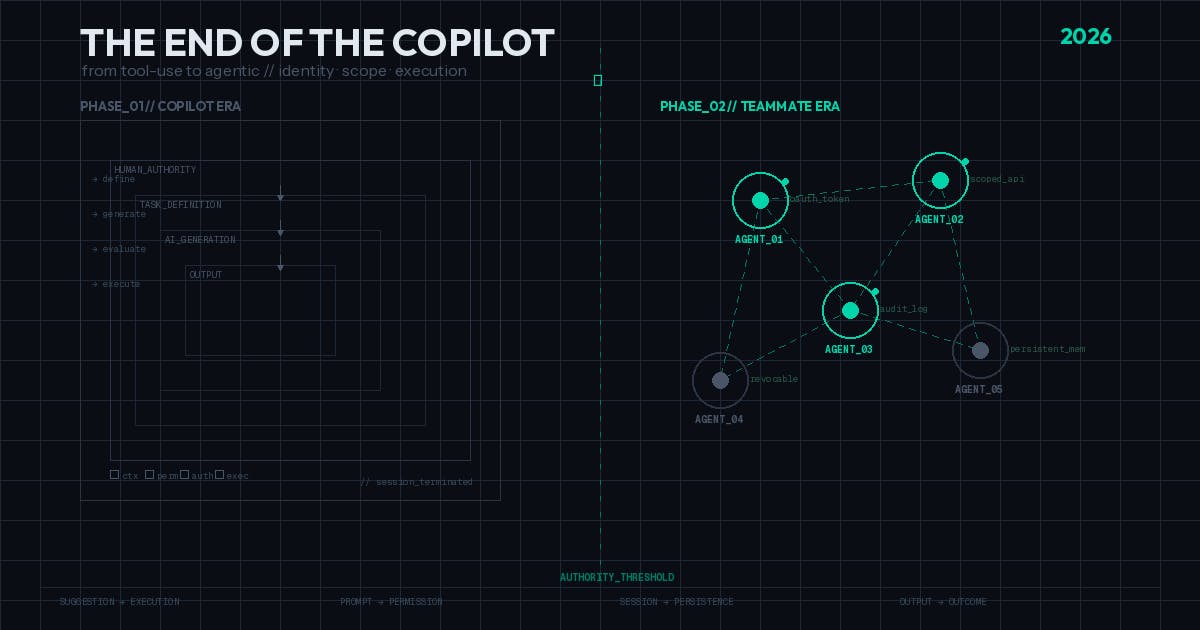
AI has been tagged a Copilot (productivity enhancer) for the last few years, requiring constant handholding and a human in the loop providing a prompt while it provides an output in the form of drafts, code snippets, and email summarization, and the session ends.
With the human holding permission, context, operational accountability, and final authority in this phase, the loop looked like this: Human defines task, AI generates outputs, Human evaluates, Human executes.
Even the name "Copilot" was misleading, as while a real copilot can fly the plane, AI in the legacy phase can be likened to a tool requiring constant manual operation from a human who manages the context by copying-pasting codes and hitting "Run."
The 2026 Shift: AI as a Teammate
The biggest AI shift this year isn't a smarter LLM or a perfect prompt but identity management, where we onboard AI not as a Co-pilot but as an actor with its own OAuth tokens, revocable credentials, persistent memory, audit visibility, and scoped API permissions to carry out interactions within our Slack channels, CRM, and GitHub repos.
In 2026, we are pivoting workflows from Tool-use (where humans drive the UI) to Agentic (where AI stops being just a browser feature and navigates the API). In practical terms, we are talking about AI using scoped access to join specific channels in your Slack workspace, AI triaging tickets in your CRM, and reviewing your GitHub pull request using a permission-limited token, AI updating documentation when commits land, and opening up issues when anomaly thresholds are crossed.
Under this shift, AI is no longer limited to improving outputs but can also influence outcomes such as merging PRs after validation, deploying codes, trades executions within policy, ad budgets reallocation, and credential rotations when risks are detected. Under this AI transition from suggestion to execution, the question shifts from how to write better prompts to how to define AI authority inside our systems since it's reliant on persistent memory.
The get rich quickly through AI talk is just a distraction, and the people who feel overwhelmed by the AI noise usually end up chasing tools. The Copilot era presents AI as a tool, but tools get rusty and break; hence, the winners in 2026 won't be the ones with the longest list of tools, but the ones who understand how to assign responsibility even to machines.
The shift to AI teammates involves onboarding, monitoring, a defined scope, and performance reviews; thereby forcing us to ask better questions than "AI prompts to 10x my workflow" to ones like:
- How do we evaluate AI performance against human benchmarks?
- If an AI agent deploys faulty code or trade, who is the technical owner of that action?
- What specific roles does this agents play in our infrastructure, and how can we define exactly where their authority stops?
Overall, the Copilot framing made AI feel helpful and reactive, but AI as a teammate is not as simple as adding another tool to our Stack, as once machines can act, log, execute, be audited, and be revoked, there is a pressing need for us to start deciding what their identity is allowed to do.