


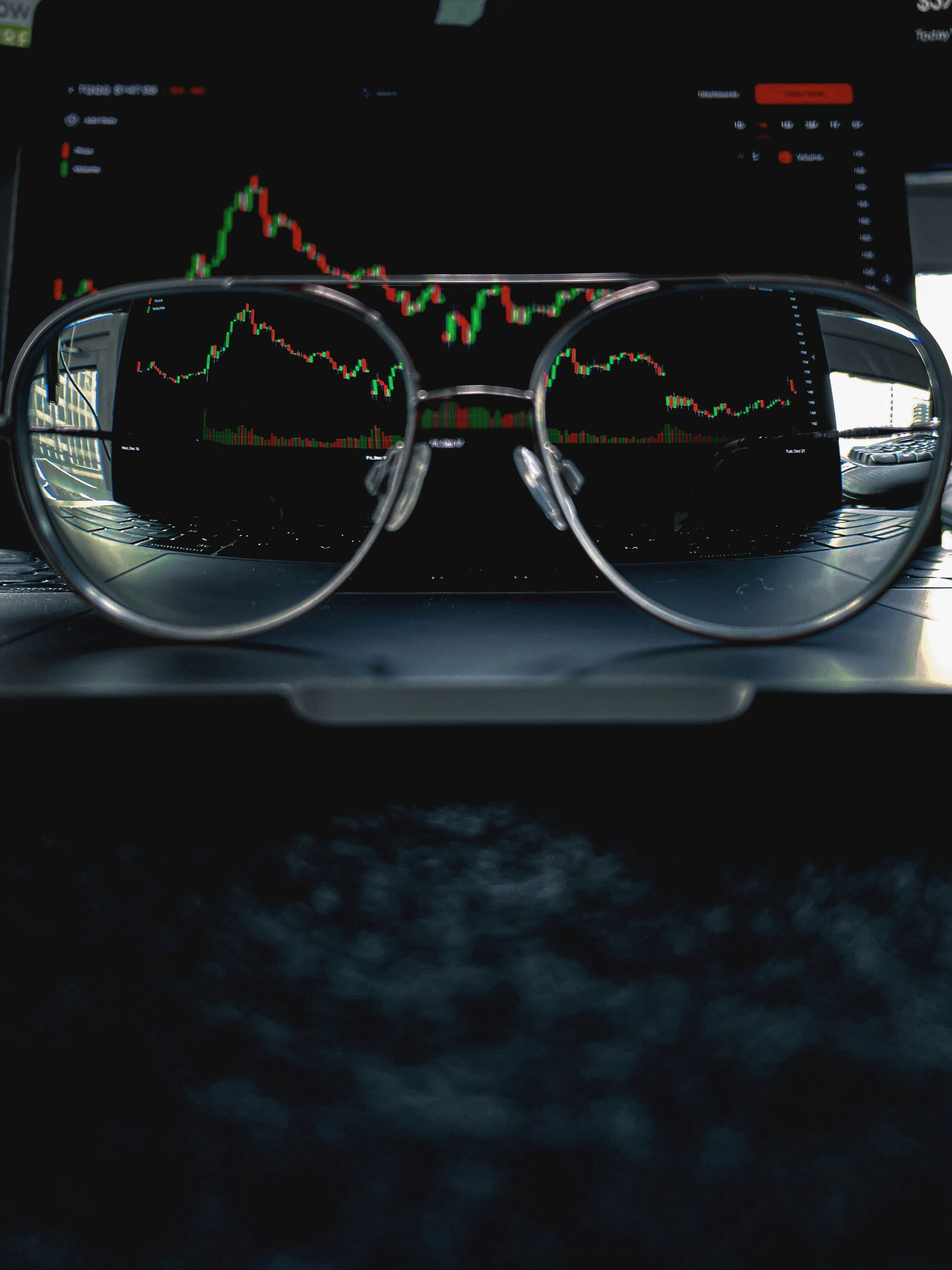
If you open a brokerage app right now, numbers are blinking in green and red. Just over the last 48 hours, we watched Bitcoin violently dump below $65,000 and the Dow shed over 800 points, instantly wiping out half a billion dollars in leveraged bets over a sudden tariff headline.
What exactly are you looking at?
Most people, specifically those trained in traditional finance or engineering, believe they are looking at "the truth." They view the ticker as a highly precise scale weighing the intrinsic value of an asset. But if technical analysis and chart patterns are often just a visual illusion—a manifestation of Pareidolia as we discussed in the Rorschach Market—then the price itself is something much deeper.
It is an epistemological illusion.
We need to talk about how we actually know what something is worth. Because the market isn't a calculator. It is a storytelling engine.
The Death of the Perfect Machine
Academic finance has spent decades building models around the Efficient Market Hypothesis (EMH). The theory assumes the market is a perfectly rational machine that instantly prices in all known information. Good earnings report? Price goes up to the exact fundamental millimeter. Bad macro data? Price drops perfectly in tandem.
It works elegantly in a university lecture hall. On a live trading floor, the reality feels far messier. Anyone who has watched a fundamentally "cheap" asset stay cheap for years, while a joke token mints millionaires, has felt this tension between theory and reality firsthand.
Price does not reflect raw data. Price reflects the crowd's emotional interpretation of that data at one specific moment in time. Information is objective; interpretation is wildly subjective. A central bank or a politician can announce a sudden policy shift. That is a fact. But whether the market interprets that move as "bullish relief" or "panic about an impending recession" depends entirely on the psychological mood of the herd that day.
The Spectrum of Hallucination
Nearly a century ago, John Maynard Keynes described the stock market as a bizarre newspaper beauty contest. The goal wasn't to pick the face you found most beautiful. The goal was to pick the face you thought everyone else would find most beautiful.
When you extrapolate this behavior across millions of human participants and algorithmic trading bots, "price" ceases to be a pure fundamental reality. It becomes a social construct.
Now, let's be intellectually honest: this does not mean every asset is a pure hallucination. The market exists on a spectrum. On one end, you have short-term government bonds and mature utility companies; their prices are heavily anchored to hard math and predictable cash flows. Gravity exists there.
But as you move toward the other end of the spectrum—high-growth tech, crypto, meme stocks—the pull of fundamentals weakens. In those areas, you are often no longer valuing an asset strictly on its utility. You are mostly guessing what the next buyer is willing to pay for it. The math matters less in the short term. The velocity of belief matters more. The hallucination temporarily becomes the mathematical reality on your screen, triggering margin calls and liquidating those who stubbornly bet only on "intrinsic value."
Reflexivity: The Tail Wagging the Dog
Things get even stranger. We are taught that fundamentals dictate the price. A company builds a great product, makes money, and therefore its stock goes up.
But in modern, hyper-financialized markets, the arrow of causality flips. The price dictates the fundamentals.
George Soros famously called this "Reflexivity." Think of the meme stock mania of 2021: a dying retailer's stock skyrockets as a joke fueled by retail traders. But because the price is suddenly so high, management issues new shares at that absurd valuation, pays off all their bankruptcy debt, and secures billions in cash. Suddenly, the "joke" secured the company's actual fundamental survival. The fake price created a real fundamental.
And it works in reverse, too. A fundamentally sound bank can suffer a sudden, rumor-driven collapse in its stock price. The collapsing price terrifies depositors, triggering a bank run, which actually bankrupts the bank. The hallucination of insolvency created actual insolvency. The tail wagged the dog.
Trading the Consensus
This breaks the minds of pure fundamental analysts. They stare at spreadsheets screaming that an asset is "overvalued" and short it into oblivion, only to get wiped out by a mob of momentum algos who simply believe a different story.
So, what do you do with this realization?
If you want to survive systemic risk, you have to abandon the search for the singular "true" price. It doesn't exist in a vacuum. You must stop asking, "What is this asset actually worth?"
Start asking, "Where does this asset live on the spectrum of hallucination? How strong is the current consensus, and what catalyst will break the crowd's belief?"
The ticker is not a window into fundamental truth. It is just a mirror reflecting the psychology of the herd.
"To navigate the market, you don't need to be a better accountant. You need to be a better observer of the madness."