


By Guru Hegde
When we first deployed
The Dream Database (and Its Hidden Catch):
Every developer and system architect dreams of a database that is not only highly available across multiple geographic regions but also boasts regional-level fault tolerance, a distributed architecture for horizontal scalability, and inherent ACID compliance for transactional integrity. This vision of a "perfect" database, where complex transaction management is handled natively, has materialized in recent years with the advent of powerful systems like CockroachDB, Google Spanner, and YugabyteDB. Let's see how CockroachDB (CRDB) solves this elegantly and where it still hurts.
Architectural Cornerstones: Consistency and Fault Tolerance
Fundamentally, CockroachDB is a CP (Consistent and Partition-tolerant) system, as defined by the
CockroachDB provides robust survival guarantees, with configurations for both zone-level survival (the default) and the more resilient region-level survival.
Let us assume a CRDB cluster with SURVIVE REGION FAILURE setting:
- Regions : 3 regions
- Quorum = 2 regions minimum
- Replicas = total 5 (3 in primary region, 2 in other region)
This ensures that the database remains available for both reads and writes even if an entire geographic region becomes unavailable. To achieve this, data is replicated across at least three regions, allowing a quorum to be maintained during a full regional outage.
Write latency: The Speed Of Light Problem
This resilience, however, introduces a trade-off: increased write latency. Every write must be coordinated across at least two regions to achieve quorum. How quickly you can write to both regions depends on the speed of light between the two regions. This write latency can be mitigated by strategically configuring the write quorum to be between low-latency region pairs (e.g., two data centers in the same country / coast).
The Read Latency: When Leaseholders Live Too Far Away
When you need to read data from a global database, speed is crucial. CockroachDB manages data using a clever system that keeps reads incredibly fast and scalable, but geographic distribution introduces a challenge:
-
Data is Split into Ranges: The database breaks up your information into manageable chunks called "ranges."
-
The "Leaseholder" Rule: For each chunk of data, one copy (replica) is chosen as the "leaseholder." This special node is the go-to contact for that specific data.
-
Super Fast Reads: When your application needs to read something, it bypasses complex consensus rules and goes straight to the leaseholder. This makes local reads very quick.
The Problem: Location, Location, Location
The speed issue comes from where the leaseholder is located relative to you. If you're accessing the system from the US West Coast, but the leaseholder for your data is currently on the US East Coast, your request has to travel all the way across the country and back. Because which node is the leaseholder can change dynamically based on system needs, the time it takes to read data becomes unpredictable. Sometimes it's fast (if the leaseholder is close), and sometimes it's slow (if the leaseholder is far away), leading to a frustrating user experience.
Fixing It: Geo-Partitioning and Leaseholder Pinning
The Tyranny of Distance: The fundamental geographic challenge is the immutable speed-of-light delay inherent in cross-region network communication. Therefore, the solution lies in intelligent cluster topology and configuration.
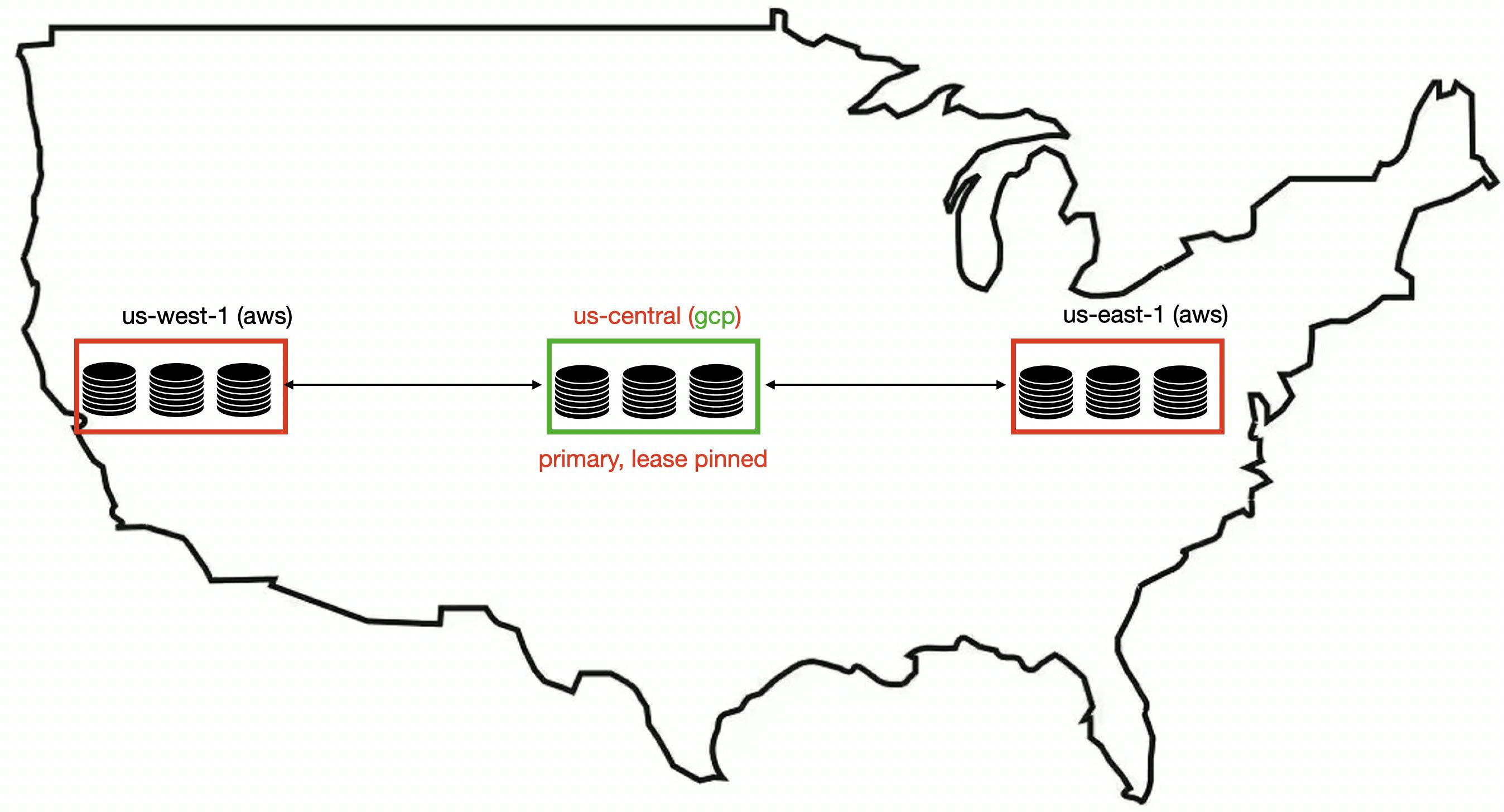
A proven strategy is to select a geographically central primary region and establish quorum with adjacent regions. For example, for a North American deployment:
- Primary Region: us-central
- Secondary Regions: us-west1 and us-east1
- Quorum Configuration: Configure the write quorum to be established between us-central and us-west1 OR between us-central and us-east1, depending on operational preference or traffic patterns.
To solve the read latency problem, you can employ leaseholder pinning. By pinning all range leases to the us-central region, you ensure that read requests from both the east and west coasts travel a roughly equivalent network distance. This transforms unpredictable read latencies into a consistent and predictable experience for all users, regardless of their location.
The Multi Cloud Edge:
CockroachDB's geographic flexibility extends to supporting multi-cloud and hybrid-cloud deployments. If an organization lacks a physical presence in a specific cloud region offered by one provider, or if the goal is to mitigate provider-specific outages, a cluster can be deployed across different cloud platforms (e.g., AWS, GCP, Azure). This topology allows the database to survive an outage affecting an entire cloud provider, offering the ultimate layer of infrastructure resilience.
Summary:
Geography isn’t an afterthought but your architecture. In CockroachDB and every geo-destributed system, the map defines the math. Model it early, test it region by region for all possible use cases, and your “perfect” database might just behave like one.