


If you scroll through the front page of this site—or any tech aggregator, really—you will see a religion being practiced. It is the Church of Control.
- "5 Ways to Future-Proof Your Stack"
- "How to Build the Next Unicorn"
- "Innovating the Unseen"
We are an industry obsessed with "God Mode." We are frantically trying to code our way out of chaos, convinced that if we just find the right framework, or invent the right tool, we can build something that has never existed before.
I work as an Adaptive Systems Architect. I build logic. But at my heart, I am a creative. And I am here to tell you that this obsession with "Novelty" is a bug, not a feature.
The Glitch in the Matrix
Three years ago, I had a stroke. In an instant, the "uptime" I took for granted crashed. I am now legally blind—20/400 in the right eye, zero peripheral vision.
If life were a software project, this would be the part where the Project Manager screams about a critical failure. It’s the ultimate "technical debt" that I cannot pay off. I cannot "optimize" my vision back to 20/20. I cannot refactor the code of my past.
For a long time, I tried to engineer my way around it. I called myself an "Inventor." I thought that if I could just build the Perceptual Grid Engine or create a new AI Pipeline, I could prove my significance. I thought I could create something the world had never seen.
But the more I tried to invent, the more I realized how impossible that truly is. Even if we don’t know their names, someone, somewhere, has had the same idea. To chase "Novelty" is to chase the wind.
The Hevel Protocol
I’ve been reflecting on the ancient wisdom of Ecclesiastes, and specifically the concept of Hevel. In Hebrew, it translates to "vapor," "smoke," or "breath." It is often mistranslated as "meaningless," but a better translation for a creative might be "Transient."
Smoke is real—you can see it, you can smell it—but you cannot grasp it.
The tech industry is trying to grab smoke. We want to be "Disruptors." We want to be "First." We want our creations to be superior to everything that came before.
But I have learned that art is not an invention meant to be superior. Art is simply an expression of yourself. It is not about being New; it is about being True.
The Sandcastle CI/CD
Imagine you are building a sandcastle on the beach. You know the tide is coming in. You know, with 100% certainty, that in four hours, your work will be flattened.
The "Inventor" mindset says: “This is a failure. It won't last. It hasn't revolutionized sand-architecture. Why bother?”
The "Creative" mindset says: “I am going to build it anyway. Not because it will last, but because the sand feels good in my hands right now.”
This is the shift I have made. I have stopped trying to build monuments that defy the tide. I have started building sandcastles.
- I create art knowing it might be forgotten.
- I love my girlfriend and my family not to "leave a legacy," but because the act of loving is the only runtime execution that matters.
- I serve others not because I have to—not to earn karma or salvation—but because I choose to.
There is a massive difference between "I have to" and "I choose to." "I have to" is slavery to an outcome. "I choose to" is sovereignty over the moment.
Architecting for Entropy
We need to stop designing our lives like we are building a patent portfolio, and start designing them like we are playing jazz.
When you accept that you are not significant—that you are Hevel—you lose the fear of unoriginality. Who cares if your idea has been done before? It hasn't been done by you.
This realization doesn't make me want to do less. It makes me want to do more, but with a lighter heart.
I am no longer trying to architect a fortress against the chaos, or invent a machine to prove my worth. I am just a creative, sitting on the shore, building my sandcastle.
So, to my fellow developers, founders, and creatives: Stop trying to optimize for eternity. Stop trying to be the "First." Go build your sandcastle. Let the tide take it. And then, with a smile on your face, build it again.
The Art
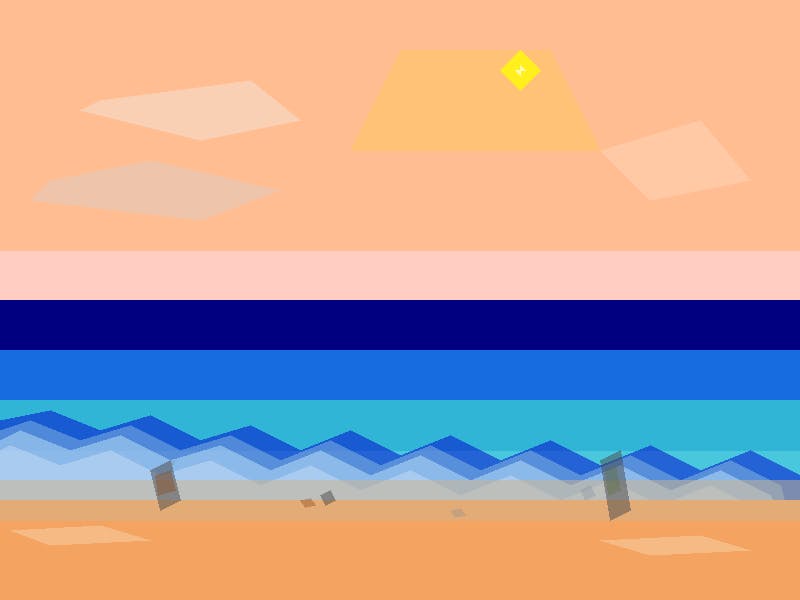
I had my Genisis Art Engine produce an image of a ocean crashing against the beach with degraded structures, clouds, and a pink sky. Visualizing the point I made about building sand castles destined to be destroyed and swept away. After all, who goes to the beach to build things that last forever? Is it not a journey to experience the beauty which is only amplified by the fact that it is temporary? Is it to know that you cannot stop the waves from crashing or optimize the sand to not be swept away? I would love to hear your answers to those questions in the comments.