
Organizations are funneling billions into advanced algorithms and AI, seeking a competitive edge through smarter decisions and streamlined operations. However, a fundamental crisis of poor data quality threatens to derail these ambitions. This is not a minor technical issue but a silent saboteur that erodes profitability and undermines strategic goals.
The challenge has now escalated into a strategic threat, amplified by the rise of AI. Because artificial intelligence systems are only as effective as the data they are trained on, feeding them poor information leads to failures and wasted investments.
This article dissects the anatomy of bad data and quantifies its staggering costs. It provides a clear roadmap to help organizations transform their data from a debilitating liability into a powerful, competitive asset.
Deconstructing "Bad Data": An Anatomy of the Crisis
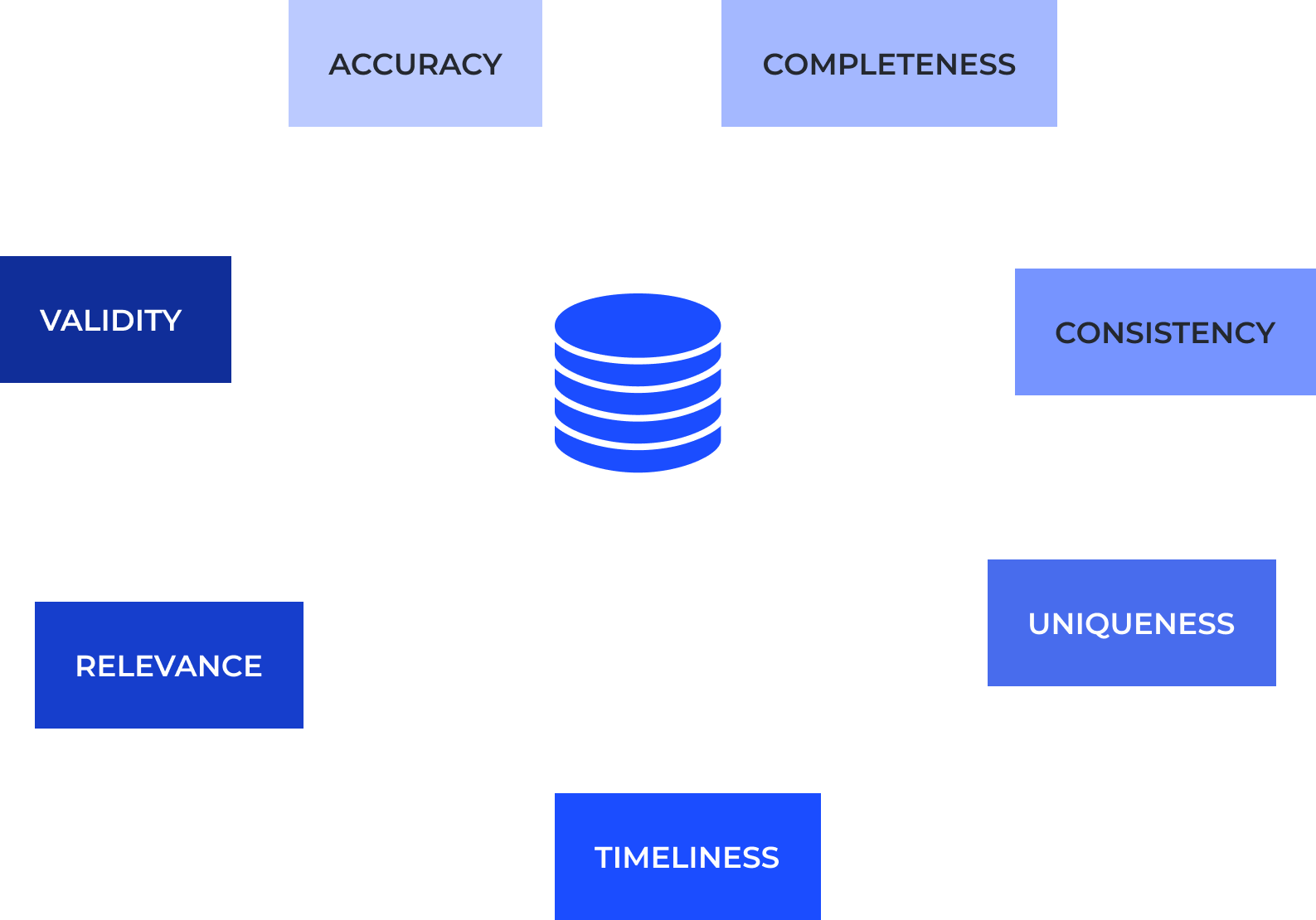
To effectively address the issue of poor data quality, it is essential to understand its multifaceted nature. "Bad data" is not a monolithic concept but rather a collection of distinct failures across several critical dimensions. Each dimension represents a standard of quality, and a failure in one often cascades, triggering failures in others. Together, these dimensions determine a dataset's ultimate fitness for any business purpose.
The Core Dimensions of Data Quality
Accuracy
At its most basic level, accuracy measures whether data correctly reflects the real-world object or event it is supposed to represent. This goes beyond simple typos. An inaccurate address prevents a delivery; an incorrect phone number wastes a sales representative's valuable time; a misreported financial transaction can lead to compliance failures. In the world of AI, inaccuracies in training data can teach a model the wrong patterns, leading it to make consistently flawed predictions.
Completeness
This dimension refers to the absence of missing values in required fields. Incomplete data breaks processes. A customer record without an email address cannot be included in a digital marketing campaign. A product record missing weight and dimensions cripples logistics planning. For analytics, missing data can skew results or render entire records unusable, reducing the sample size and weakening the statistical power of any insights derived.
Consistency
Consistency ensures that data is uniform and non-contradictory across different systems and reports. Inconsistency arises when one department records dates as "MM/DD/YYYY" while another uses "DD-MM-YY," or when a customer is listed as "ABC Corp." in the CRM and "ABC Corporation, Inc." in the billing system. These discrepancies create massive hurdles for data integration and make it nearly impossible to achieve a single, trusted view of the customer or business operations.
Timeliness
This dimension addresses whether information is current and available when it is needed. The value of data is often time-sensitive. Financial market data can become obsolete in seconds, while a customer's job title might change annually. Using stale data inevitably leads to outdated insights and poor decision-making. A marketing campaign based on last year's customer segments is destined to underperform. A natural data decay rate of at least 10% annually is common for customer records, meaning a significant portion of your database becomes less valuable each year without proactive maintenance.
Uniqueness
Uniqueness ensures that there is only one record for each real-world entity. Duplicate records are a pervasive plague in corporate databases, with duplication rates reaching as high as 20% in some CRM systems. Duplicates waste resources by targeting the same customer multiple times, skew analytics by inflating counts, and create confusion that can lead to a fragmented and frustrating customer experience.
Validity
Data validity confirms that information conforms to predefined formats, types, and ranges. This means a phone number field should only contain numbers, an email address should follow the "name@domain.com" syntax, and a date of birth should be a plausible date. Invalid data is often unusable by automated systems and requires costly manual intervention to clean.
Relevance
This dimension evaluates whether the data collected is actually suitable for its intended purpose. Organizations often fall into the trap of collecting vast amounts of data under the mistaken belief that it might be useful someday. This irrelevant data places an unnecessary strain on collection and storage systems, increases security and compliance risks, and adds noise that can obscure meaningful insights.
The Root Causes: Where Bad Data Originates
Understanding the root causes of poor data is crucial for transitioning from reactive cleanup to proactive prevention.
- Human Error: Despite increasing automation, manual data entry remains a significant part of many business processes. Simple typos, careless mistakes, omissions, and a lack of attention to detail accumulate over time, systematically degrading the quality of an entire database.
- Fragmented Systems & Data Silos: Most organizations operate with a complex patchwork of technologies. Data resides in isolated departmental systems – the CRM, the ERP, marketing automation platforms, billing systems – each with its own standards and structures. When data is moved between these silos without proper integration and deduplication checks, inconsistencies and duplicates multiply.
- Lack of Data Standards & Governance: This is arguably the most significant contributor. Without a clear, organization-wide data governance program that establishes and enforces standards for data entry, formatting, and maintenance, chaos is inevitable. The absence of defined processes, metrics, roles (like data stewards), and responsibilities for data quality management means that no one truly owns the problem.
- Poor Data Integration: Merging data from multiple sources is a monumental challenge, with 65% of customers reporting struggles. Flawed ETL (Extract, Transform, Load) processes can corrupt data, misalign fields, or fail to reconcile differences between source systems, introducing large-scale errors.
- System Failures & Architectural Inefficiencies: Technical issues, such as bugs in an application interface, failures in data collection processes, or an inefficient data architecture that stores information incorrectly or redundantly, can lead to widespread data loss or corruption.
- Lack of Staff Qualification and Awareness: Data quality is often perceived as a technical problem, not a business one. When employees who create and use data every day are not trained on quality standards or made aware of the downstream impact of errors, they cannot be part of the solution. Improving data quality requires a cultural shift where it becomes an integral and shared responsibility.
Quantifying the Financial Impact of Poor Data Quality
The financial impact of poor data quality is not an abstract concept; it is a concrete, measurable drain on resources that affects organizations at every level.
The Macro View: A Multi-Trillion-Dollar Problem
The scale of the problem is breathtaking. According to the IBM Big Data & Analytics Hub, poor data quality costs the U.S. economy an astonishing $3.1 trillion every single year, according to the IBM Big Data & Analytics Hub. This figure represents a massive drag on productivity and innovation across the entire economic landscape.
At the organizational level, the costs are just as severe. Gartner estimates that poor data quality costs the average organization $12.9 million annually. Other reports place the cost of lost revenue and squandered resources between 15% and 25% of total revenue. Perhaps the most telling statistic is that a shocking 50% of IT budgets are consumed by the task of reprocessing and correcting flawed data. Imagine half of your technology investment being spent not on building the future, but on endlessly fixing the mistakes of the past.
The "1-10-100 Rule": The Exponential Cost of Neglect
This widely cited principle provides a powerful economic framework for understanding why proactive data quality management is essential.
- $1 for Prevention: This represents the minimal cost of preventing an error at the point of entry. This includes implementing simple data validation rules on a web form or training an employee on proper data entry standards.
- $10 for Remediation: This is the cost of correcting bad data after it has entered your systems. This involves the time and resources needed for data analysts to find the error, diagnose it, and perform manual or automated cleansing, as well as the cost of the data quality software itself.
- $100 for Inaction (Failure): This represents the immense downstream cost incurred when a data error is never corrected and is allowed to impact the business. These costs manifest as failed marketing campaigns, lost sales opportunities, flawed strategic decisions, supply chain breakdowns, regulatory penalties, and irreparable damage to your brand's reputation.
Consider a simple scenario: a company with 500,000 customer records finds that 30% are inaccurate. Based on the "1-10-100 Rule," it would cost $15 million to correct those issues if they are allowed to persist and lead to failures (500,000 records * 30% inaccurate * $100 per record for failure). In stark contrast, it would cost only $150,000 to prevent those inaccuracies from occurring in the first place (500,000 records * 30% inaccurate * $1 per record for prevention).
Impact Across Key Business Functions
Poor data quality does not merely impact the overall bottom line; its effects manifest as specific, quantifiable losses across various departments.
Sales & Marketing
44% of businesses report losing more than 10% of their annual revenue due to inaccurate CRM data. Sales teams waste time chasing dead-end leads with wrong phone numbers. Marketing campaigns built on incorrect segmentation waste ad spend by targeting the wrong audience. Bounced emails not only reduce campaign effectiveness but also damage the company's sender reputation, making it harder for all emails to reach the inbox. The impact on customer acquisition cost (CAC) is direct; a "leaky" funnel caused by bad data forces companies to spend more to hit their targets, driving the average net loss per new customer up from $9 a decade ago to $29 today.
Operations & Efficiency
When data is flawed, processes break down, and employees are forced to spend their time on data correction instead of their core responsibilities. Inaccurate inventory data leads to costly stockouts or overstocking, with associated costs that can be three times higher than for well-managed inventory. In logistics, bad quality data leads to delayed shipments, inaccurate forecasts, and supply chain inefficiencies. The case of Amerit Fleet Solutions is a powerful illustration. An $80 repair bill could escalate to $600 worth of extra work due to the need for customer support, procurement, and billing involvement. By implementing a solution to catch these errors, they saved at least six figures annually and dozens of hours of labor each day.
Customer Service & Retention
When customer records are inconsistent or incomplete, experiences become fragmented and frustrating, leading to abandoned carts and higher churn rates. The economics of this are brutal: acquiring a new customer is 5 to 10 times more expensive than retaining an existing one. Conversely, research shows that increasing customer retention by just 5% can boost profits by a remarkable 25% to 95%. Poor data directly erodes the customer trust that is essential for long-term loyalty and profitability.
Strategic Decision-Making & Compliance
Strategic decisions based on inaccurate financial data or flawed market research can lead to misguided investments worth millions. In regulated industries like finance and healthcare, inaccurate reporting can result in severe fines and legal action. Furthermore, when leadership loses trust in the data, it undermines the entire premise of a data-driven culture, leading to a reversion to gut-feel decision-making and rendering investments in analytics technologies useless.
From Audit to Action: A Roadmap to Data Excellence
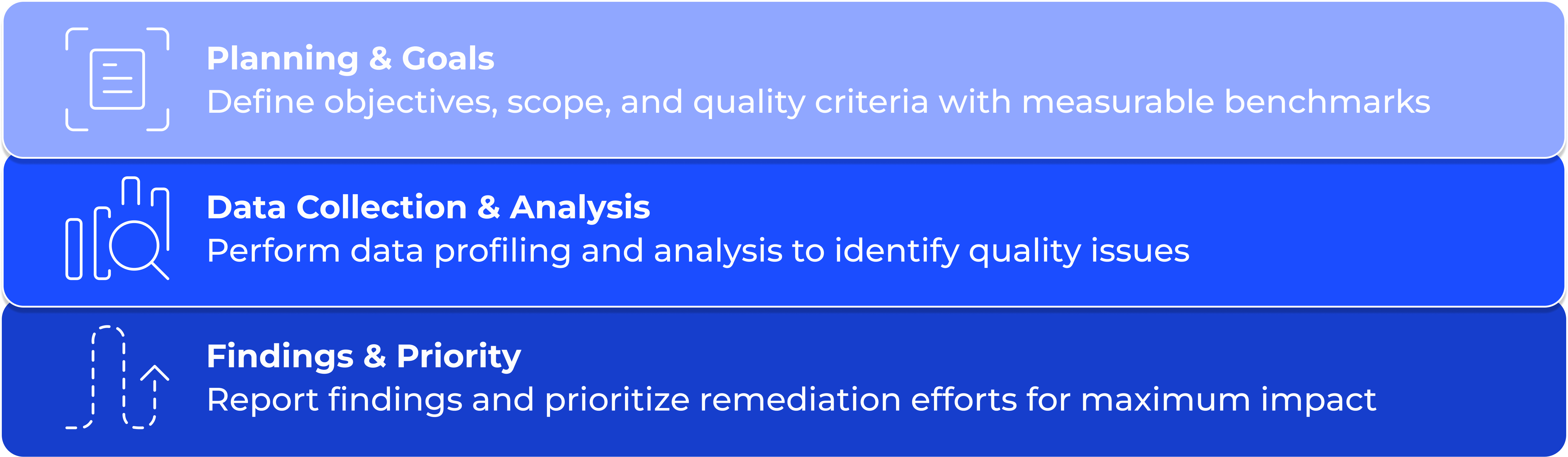
A comprehensive data quality audit is a systematic process designed to identify, measure, and analyze data defects, providing the visibility needed to prioritize remediation. This audit is typically conducted in three distinct phases.
Phase 1: Pre-Assessment Planning and Goal Definition
This phase involves defining clear audit objectives and scope, focusing on critical data elements that directly impact core business activities like customer information or transaction data. Explicit data quality criteria, such as accuracy, completeness, consistency, and timeliness, are established with measurable benchmarks. A detailed audit plan is then created, outlining timelines, responsibilities, and analysis procedures.
Phase 2: Data Collection and Analysis
Here, data is gathered from selected datasets for detailed analysis. The core technique is data profiling, which offers deep visibility into the data's content, structure, and quality. Using automated tools, analysts perform frequency distributions, uniqueness tests, pattern analysis, and null count assessments to identify potential issues.
Phase 3: Assessment Findings and Prioritization
The final phase involves reporting the audit findings, including identified data quality issues, their root causes, and business impact, to secure buy-in for improvement initiatives. These findings create a baseline against which future progress can be measured. Most importantly, this phase involves prioritizing remediation efforts, focusing on fixes that offer the highest impact and feasibility.
Building a Foundation for Continuous Data Quality
Sustained data quality requires an ongoing, organization-wide commitment built on several pillars:
- Data Governance: This is the cornerstone, providing a comprehensive framework of policies, standards, and processes to manage data integrity and security. Effective governance requires executive buy-in, clearly defined roles, and alignment with broader business objectives.
- Core Processes: Continuous improvement relies on implementing core data quality processes, including data cleansing and standardization to correct errors and remove duplicates, data validation at entry points to prevent bad data from entering systems, data enrichment to augment records with valuable external information, and continuous monitoring with real-time alerts to proactively identify and address issues.
- Essential Tools and Technology: Modern auditing relies on a suite of tools for data profiling, cleansing, validation, and monitoring. Increasingly, AI&ML are integrated into these tools to automate anomaly detection, predict quality issues, and enable self-healing data pipelines.
- Culture and Collaboration: Data quality is a shared responsibility. Fostering a culture of data ownership requires cross-functional collaboration, open communication, and continuous training and data literacy.
The Return on Investment (ROI) of Data Quality
Investing in data quality is not an expense but a strategic investment that yields substantial returns. The ROI extends beyond cost avoidance to actively generate value through hard cost savings, increased productivity, and new revenue opportunities driven by reliable, data-driven decision-making. High-quality data is the foundation for advanced analytics, innovation, and a superior customer experience, transforming it from a liability into a powerful organizational asset.
Calculating Data Quality ROI: A Practical Approach
Measuring the ROI of data quality requires a systematic approach that quantifies benefits against costs, often calculated using the formula:
Data ROI = (Value Generated from Data - Cost of Data Initiatives) / Cost of Data Initiatives
To apply this formula effectively, the process begins by establishing a measurement framework to set a baseline for key metrics, such as accuracy rates. Next, organizations should analyze the Cost of Poor Data Quality by quantifying losses from inefficiencies and customer churn. Finally, the benefits from data quality investments, such as increased revenue and improved operational efficiency, are measured and correlated with the initiative's costs. This practical calculation justifies continued investment and positions data governance as a crucial business enabler, not just an IT cost center.
Conclusion: Transforming Data from Liability to Strategic Asset
The evidence is undeniable: poor data quality is far more than a technical problem. It is a profound business liability with severe financial consequences that impact all areas of a business. From the multi-trillion-dollar strain on the economy to the millions lost by individual companies in wasted resources, lost customers, and misguided strategies, the cost of bad data is widespread, quantifiable, and growing.
However, this narrative is not one of inevitable failure but of immense opportunity. By committing to a holistic and continuous approach, organizations can reverse this trend. The compelling ROI demonstrates that prioritizing data excellence yields measurable improvements in efficiency, profitability, and innovation.
To thrive in an increasingly data-centric world, leaders must shift their perspective. Data quality is not a project to be completed; it is a discipline to be mastered. The choice is clear: invest in data quality now, or continue to pay the escalating, hidden price of neglect. In the age of intelligence, the quality of your data will ultimately determine the quality of your future.
[story continues]
tags