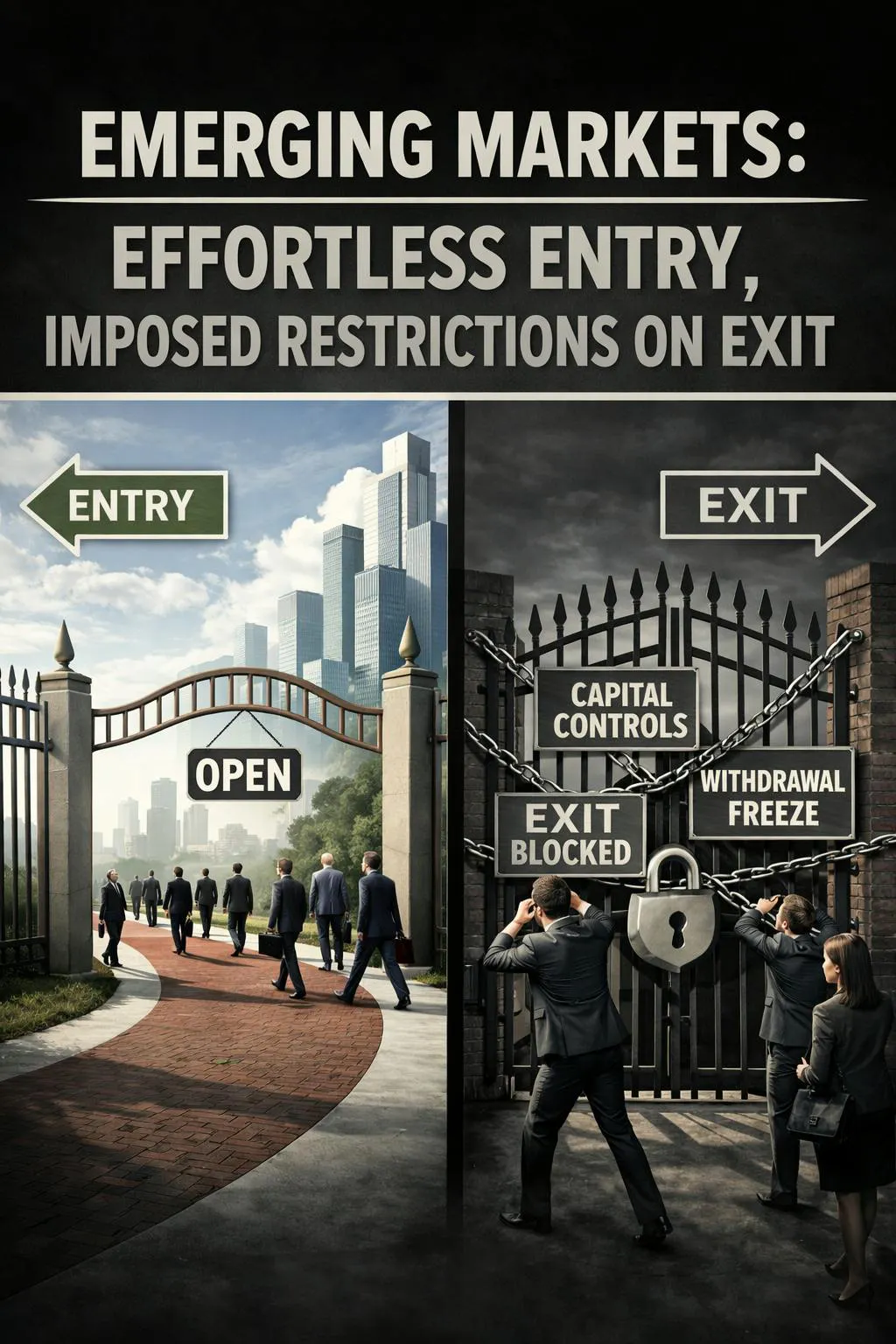
To the uninstitutionalized family office or the individual sitting on nine-figure liquidity, these jurisdictions represent the last frontier of true growth. However, the reality of the EM landscape is governed by a singular, cold truth that most advisors are too timid to articulate:
In an emerging market, your capital is welcomed with a red carpet and retained with a locked door.
The friction discussed here is not a mere “administrative hurdle”. When you deploy $50 million or $500 million into a jurisdiction with developing capital controls, you are not just making an investment, you are entering into a non-consensual partnership with a Central Bank whose primary mandate is the survival of the state currency, not the protection of your private IRR.
Traditional financial institutions offer “emerging market exposure” through sanitized, liquid instruments. However, investors seeking direct entry — whether through private equity, real estate, or strategic infrastructure — often fall into what can be called the “VIP Syndrome”: the mistaken belief that status or connections will grant an exception to the rules of currency convertibility and capital repatriation.
They will not.
When a local currency enters a tailspin, the underlying mechanics of the state operate independently of pedigree, access, or influence
This analysis moves beyond the surface-level optimism of “market growth” to examine the Logic of the Friction and the subsequent Architecture of the Solution.
The Math of the Friction: The Central Bank’s Zero-Sum Game
To navigate capital controls, one must first understand that they are mathematically inevitable in volatile economies. An emerging market government views your hard currency (USD, EUR, CHF) as a national resource. The moment you convert your capital into a local, non-convertible currency to fund a project, you have effectively surrendered your Strategic Mobility.
Capital controls are not signs of a broken system; they are the system working as intended. They function as a “liquidity dam”. During periods of high growth, the dam is open to let investment flow in. During periods of volatility, which are cyclical and guaranteed,t he sluice gates are slammed shut.
The friction manifests in three specific archetypes:
1. The Convertibility Gap: You may have the local funds to exit, but the Central Bank refuses to sell you the foreign exchange required to move that value across the border.
2. The Repatriation Queue:A bureaucratic “waiting list” where your request to move dividends is reviewed for “national economic impact”, a euphemism for “we don’t have the dollars to give you right now.”
3. The Fiscal Hostage Scenario: Retroactive tax adjustments or “special levies” applied specifically to outbound capital flows, effectively clipping your exit by 20% or more without warning.
For the private investor, this creates a Zero Trust environment. You cannot trust the “spirit” of the investment law, you can only trust the hard-coded structural defenses you build before the first dollar crosses the border.
The Architecture of the Solution: Engineering the Exit Before the Entry
If the problem is the state’s desire to trap capital, the solution is Architectural Divergence. We do not fight the local law, we build a parallel structure that renders the local friction irrelevant. This is where “Service Providers” fail and “Architects” succeed.
The primary objective is to ensure that the economic reality of the investment remains international, even if the physical reality is local. We achieve this through a process of Jurisdictional Decoupling.
Instead of a direct investment into the local operating company (OpCo), the HNWI must utilize a multi-layered Offshore Holding Structure situated in a tier-one jurisdiction with a robust Bilateral Investment Treaty with the target market.
This is not about tax evasion, it is about governance protection.
A BIT elevates your investment from a private contract to a matter of international law, providing a mechanism for arbitration outside the local courts, which are often compromised by the same nationalist pressures that drive capital controls.
Furthermore, we utilize Synthetic debt structuring. Rather than funding the project entirely through equity, which is the most difficult form of capital to repatriate, we structure a significant portion of the “investment” as a Cross-Border Shareholder Loan.
In the eyes of many Central Banks, the repayment of international debt is a higher-priority claim on foreign exchange than the distribution of discretionary dividends. By transforming your profit into “debt service,” you move to the front of the repatriation queue.
The Governance Blueprint: Neutralizing Sovereign Risk
For a deal of this magnitude to survive the “Zero Trust” environment of an emerging market, the following Governance blueprint must be implemented.
I. The Master Escrow Protocol: Never allow the entirety of your capital to sit within the local banking system simultaneously. We implement a Tranche-Based Escrow located in a neutral jurisdiction (e.g., Singapore, Zurich, or Abu Dhabi). Capital is released to the local OpCo only upon the achievement of verifiable, audited milestones.
This maintains financial leverage over local partners and authorities throughout the deployment phase.
II. The Treaty-Based Perimeter: The choice of the HoldCo jurisdiction is not a matter of convenience, it is a matter of shielding. The HoldCo must be located in a jurisdiction that has an active, “Gold-Standard” Bilateral Investment Treaty with the emerging market. This treaty must include:
Fair and Equitable Treatment clauses.
Protection against Indirect Expropriation — (which includes “creeping” capital controls that render your investment unusable).
International Arbitration Rights — (ICSID or UNCITRAL), bypassing local judiciaries entirely.
III. The Hybrid Capital Stack
The investment is structured as a hybrid instrument. We utilize convertible debt or redeemable preference shares held by the offshore entity. This allows the investor to extract “Interest” and “Redemption Payments” rather than “Dividends.”
Interest is often treated as a deductible expense locally and a non-discretionary outflow by the Central Bank, effectively lowering the tax burden while increasing the speed of capital exit.
IV. The Proxy Liquidity Window
In markets with extreme currency volatility, we negotiate Offshore Collateralization Agreements. If the local OpCo generates significant cash flow but cannot convert it due to capital controls, that local cash is pledged to a global bank. The bank then provides a Back-to-Back Credit Facility to the investor’s offshore entity in USD or EUR. This allows the investor to access the value of their investment globally, even while the physical cash remains temporarily trapped behind a capital control wall.
V. The Firewall of Confidentiality
For the UHNWI, visibility is a liability. The structure must be designed to decouple the individual’s identity from the investment through discreet trust frameworks. This ensures that if political winds shift in the emerging market, the investor is not personally targeted for “capital flight” or “economic sabotage” ,labels often used by populist regimes to justify the seizure of foreign assets.
The Pull Strategy: Why We Filter
The strategies outlined above are not “services” that can be purchased off a shelf. They are engineered alignments. Most investors fail in emerging markets because they seek a “service provider” who will tell them what they want to hear: that the market is “opening up” and their “connections” are solid.
We operate on a principle of absolute scarcity. We do not accept transactional clients or those looking for “market tips.” We work exclusively with those who recognize that in the modern geopolitical landscape, structure is more important than strategy.
The process of engaging with us requires prior strategic alignment. We do not “pitch” for the privilege of managing your capital. We audit your existing deal structures and expose the “friction points” that your current advisors have ignored. If, and only if, the math of the risk aligns with our architectural capabilities, do we proceed to build the defense.
Conclusion: The Sovereignty of the Structure
Emerging markets are a high-stakes game of asymmetric information. The government knows when it will close the gates, the local partner knows how to navigate the graft and the traditional bank knows how to collect its fees regardless of your outcome.
As an investor, your only defense is the sovereignty of your structure. You do not need to trust the local government, and you certainly do not need to trust us. You must trust the Mechanics of the Governance Blueprint. By engineering the exit before the entry, utilizing treaty-based perimeters, and deconstructing the capital stack into debt-servicing flows, we transform a prisoner of capital controls into a master of Cross-Border Mobility.
Capital is only as valuable as your ability to move it. Without structure, your “high-growth” investment is nothing more than a localized liability. With the right architecture, it becomes a global asset.
[story continues]
tags