I've been digging into eSIM infrastructure lately, and there's one question that keeps getting dodged: where does my data actually route?
The marketing is always the same:
- "Coverage in 190+ countries."
- "Local data plans."
- "Seamless global connectivity."
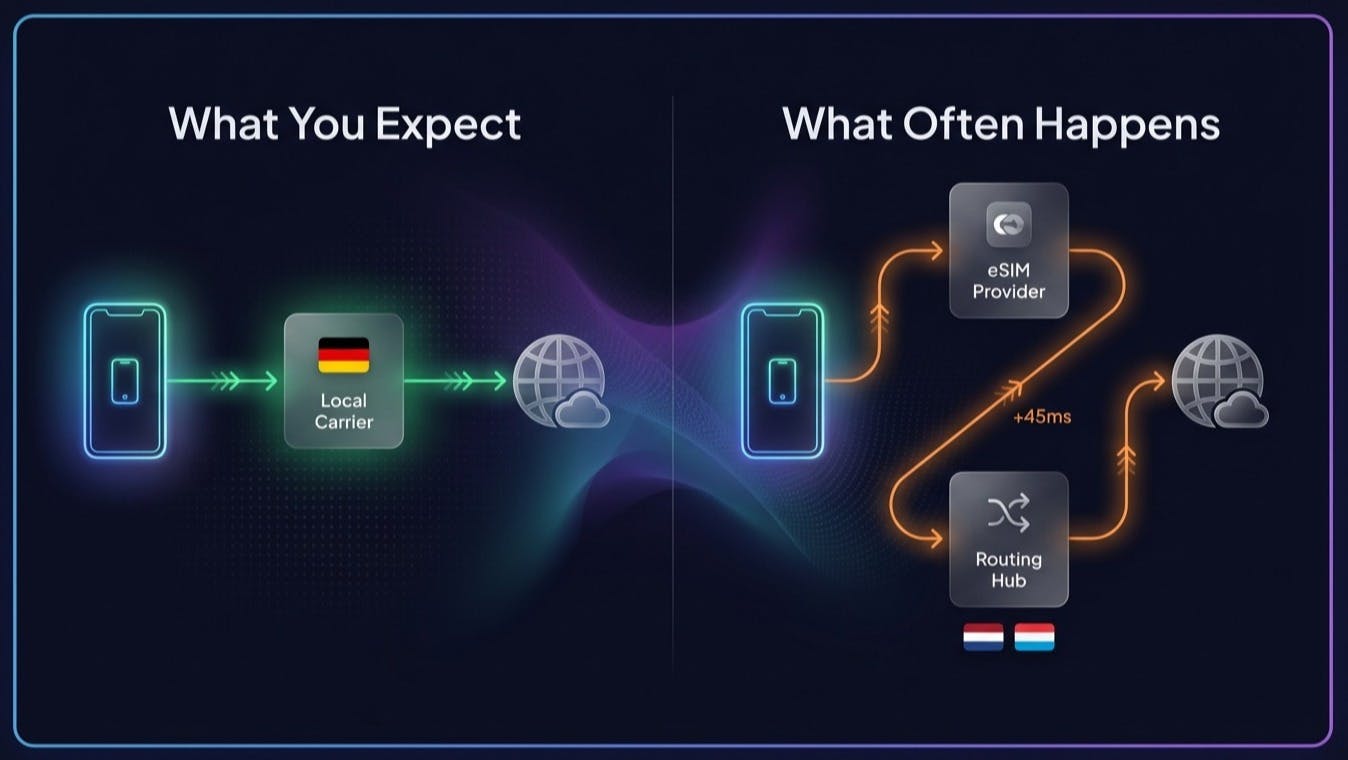
You'd assume that means local infrastructure — connect in Germany, get a German IP, traffic routes through German carriers. Often that's not what happens.
How eSIM routing actually works
When you buy an eSIM, you're not getting a direct relationship with a local carrier. You're buying access through a chain of intermediaries.
Here's the typical architecture:
Your Device
 ↓
eSIM Profile (downloaded via SM-DP+)
 ↓
Aggregator's Network Hub
 ↓
Wholesale Carrier Agreement
 ↓
Local Radio Access (the actual cell tower)
↓
Internet Breakout Point ← This is where it gets interesting
That last part — the internet breakout point — determines where your traffic actually emerges onto the internet. And it's often not where you physically are.
Local breakout vs. hub routing
There are two main approaches:
Local breakout: Your traffic exits to the internet in the country you're connected. You get a local IP, local latency, everything behaves as expected.
Hub routing: Your traffic routes back through a central hub — often in the Netherlands, Luxembourg, Singapore, or wherever the aggregator's infrastructure sits. You're "connected" in Germany, but your IP says Amsterdam.
Why hub routing? It's cheaper and simpler to manage. The aggregator maintains one internet exchange point instead of dozens. Most users never notice.
Why providers don't talk about this
I don't think it's always intentional deception. A few reasons came up as I looked into it:
It's genuinely complex. Routing arrangements involve multiple carriers and aggregators. The path your data takes might depend on the country, the local carrier's capacity, even the time of day. Explaining all of that to customers isn't easy.
It changes. Providers switch aggregators, renegotiate carrier deals, add new partnerships. Publishing details means maintaining documentation constantly — most would rather keep it vague.
Competitive concerns. Routing infrastructure is part of what differentiates providers. Publishing your setup means competitors can see it.
Most customers don't ask. The average traveler buying an eSIM for a vacation wants data that works. "Where does my traffic route?" isn't on their radar. Providers focus marketing on what sells: price, coverage, ease of use.
None of these are great excuses, but they explain the industry-wide silence.
Why it matters more than providers admit
For casual use — checking email, browsing social media on vacation — routing probably doesn't matter. Your connection works, and that's enough.
But for certain use cases, it matters a lot.
Latency. Hub routing adds distance. A connection that routes from Frankfurt → Amsterdam → Internet adds 10-20ms minimum. For video calls, real-time apps, or anything where milliseconds matter, you'll feel it.
Platform trust. Banking apps, streaming services, and social platforms check for consistency between your IP location and other signals. If your IP says Netherlands but your timezone says Germany, that inconsistency can trigger verification prompts or get flagged as suspicious. I've had login prompts triggered purely because of this mismatch.
Jurisdiction. Your traffic passing through a country subjects it to that country's legal framework. If you care about which jurisdictions your data transits, routing matters.
Remote work. If you're accessing company resources or region-locked tools, where your IP appears to be located can affect access. A "local" eSIM that routes through another country might not behave the way you expect.
Content access. Some region-locked content checks IP location, not just account region. Hub routing can put you in the wrong bucket.
How to check where your traffic actually goes
If you're curious about your own connection,
Check your public IP:
curl -s ifconfig.me
# or for more detail
curl -s ipinfo.io
Get detailed geolocation:
curl -s ipinfo.io/json | jq '{ip, city, region, country, org}'
Trace the route:
traceroute 8.8.8.8
# or on Windows
tracert 8.8.8.8
If you're physically in Germany but ipinfo.io says Netherlands, you've got hub routing.
Compare with expected location:
# Your device's timezone
date +%Z
# vs your IP's reported location
curl -s ipinfo.io/timezone
A mismatch here is the classic sign of hub routing.
What providers actually do
I looked at several eSIM providers to see how they address routing. The transparency varies wildly.
Airalo is one of the biggest names in the space. Great coverage, competitive pricing, solid app. But their documentation doesn't go deep on routing — you'll find info about which countries are covered and what speeds to expect, but not where your traffic actually terminates. I reached out to support and got a generic response about "local carrier partnerships." Not malicious, just not helpful.
Holafly focuses on unlimited data plans, which is their main selling point. Same story on routing — the marketing emphasizes unlimited data and coverage, not infrastructure details. For travelers who just want to avoid data caps, that's probably fine.
Saily takes an interesting approach. Backed by Nord Security (the NordVPN people), they include a Virtual Location feature with their eSIM plans. They don't publish routing details either, but this feature lets you control your apparent location regardless of how the underlying eSIM routes. It's a workaround rather than transparency, but it solves the same problem for some users.
VoidMob is smaller but actually publishes routing details and is upfront about where traffic terminates — they've written about
The pattern is clear: bigger consumer-focused providers optimize for coverage marketing. Infrastructure transparency isn't a priority because most customers never ask.
The technical reality
If you want to understand this at a deeper level, here's what's actually happening under the hood.
eSIM profiles are provisioned via SM-DP+ (Subscription Manager — Data Preparation). The profile contains authentication credentials for the carrier network, but doesn't dictate routing.
Routing decisions happen at the aggregator level. Companies like BICS, Tata Communications, and others run the wholesale networks that connect eSIM providers to local carriers. They decide where traffic breaks out to the internet.
Local carrier breakout requires agreements with each carrier in each country — expensive and complex. Hub routing is simpler: all traffic comes back to a central point, regardless of where the radio connection is.
The
What you can do about it
If routing matters for your use case:
-
Ask before buying.
"Where does traffic terminate when I connect in [country]?"
If they can't or won't answer, that tells you something.
-
Test it yourself.
Use the commands above. Get data, don't assume.
-
Consider VPN/Proxy bundled options.
If the provider won't give you routing transparency, a VPN or Proxy gives you location control regardless of the underlying infrastructure.
-
Check provider documentation.
The rare few who publish routing info deserve credit for it.
The bottom line
eSIM marketing focuses on coverage and price because that's what most people care about. Routing stays hidden because it's complicated, competitive, and most customers never ask.
But if you're using an eSIM for anything beyond basic travel browsing, it's worth understanding what you're actually getting. A few providers are transparent about it. Others give you tools to work around it. Most just stay quiet.
I'd like to see more transparency across the industry. For now, asking the right questions — or choosing providers who answer them preemptively — is the best approach.
[story continues]
tags