


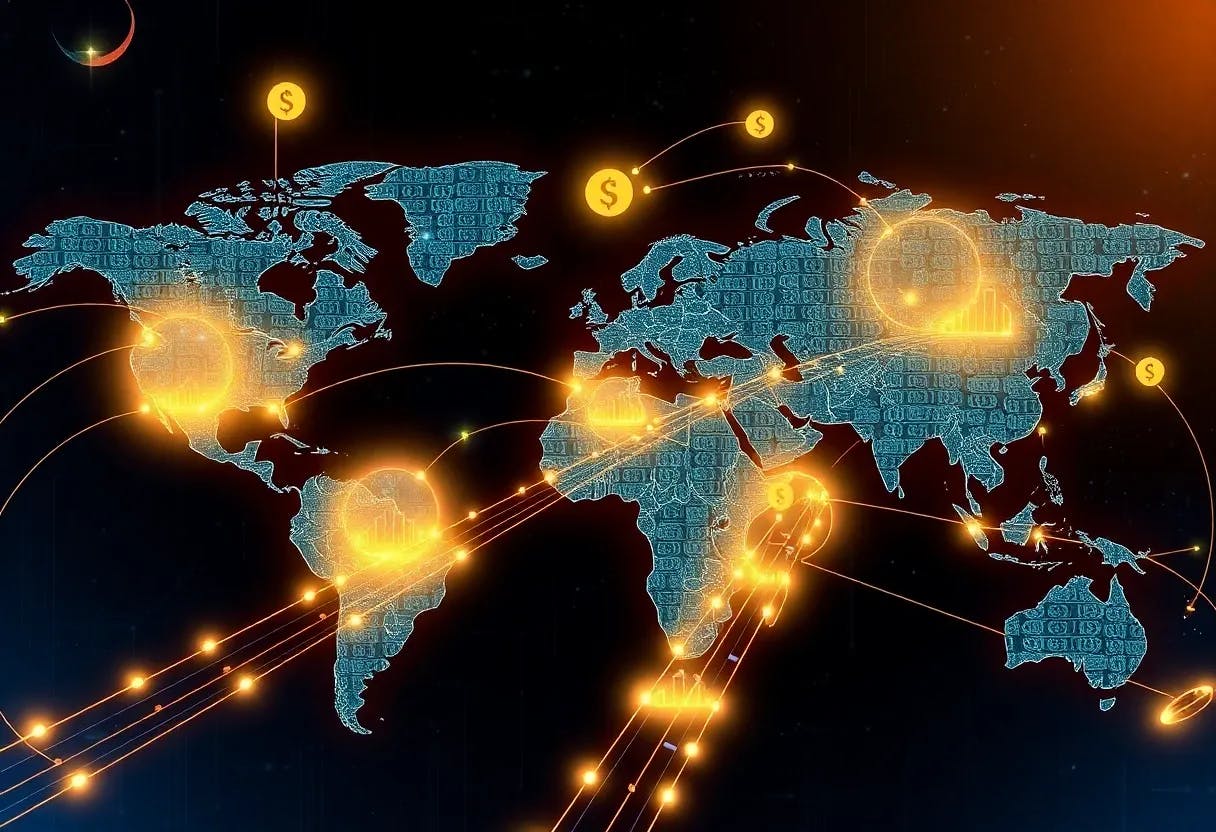
The Evolution of the Transfer
In the wild world of cryptocurrency, where values swing like a pendulum, stablecoins have emerged as reliable anchors that can hold steady. Imagine a digital currency that's as predictable as cash, pegged to a stable asset like the US dollar. That's essentially what stablecoins are – a safe haven from the volatility of Bitcoin and company.
One way to think of them is as a digital equivalent of a neutral, low-risk holding spot. They're designed to maintain consistent value, usually 1:1 with a fiat currency, making them perfect for transactions or as a temporary parking spot for funds in the crypto space.
Stablecoins enable near-instant, low-cost international transactions. Just as sending an email is instant compared to a physical letter, stablecoins allow value to move at the speed of data, 24/7, without losing the stability of the US Dollar or Euro.
In the US, legislative moves like the GENIUS Act are lending legitimacy to stablecoins, paving the way for wider adoption. This opens doors for global commerce, remittances, and financial inclusion, especially in underserved regions. Major players like Tether (USDT) and USD Coin (USDC) are leading the charge, with billions in circulation.
The Bridge to Modern Infrastructure
Stablecoins are already starting to play an important part in how financial institutions move money around – by providing a new type of payment rails. Just as tracks allow trains to move across the country, payment rails are the pathways that allow money to move seamlessly between different financial systems.
Stripe's 2025 acquisition of Bridge, a stablecoin platform that enables global payments, signals a major push toward creating a "universal translator" for money - enabling different financial systems to talk to each other instantly. This move highlights stablecoins' potential as truly a “bridge” between traditional finance and the digital blockchain.
The real game-changing feature that takes them to the next level is that they can actually be programmed. Since these “digital dollars" have editable code, it allows them to be programmed for specific conditions – like releasing payment only after a digital service is delivered. This makes them a much more customizable financial token than traditional currency.
Empowering the "Agentic" Economy
The agentic economy is defined by software agents that understand intent via conversation, make autonomous decisions and take action across systems on a user’s behalf. Conversational AI is simply the interface, their agency is derived from selecting vendors, negotiating prices, scheduling logistics and triggering orders. Their ability to transcend from being assistive to fully operational is blocked by their reliance on legacy finance to pay instantly.
Traditional payments were built for humans and business hours, manual reviews and batch settlements. The agentic economy is built for machine-like speed and continuous operation, deterministic execution and real-time feedback loops. Stablecoin rails close this gap by giving AI agents a native way to complete financial transactions, not just recommend them because these digital dollars are programmable and always-on. Conversational AI gives agents intent. Stablecoin rails grant them agency. Agentic systems will reach their full potential when they can make decisions, execute, and settle transactions in a single flow.
AI agents leveraging stablecoin rails create speed symmetry - the agent thinks, acts, and settles at roughly the same tempo. That symmetry unlocks use cases that cannot exist on human-speed banking rails. Agents cannot rely on traditional payment rails because those introduce settlement delays and cutoff times requiring human oversight.
Here’s an example of how an AI agent can complete an economic loop end-to-end for a complex use case of booking a business trip.
A Focus on Growing Democracies
India is one of the largest remittance recipients in the world with annual inflows exceeding $125B. This supports household consumption, education and healthcare. Stablecoins empower these inflows by moving funds instantly beyond typical banking hours and finalizing settlements with programmable conditions. This could mean more reliable household income especially for those managing cash flow weekly. Cross-border payments typically cost up to 7% in fees and other hidden charges. That adds up to billions of dollars on a $125B remittance inflow. Stablecoins reduce this with near-zero transfer costs and transparent foreign exchange conversion. This results in families receiving more of what was originally sent and small businesses receiving working capital that is typically lost to fees. Traditional cross-border payments limit India’s competitiveness in being a global software powerhouse. With Stablecoins, a solo developer or small studio in India can get paid by a client in San Francisco as easily as a local transfer.
A More Inclusive Economic Map
Reduced costs and time to move money increase access to a global digital economy. Stablecoin rails result in people getting paid instantly, families relying on income arriving when it is needed and small businesses operating globally from day one without expensive financial infrastructure.
When stablecoin rails are used as a transport mechanism most businesses and consumers will never have to see, hold, or understand crypto. While the technology supporting these rails is highly complex, the outcome is deeply humane. Regardless of where someone lives or which baking system they’re born into, it will be easier to trade, create and get paid.