


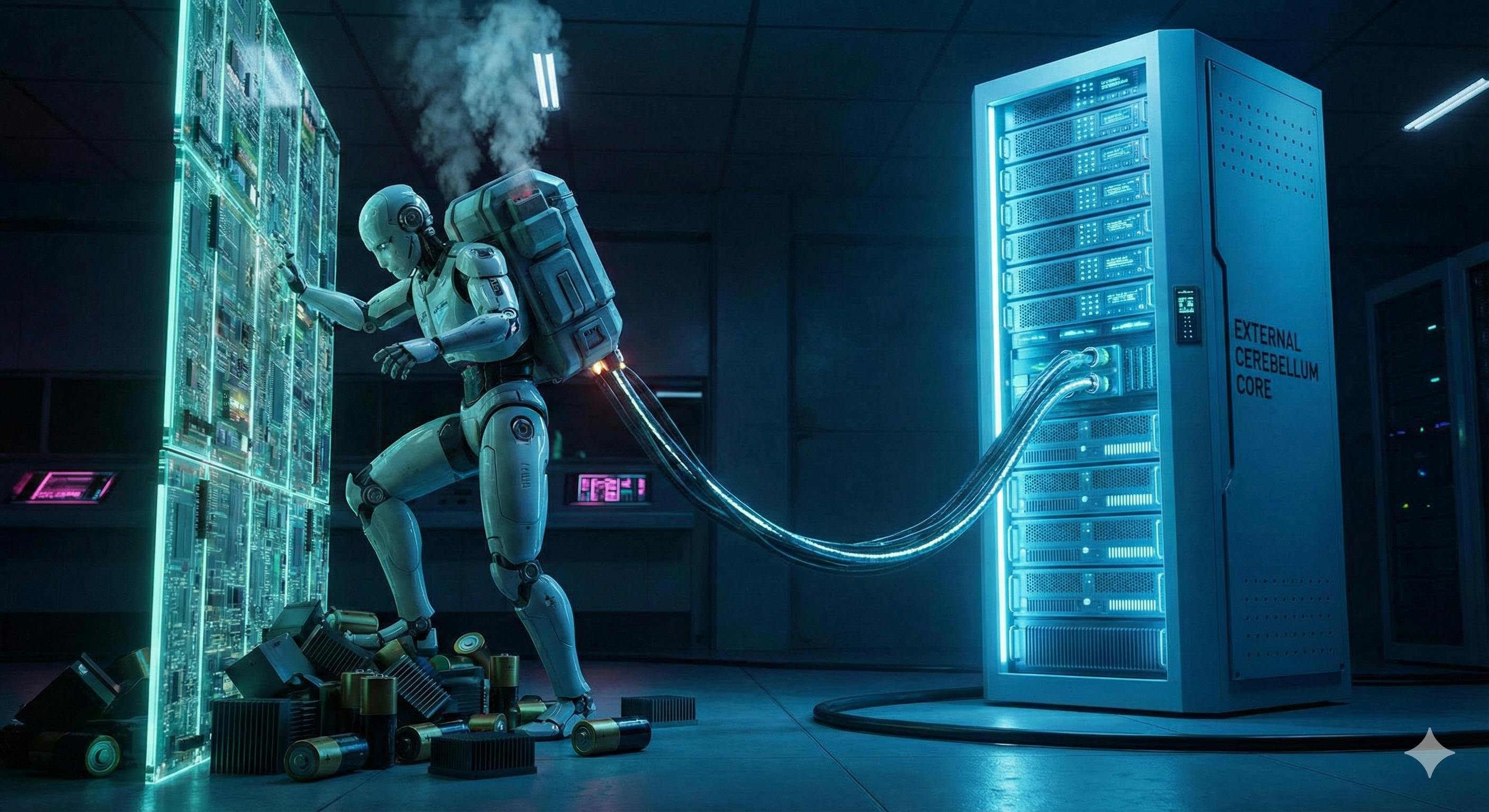
Humans created an analogue of the "Cerebral Cortex" for AI in the form of LLMs, but the creation of a cerebellum is a separate question. After all, thermodynamics and the density of modern batteries are ready to derail this entire noisy, accelerated train of hype surrounding robotics. In this article, I will attempt to analyze the challenges and the ways of their solution in the question of creating a full-fledged brain for robots.
We live in an era of technological euphoria, I would even say, of collective intoxication. After the explosive release of ChatGPT and the subsequent race of large language models (LLMs), the imagination of the tech world arrived at a seemingly absolutely logical conclusion: "If we already possess an AI that passes the Turing test, writes working code, and composes passable sonnets, then the Era of Humanoid Robots is inevitable and will arrive literally tomorrow morning, immediately after coffee." On the surface, this logic appears concrete, impenetrable.
- We possess the "Mind" (the most powerful models from OpenAI, Anthropic, Google).
- We possess the "Body" (mechanics from Boston Dynamics, Tesla Optimus, Figure).
Investors sincerely, childishly believe: it remains simply to connect the wires, and by 2030, a robot butler will be neatly folding our laundry and brewing lattes. But I would pour a bucket of ice water onto this raging campfire of hype. For the problem lies not in artificial intelligence. The problem is not in the software, not in the code, and not in the logic. The problem lies in the fundamental, deepest misunderstanding of the difference between Thinking (Cortex) and Movement (Cerebellum).
Humanity has created a digital Einstein; there is no dispute. But we are attempting with the persistence of maniacs to shove him into a body which, for the banal tying of shoelaces, requires, pardon me, a portable nuclear power plant behind its back. We are ignoring the "Iron Wall" — thermal, energetic, and physical. A wall that cannot be bypassed by any quantity of code in Python. In order to understand why this is so, we need to have a serious conversation about the simple couch in your home.
The "Couch Problem" — Why Physics Is Harder Than Poetry
In the world of AI, we often quote Moravec's Paradox with a clever look: "It is comparatively easy to make computers exhibit adult-level performance on intelligence tests or playing checkers, and difficult or impossible to give them the skills of a one-year-old when it comes to perception and mobility." Let us conduct a harsh thought experiment. Imagine an advanced humanoid robot of the 2030 model. Let us call him, conditionally, "Adam." You give Adam a simple, household command: "Adam, sit on the couch next to me." For a human, this is easy. It is a reflex. You do not even think about it. For a robot, however, this is a mathematical nightmare from the field of Soft Body Dynamics and the most complex Inverse Kinematics.
Here is what Adam's unfortunate "Cerebellum" (the motion processing unit) must calculate in real time, with a delay (ping) of less than 2 milliseconds, otherwise a catastrophe will occur:
-
Material Analysis: Approaching the couch, his vision system must instantly identify the surface. What is this? Is it leather? Is it velvet? Is it a rigid wooden bench with a thin cushion or a deep, sinking beanbag chair? He cannot simply "guess." If he calculates the coefficient of friction of the leather incorrectly, he will slip. If he underestimates the compressibility of the cushions, he will fall backward.
-
"Crash" Simulation: Unlike walking on concrete (a hard, predictable surface), a couch is a deformable object. When Adam begins to lower his heavy, 80-kilogram metal frame, the surface changes shape. His onboard computer must solve partial differential equations in real time to predict exactly how the foam rubber will compress under his "rear end," in order to find a new center of gravity.
-
Feedback Loop: This is the most complex part. A human has thousands of tactile sensors in the skin. When you sit down, your body instantly, at the level of spinal reflexes, micro-corrects muscle tension based on the pressure that you feel. Adam requires thousands of pressure sensors on the entire chassis. The flow of data from them is huge. He needs to process gigabytes of tactile data per second, combine them with gyroscope data, and send commands to dozens of actuators (motors) to balance.
If the delay between "felt the cushion" and "applied current to the motor" exceeds 5–10 milliseconds, Adam will enter a cycle of self-exciting oscillation. He will begin to shake, and he will collapse. To do this smoothly — to sit with the grace of a human, and not fall like a sack of bricks — requires local computational power comparable to a modern data center. And this brings us to the "Iron Wall."
Thermal Nightmare: A Server Rack on Legs
Let us look at the specifications, discarding marketing. To solve the "Couch Problem" — vision, voxel world building, physical simulation of soft bodies, and control of 40 motors in real time — we are not speaking about a smartphone chip. Forget about mobile processors. We are likely speaking about computational power equivalent to at least two GPUs of the NVIDIA H100 level (or their future analogues B200), working locally, right in the body. One chip crunches numbers for the Vision Model, the second grinds through the Physics Let us perform a rough engineering calculation "on a napkin" for our hypothetical robot Adam, built on technologies of the years 2026–2030.
- Energy Consumption (TDP): An advanced AI accelerator under peak load consumes from 700 to 1000 W. Let us be optimists and assume that miraculous, super-efficient 2-nanometer chips have appeared. Let us assume the robot's "Brain" consumes only 1500 W (1.5 kW) to process the world in high detail. Add to this ravenous sensors (LiDAR, high-resolution cameras) and the power motors themselves (walking requires huge energy). We are looking at a machine that consumes from 2.5 to 3 kW of continuous power simply to exist and not fall.
- Thermodynamics: Thermodynamics, as is known, cannot be cheated. If a chip consumes 1500 W, it releases exactly 1500 W of heat. Have you ever seen a powerful gaming PC with a power supply unit of 1000 W? It needs massive radiators and howling fans. Now try, purely mentally, to shove such a cooling system into the volume of a human head or a thin torso. This is physically impossible. Air cooling will simply won't suffice; the robot's head will howl like the turbine of a taking-off Boeing 747 and will melt the plastic case in mere minutes. You need heavy circuits of liquid cooling, pumps, reservoirs, and radiators. In essence, "Adam" will not look like an elegant human from the movies. He will look like a walking refrigerator with a huge, ugly radiator hump on his back.
Battery Limit
Next comes the problem of energy density. The Tesla Model S has a huge flat bottom, consisting entirely of batteries (capacity about 100 kWh). A humanoid robot has only a small chest cavity. Even with fantastic, solid-state batteries of the next generation, you will realistically be able to shove into the torso 2–3 kWh of energy. Otherwise, the robot will become too heavy for walking and will crush its own joints.
Let us calculate the energy economics:
- Capacity: 3 kWh
- Consumption: 3 kW
- Operating time: 1 hour.
And this is still optimistic. This is if he simply stands and watches. If the robot does something complex (climbing stairs with a load or calculating the physics of that very couch), the autonomous operation time will drop to 20–30 minutes. Is a universal robot needed by anyone in everyday life or in production, which must charge for 4 hours after every 20 minutes of work? No. It is an expensive toy.
The Memory Bottleneck: The World Weighs A Lot
The matter is not only in the processor, the matter is also in memory. LLMs (Large Language Models), to which we are accustomed, work with text. Text is a light substance. The physical world is heavy. So that a robot can orient itself in a cluttered apartment, it needs a dynamic Voxel Map — a detailed 3D grid of the world.
- Far field (10m+): Low resolution (meters).
- Near field (1m): High resolution (centimeters).
- Contact field (0m): Micro-resolution (millimeters/microns).
When a robot reaches with its hand for a thin glass tumbler of water, it must remember the exact coefficient of friction and the shape of the tumbler, the wet slippery spot on the table, and the position of its fingers with an accuracy of up to a millimeter. This requires memory of the HBM type (High Bandwidth Memory), which is insanely expensive and ravenous. We demand an autonomous mobile device to carry within itself the memory architecture of a supercomputer.
The Dotcom Bubble in Robotics
We have already seen this pattern before, history is cyclical. In 1999, during the insane dotcom bubble, investors poured billions into such companies as Webvan (grocery delivery). The idea was correct, ingenious. Online commerce truly was the future. But the timing was erroneous. In 1999, we did not have smartphones, there was no cheap 4G/5G, there was no optimized warehouse logistics. The infrastructure physically could not support this vision. It required another 15 years of "hardware" progress for Uber, Instacart, and Amazon to make these ideas viable and profitable.
Today, in 2026, we find ourselves in a Robotics Bubble. We invest in the idea of a humanoid (the Vision), fully ignoring that uncomfortable fact that the enabling hardware (energy density, efficient heat dissipation, neuromorphic chips with low consumption) lags behind the schedule by some 15–20 years. We are attempting to run an operating system of 2040 on hardware of 2026. That is precisely why in the coming decade, a robot similar to R2-D2 from the Star Wars movie will gain victory over C-3PO. C-3PO (a humanoid) must constantly spend energy on balancing on two legs. R2-D2 (a specialized bot) calmly rolls on wheels. He does not need to "feel" the couch with buttocks; he simply needs to know how not to crash into it. Harsh economic pragmatism dictates that specialized robots ("boxes on wheels") will dominate until the problem of physics is solved.
"Avatar Protocol" — How to Break the Iron Wall
So what, is this all? Are we doomed to wait until the conditional year 2045 for a robot that will be able to bring a beer from the refrigerator and not fall along the way? Are we stuck with "smart vacuums" forever, whilst dreams of androids gather dust on the shelf of science fiction? If we continue to go along the current path — attempting to cram a supercomputer into the tight cranium of an autonomous robot — then likely yes. The physics of silicon will defeat us. But... there is a loophole. I propose an engineering architecture that will allow us to bypass the limitations on heat, bypass the limitations of the battery, and build a "Superintelligent Humanoid," using those chips that we possess already today. This requires from us the boldness to rethink the very definition of a "robot." This requires separating the Brain and the Body. This engineering concept can be called "Avatar Protocol."
Concept: Split-Brain Architecture
Possibly the root error of the current approach (Tesla Optimus, Figure, etc.) is the attempt to squeeze the entire nervous system inside the robot. Both the Cortex (logic, planning), the Cerebellum (physics, balance), and the Spinal Cord (reflexes). "Avatar Protocol" proposes a radical surgical intervention: we move higher brain functions outside the body. In this architecture, the robot ceases to be an autonomous creature. He becomes a Terminal — a high-tech "puppet" of sensors and actuators, tied by an invisible umbilical cord of super-speed connection to an external supercomputer. This is an analogue of how "cloud gaming" (GeForce Now) works, only instead of graphics, we stream the physics of reality.
1. Body (Local Level / The Edge)
The humanoid robot walking around the shop floor is maximally lean in terms of calculations.
-
"Spinal Cord" on board: Inside the robot stands only a low-power, cold specialized chip (for example, based on FPGA or an energy-efficient ARM processor).
-
Functions of the Spinal Cord: It does not think. It does not plan the route. It does not calculate the physics of the couch. Its tasks are exclusively Reflexes and Safety.
-
Stabilization (PID controllers): Maintaining a vertical position at rest.
-
Emergency Stop (Dead Man's Switch): This is critically important. If the connection with the External Brain is interrupted for even 50 milliseconds, the Spinal Cord instantly intercepts control and transfers the robot into a safe pose (for example, crouch and freeze) so that it does not fall.
-
-
Result: The robot consumes minimum energy on calculations. The entire battery goes to the motors, which increases the operating time by 3-4 times.
2. Brain (Remote Level / The Core)
Here is where the magic happens. In a radius of 100–500 meters from the robot (in the corner of the warehouse, in the server room of the building, or in a mobile container at the construction site) stands a Computational Node. This is not an Amazon cloud somewhere in Virginia. This is a local "cabinet" — a server rack with liquid cooling, connected to the industrial power grid.
- Infinite Energy: Here we place those very hot and ravenous NVIDIA H100/B200 cards. We have terabytes of RAM.
- Functions of the External Brain:
- Voxel Mapping: Construction of that very super-detailed 3D map of the world in real time.
- Physical Simulation (Isaac Sim): The Brain receives data from the robot's sensors and runs thousands of simulations of "sitting on the couch" per second, choosing the optimal trajectory.
- Movement Generation: It sends the robot not a high-level command "Sit," but a low-level stream of data: "In 10ms bend knee actuator No. 4 by 1.2 degrees with force X."
The External Brain is limited neither by battery nor by heat. We can place there even 10 kilowatts of computational power. We can launch neural networks with trillions of parameters which are inaccessible to onboard chips.
3. Umbilical Cord (Communication Channel)
This is the Achilles' heel of the system. So that "Avatar" works, the latency between "eye saw" and "leg twitched" must be minimal.
- Requirements: Ping (Round Trip Time) must be strictly lower than 10–15 milliseconds.
- Technologies: Ordinary office Wi-Fi will not suit. Industrial solutions are needed: Wi-Fi 7 (802.11be) or Private 5G / 6G (mmWave). Deployment of a private cellular network on the territory of the enterprise (millimeter waves) gives huge speed and low ping at short distances.
How does this solve the "Couch Problem" in practice? Let us return to our example. The Robot Avatar approaches the soft couch.
- Sensorics (T=0ms): Cameras and lidars on the robot's body collect raw data. The Spinal Cord does not process them, but simply packs and "spits" them into the radio channel.
- Transmission (T+5ms): Data flies via 5G to the server cabinet in the corner of the room.
- Thinking (T+20ms): The External Brain (Cerebellum) accepts data. Powerful GPUs build a physical model of the couch, predict its deformation under the weight of the robot, and generate an ideal sequence of tensions for 40 muscle-actuators for the next 100ms of movement.
- Command (T+25ms): The packet of instructions flies back to the robot.
- Action (T+30ms): The local Spinal Cord receives instructions and transmits them to the motor controllers. The robot smoothly begins to sit.
Where is the catch? Even 30ms of delay can be a lot for an ideal balance. Therefore, the External Brain does not simply react, it predicts. It sends commands with a small anticipation in time. The local Spinal Cord checks the forecast against reality in the last millisecond and makes micro-corrections.
Economic and Strategic Justification
Creation of "Artificial Intelligence — Cerebellum": Why build this Rube Goldberg machine of servers, industrial networks, and heavy infrastructure, instead of simply sitting and waiting for new chips? The answer lies not in tactics. The answer lies... or, it would be more accurate to say, the foundation of the answer lies in the global strategy of AI development. We need to radically change optics. We need to stop viewing robotics as a task of creating an "Iron Man" from comic books. We need to start viewing it as a task of creating a fundamentally new type of fundamental intelligence — the "Digital Cerebellum."
1. Laboratory without Constraints (Freedom from Constraints)
To attempt to develop perfect motor intelligence inside the tight, overheated cranium of an autonomous robot is, in essence, Sisyphean labor. It is the same as attempting to train GPT-4 on a calculator. This is a dead end. A technological dead end. "Avatar Protocol" creates conditions of a "Higher Scientific School." Moving the brain into a cool, stationary server rack, we completely remove all physical limitations on energy and computational power. We give scientists and engineers an infinite resource. Carte blanche. It is precisely in this environment, in this digital incubator, that we can create, grow a true AI-Cerebellum — a neural network that understands the physics of the world, inertia, friction, and gravity just as deeply and intuitively as LLMs understand text. We can train models that are 1000 times more complex and heavier than those that can physically work on mobile chips. We create the software of the future already today, not waiting until "hardware" catches up.
2. Body Polymorphism: From Humanoid to Factory
The most important thing, which at first glance can be overlooked: in this architecture, a humanoid is merely a special case. This is only one of the possible bodies. As soon as we create a powerful centralized "Cerebellum" in a server cabinet, it becomes absolutely unimportant to us what exactly to control. The body becomes a replaceable peripheral device.
- Scenario A: This can be one complex humanoid-rescuer clearing rubble.
- Scenario B: This can be a swarm of 100 simple, cheap wheeled robots at an Amazon warehouse. They do not need their own brains, they are "dummies." They are controlled by one "Conductor" in the corner of the warehouse, coordinating their movements as a single organism, excluding collisions and optimizing routes with an efficiency absolutely inaccessible to autonomous loners.
- Scenario C (Industrial): The body of this AI can become a whole factory. Imagine a CNC lathe or a most complex milling installation. If one connects them to an "External Cerebellum," the machine begins to literally "feel" the metal. It can in real time, in milliseconds, correct the cutting, sensing micro-vibrations and material inhomogeneity, just as an experienced master feels wood with a chisel.
In this concept, the factory becomes the robot. And the machines — its limbs.
3. The "Spillover Effect" of Discoveries
This is a classic principle of large scientific projects, like the Apollo lunar program. Working on the super-complex, ambitious task of controlling a humanoid remotely, we will inevitably create technologies that business needs already now:
- Protocols of super-fast, guaranteed transmission of tactile data (Tactile Internet).
- Real-time adaptive systems for controlling industrial equipment.
- New methods of compressing physical data.
Even if an ideal, fully autonomous android appears only in 2040, the technologies of "Avatar Protocol" will begin to pay off and bring profit already tomorrow — at smart factories, in telemedicine, and in complex logistics. We do not wait for the finale, we implement intermediate results.
Conclusion: We Are Building a Mind, Not Just a Doll
"Avatar Protocol" is not simply a clever engineering way to bypass processor overheating. This is a paradigm shift. We are accustomed to thinking about robots as lonely, isolated devices. But the future, possibly, is not for autonomous loners, but for centralized Motor Intelligence. We stand before a tough choice:
- To continue banging our head against the "Iron Wall" of physics, attempting to cram the uncrammable into a small battery, and at the output receive "smart vacuums."
- Or honestly admit that the Mind (both Cortex and Cerebellum) must live where there is energy and coolness — in a server. And the body — is merely a replaceable tool of interaction with the world.
I propose path number two. The path of brute computational force. Let us build this "Big Cabinet." Let us create in it the most perfect "Cerebellum" in the world. And let it control a clumsy experimental humanoid today, tomorrow it will control a high-precision machine. We do not need to wait for the future. We simply need to take the brain out of the equation.
Disclaimer: I am not the director of a robotics company or the CTO of a large corporation. I am a financial analyst who is fascinated by this topic and sees the physical limitations of current approaches. The concept outlined above is a theoretical architecture, an attempt to find a way out of a technological dead end. Possibly, someone who encounters these problems in practice — in R&D labs or in production — will find in these ideas a useful grain that will help bring the future closer.