


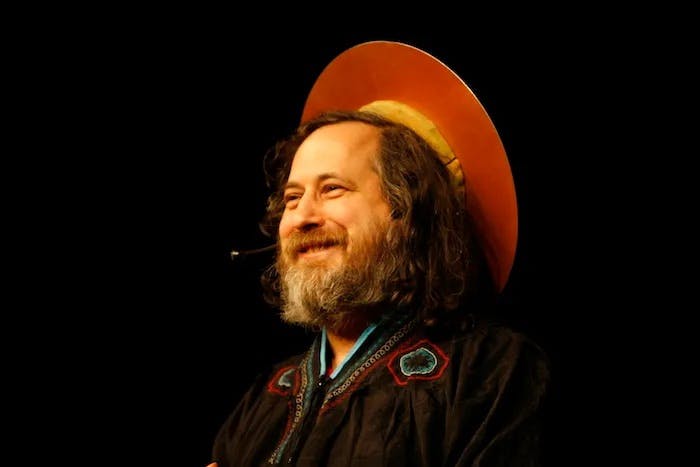
You might have heard Linux Torvalds’ name a dozen times, but you might not have heard of Richard Stallman. And that is a pity! (This is a longer story, so please stay to the end about the 2026 interview that almost happened.)
In the sprawling, sterilized history of the digital age, Richard Matthew Stallman (RMS) exists as a singular, indigestible singularity. He is the ghost in the machine of modern computing, a figure whose code runs the internet but whose philosophy is actively rejected by the corporations that profit from it. To understand the trajectory of the twenty-first century’s technological infrastructure, one must confront the paradox of Stallman: he is simultaneously the industry’s most revered architect and its most ostracized pariah. He built the foundation, but he refuses to enter the building.
Stallman is not merely a programmer; he is the last survivor of a lost civilization—the hacker culture of the 1970s MIT Artificial Intelligence Laboratory. His life’s work has been a desperate, decades-long attempt to preserve the ethics of that destroyed world through legal and technical fortification. While contemporaries like Bill Gates and Steve Jobs viewed software as a product to be enclosed and sold, Stallman viewed it as a scientific truth to be shared. This fundamental divergence led him to found the GNU Project, write the General Public License (GPL), and ignite the Free Software movement. Without Stallman, the open collaborative ecosystem that powers Google, Amazon, and the global cloud infrastructure would likely not exist; yet, Stallman considers these very implementations a perversion of his ideal, a commodification of freedom that enslaves the user rather than liberating them.
This profile looks deep into Stallman’s life, technical contributions, philosophical rigidity, and the controversies that have come to define his public persona. It traces his evolution from the "last true hacker" at MIT to the "Saint Ignucius" of the Free Software Foundation, details his exile and return following the 2019 Epstein scandal, and examines his late-life crusade against Generative AI. Finally, it concludes with an intimate, atmospheric profile of the man in his eighth decade, observing him as he navigates a world that has largely heeded his code while ignoring his commandments.
Part I: The Eden of the AI Lab (1971–1983)
1.1 The Hacker Ethic and the Incompatible Timesharing System
Richard Stallman arrived at Harvard University in 1970 as a physics major, but his spiritual migration occurred a few miles down the Charles River at the Massachusetts Institute of Technology. In 1971, he was hired as a system programmer at the MIT Artificial Intelligence Laboratory, a facility that would become the crucible of his entire worldview.1
The AI Lab of the 1970s was an anomaly in the history of labor. It was a meritocratic anarchy governed by what Steven Levy later termed "The Hacker Ethic." This ethic was not a written manifesto but a lived reality, predicated on the belief that information—specifically the logic governing computers—should be free. The lab operated on the PDP-10 mainframe, a machine the size of a room, running the Incompatible Timesharing System (ITS). ITS was built by the hackers themselves, designed for maximum flexibility and minimum security.
In this environment, "security" was viewed as an impediment to progress. There were no passwords on the ITS system. Any user could walk up to any terminal, log in, and modify any file on the system. This radical openness was intentional; if a hacker found a bug in a colleague's code at 3:00 AM, they could fix it immediately without waiting for permission.2 Stallman, who adopted the login "RMS," flourished in this ecosystem. He worked on TECO (Text Editor and Corrector), the Lisp Machine Operating System, and optimized the lab's utilities with an intensity that bordered on religious devotion.3
The culture extended beyond the screen. The "Tourist Policy" allowed any curiosity-seeker to enter the lab and use the machines, provided they did not interfere with ongoing research. This openness fostered a cross-pollination of ideas that Stallman came to regard as the natural state of computing—a scientific commons where knowledge was shared like recipes.2
1.2 The Enclosure of the Commons: The Xerox 9700 Incident
The Serpent entered this Eden in the form of a laser printer.
In the late 1970s, the AI Lab received a donation of a Xerox 9700, a cutting-edge high-speed laser printer. It was a significant upgrade from the lab's previous printer, a modified device driven by the PDP-10. For the old printer, Stallman had written code that notified users when their print jobs were complete or if the printer had jammed—a crucial convenience in a building where the printer was located on a different floor.4
When the Xerox 9700 arrived, Stallman intended to implement the same notification features. However, unlike the home-brewed hardware of the PDP-10 era, the Xerox printer ran on proprietary software provided by the manufacturer. When Stallman attempted to modify the driver, he was blocked: the source code was closed. He could not read it; he could not change it.4
The situation escalated when Stallman learned that a colleague at Carnegie Mellon University had a copy of the source code. Stallman visited the professor, expecting the traditional hacker exchange of knowledge. To his shock, the professor refused to share the code, citing a Non-Disclosure Agreement (NDA) signed with Xerox.
For Stallman, this refusal was not a professional inconvenience; it was a moral catastrophe. It represented a betrayal of the fundamental human obligation to help one's neighbor. The NDA was a contract that compelled the signer to act selfishly, to withhold useful information from the community. This moment radicalized Stallman. He realized that the software industry was shifting from a model of shared scientific inquiry to a model of proprietary control, where users were prohibited from understanding or modifying the tools they relied upon. He later described this realization as a stark choice: he could sign the NDAs and become a "serf" in the proprietary world, or he could fight to rebuild the commons he was losing.5
1.3 The Password Wars and the Destruction of the Lab
As the 1980s approached, the pressures of commercialization began to fracture the AI Lab. The administration, citing security concerns and government contracts, moved to install a password control system on the lab's computers in 1977. To Stallman, this was an imposition of "bureaucratic fascism," a wall erected inside the commune.
Stallman launched a campaign of civil disobedience. He discovered a method to decrypt the password file. Once he had cracked the passwords, he sent an automated message to every user on the system:
"I have found your password. It is [password]. You should change it to the empty string."
He advocated for the "empty string"—effectively no password—to maintain the anonymous, open access of the ITS era. While he claimed that 20% of the users complied with his request, the administration eventually prevailed. The password system remained, and the psychological architecture of the lab shifted from trust to control.3
The final death knell for the AI Lab culture was the "Lisp Machine Wars." Two spin-off companies, Symbolics and Lisp Machines Inc. (LMI), were formed to commercialize the Lisp machines developed at MIT. Symbolics aggressively hired the lab's best hackers, offering high salaries and stock options. The resulting brain drain devastated the community.
Stallman, refusing to join the exodus, remained at the lab as it emptied out. From 1982 to 1983, he fought a one-man war against Symbolics. He reverse-engineered their improvements to the Lisp Machine operating system and released them to LMI and the public domain, attempting to prevent Symbolics from monopolizing the technology. It was a heroic, exhausting, and ultimately futile rearguard action. The community was dead.2
Part II: The GNU Manifesto and the Toolchain (1984–1991)
2.1 The Great Refusal
In January 1984, Richard Stallman made the most significant decision of his life. He resigned from his position at MIT. He did so not to leave the field of computer science, but to save it. He feared that if he remained an employee, the university could claim copyright over his new work and license it to a corporation, defeating his purpose. He negotiated to keep his office as a "Visiting Scientist"—a role he would hold until 2019—but legally, he was a free agent.7
His goal was audacious: to create a complete, Unix-compatible operating system that was entirely free software. He named it GNU, a recursive acronym for "GNU's Not Unix." The name was a hacker's joke, but it also signaled a strategic decision. Unix was a proprietary system, but its design was modular and portable. By mimicking the architecture of Unix, Stallman ensured that his new system would be compatible with existing hardware and software, making adoption easier.6
2.2 The Four Freedoms
At the heart of the GNU Project was a definition of "freedom" that Stallman would spend the next forty years refining and defending. He famously distinguished between price and liberty: "Think of free speech, not free beer".12 This philosophy crystallized into the Four Essential Freedoms, which became the dogma of the Free Software Foundation (FSF), founded in October 1985 to support the project.
|
Freedom |
Definition |
Implication for the User |
|---|---|---|
|
Freedom 0 |
The freedom to run the program as you wish, for any purpose. |
No restrictions on commercial, military, or "unethical" use. The tool is neutral. |
|
Freedom 1 |
The freedom to study how the program works, and change it. |
Access to source code is a strict prerequisite. |
|
Freedom 2 |
The freedom to redistribute copies so you can help your neighbor. |
Sharing is an ethical imperative; preventing sharing is antisocial. |
|
Freedom 3 |
The freedom to distribute copies of your modified versions. |
The community benefits from individual improvements; the fork is a right. |
|
13 |
|
|
2.3 Constructing the Toolchain: GCC and Emacs
To build an operating system from scratch, Stallman had to write the tools to build the tools. His productivity during the mid-1980s is legendary in the annals of computer science.
GNU Emacs (1985): Stallman’s first major release was GNU Emacs. While nominally a text editor, Emacs was a programmable environment, an interpreter for a dialect of Lisp. It was infinitely extensible, allowing users to write their own commands, email clients, and games within the editor. Emacs became the first "killer app" of the free software world, proving that free tools could rival or exceed the quality of commercial competitors like Gosling Emacs.11
The GNU Compiler Collection (GCC) (1987): This was the keystone. An operating system is written in a high-level language (usually C), which must be translated into machine code by a compiler. Existing compilers were proprietary and tied to specific hardware. Stallman wrote GCC to be a portable, optimizing compiler that could support multiple architectures. It allowed code to be written once and run on many different machines. GCC became the standard compiler for the entire industry, powering not just GNU, but eventually the vast majority of Unix-like systems.11
By 1990, the GNU Project had delivered a shell (Bash), a compiler (GCC), an editor (Emacs), a debugger (GDB), and the C library (glibc). The cathedral was almost complete. It lacked only one thing: the floor.
Part III: The Legal Hack — GPL and Copyleft
While Stallman is a brilliant programmer, his most enduring contribution to the world is arguably a legal hack. He recognized that releasing software into the public domain was insufficient; if code was Public Domain, a corporation could modify it, compile it, and release the binary as a proprietary product, effectively enclosing the commons again.
To prevent this, Stallman invented Copyleft. He used the existing machinery of copyright law to subvert its usual purpose. Instead of "All Rights Reserved," Copyleft ensured "All Rights Reversed."
3.1 The GNU General Public License (GPL)
The legal embodiment of Copyleft is the GNU General Public License (GPL), first released in 1989. The GPL grants users the Four Freedoms, but it attaches a critical condition known as the "viral clause" (Section 2b in GPLv2):
"You must cause any work that you distribute or publish, that in whole or in part contains or is derived from the Program... to be licensed as a whole at no charge to all third parties under the terms of this License."
This clause meant that if a developer used GPL code in their project, their entire project had to be released under the GPL. It prevented "embrace, extend, extinguish" tactics. It created a protected zone where free code could accumulate, safe from proprietary enclosure. It forced corporations to contribute back to the commons if they wanted to use the software.10
This license was viewed with terror by the software industry. Microsoft executives later famously referred to the GPL as a "cancer" because of its contagious nature. Yet, it was this license that guaranteed the longevity of the GNU tools and, eventually, the Linux kernel. It created a distinct economy of shared value that could not be privatized.16
3.2 Side bar: Top 5 Licenses on GitHub (2025/2026)
Based on recent usage statistics, the MIT License remains the most dominant, followed closely by Apache 2.0. The GPL (versions 2 and 3) and BSD 3-Clause make up the remainder of the top five.
|
Feature |
MIT License |
Apache License 2.0 |
GNU GPLv3 |
GNU GPLv2 |
BSD 3-Clause |
|---|---|---|---|---|---|
|
Rank (Approx.) |
#1 (Most Popular) |
#2 |
#3 |
#4 |
#5 |
|
Type |
Permissive |
Permissive |
Copyleft (Strong) |
Copyleft (Strong) |
Permissive |
|
Main Philosophy |
"Do whatever you want, just keep my name on it." |
"Do whatever you want, but don't sue me for patents." |
"If you share this, you must share your changes under the same license." |
Same as v3, but with loopholes for hardware locking (Tivoization). |
Similar to MIT, but you can't use my name to endorse your product. |
|
Commercial Use? |
Yes. Can be used in proprietary software. |
Yes. Can be used in proprietary software. |
Yes. But the source code of the entire product must be released if distributed. |
Yes. Same source code disclosure requirement as v3. |
Yes. Can be used in proprietary software. |
|
Patent Grant |
No explicit grant. |
Yes. Includes an explicit patent license from contributors to users. |
Yes. Includes explicit patent protection clauses. |
No explicit grant (implicit in some jurisdictions). |
No explicit grant. |
|
Must Share Source? |
No. You can keep your modifications private. |
No. You can keep your modifications private. |
Yes. Modifications must be open-sourced if the software is distributed. |
Yes. Modifications must be open-sourced if distributed. |
No. You can keep your modifications private. |
|
Tivoization |
Allowed (No restriction on hardware locking). |
Allowed. |
Banned. You cannot prevent the user from running modified versions on the hardware. |
Allowed. |
Allowed. |
|
License Notice |
Required. |
Required (plus NOTICE file if present). |
Required. |
Required. |
Required. |
Part IV: The Missing Kernel and the Linux Synthesis
4.1 The Hurd Debacle
By the early 1990s, the GNU system was a collection of brilliant organs without a body. It lacked a kernel—the core program that manages the hardware, memory, and CPU processes. Stallman and the FSF had begun work on a kernel called the GNU Hurd.
The Hurd was architecturally ambitious. It was designed as a microkernel, a collection of servers running on top of the Mach microkernel. This design was theoretically elegant, promising greater stability and modularity. However, it was a nightmare to debug. The asynchronous message-passing between the components created complex race conditions that stalled development for years. While Stallman waited for the "perfect" design, the GNU system remained unbootable on its own.11
4.2 Enter Linus Torvalds
In 1991, a Finnish student named Linus Torvalds began a hobby project: a monolithic kernel for the Intel 386 processor. Torvalds was not an ethical crusader; he was a pragmatist who wanted to run Unix on his PC. He named his kernel Linux.
Critically, in 1992, Torvalds released the Linux kernel under the GNU GPL. This decision was the catalyst for the modern open-source revolution. Developers around the world realized they could combine the working Linux kernel with the rich suite of existing GNU tools (GCC, Bash, Emacs).
The synthesis was immediate. The combination created a fully free, functional operating system. It was the realization of Stallman’s dream, but it was not the system he had designed. It was a chimera.11
4.3 The Naming Controversy: GNU/Linux
The combined system was almost universally referred to as "Linux." This deeply frustrated Stallman. He began a decades-long, often pedantic campaign to have the system referred to as GNU/Linux.
Stallman’s argument was threefold:
- Quantity: In the early distributions, the GNU software constituted a much larger percentage of the code than the kernel.
- Taxonomy: A kernel is not an operating system; it is a component. Calling the whole system "Linux" was technically inaccurate.
- Philosophy: This was the crucial point. Torvalds did not share the FSF’s ethical stance. He viewed open source as a superior development methodology, not a moral imperative. Stallman feared that if users called the system "Linux," they would attribute the entire achievement to Torvalds' pragmatism and ignore the ethical philosophy of freedom that had made the system possible.17
The community reaction was mixed. Some distributions (Debian) eventually adopted the "GNU/Linux" nomenclature, but the vast majority of the world—and the media—continued to use "Linux." Stallman’s insistence on the name earned him a reputation as an egoist, but he maintained it was a necessary defense of the project's political goals. He famously argued, "Linux is a secondary contribution... giving the credit to the kernel writer is like crediting the bricklayer for the cathedral".19
4.4 Side bar: the cold peace of two titans
The relationship between Richard Stallman (RMS) and Linus Torvalds is the foundational "odd couple" dynamic of modern computing. It is less a personal feud and more a permanent philosophical schism between Idealism (Stallman) and Pragmatism (Torvalds).
The Dynamics: The Saint and the Engineer
- Richard Stallman (The Philosopher): Views software as a moral issue. For him, "Free Software" is a social imperative involving human rights. He refuses to use proprietary software, even if it is convenient.
- Linus Torvalds (The Pragmatist): Views software as an engineering challenge. He supports "Open Source" because it creates better code through collaboration, not because of a moral crusade. He is willing to use proprietary tools (like BitKeeper) if they get the job done.
While they have never truly "reconciled" their views, they have reached a state of cold peace, mutually acknowledging that neither would have succeeded without the other. There was no singular handshake or treaty. Instead, the relationship has settled into a functional separation of powers:
- Torvalds controls the code that runs the world (the Kernel).
- Stallman controls the conscience of the movement (the Philosophy).
Torvalds has admitted that without the GPL, Linux might have been co-opted by corporations. Stallman has admitted that without the Linux kernel, the GNU system would have remained a collection of tools without a body.
Part V: The Schism — Open Source vs. Free Software
5.1 The Palo Alto Meeting and the Rebranding
In 1998, Netscape announced it would release the source code of its browser. This was a massive victory for free software, but corporate executives were uncomfortable with Stallman’s radical language. The term "Free Software" was ambiguous (suggesting zero cost) and the FSF’s talk of "ethics" and "social ills" was alienating to business.
A group of technologists, including Eric S. Raymond (author of The Cathedral and the Bazaar) and Bruce Perens, met in Palo Alto to strategize. They decided to rebrand the movement to make it more palatable to the corporate world. They coined the term Open Source.12
5.2 Divergent Philosophies
Stallman rejected the new term immediately and refused to join the Open Source Initiative (OSI). He argued that the difference between the two movements was fundamental and irreconcilable:
|
Feature |
Free Software Movement (FSF/RMS) |
Open Source Movement (OSI) |
|---|---|---|
|
Core Value |
Freedom and Justice. |
Practicality and Technical Efficiency. |
|
View on Proprietary Code |
It is unethical; a social trap. |
It is a suboptimal development model. |
|
Goal |
To liberate the user. |
To create better, bug-free software. |
|
Slogan |
"Free as in Speech." |
"The Cathedral and the Bazaar." |
Stallman famously summarized the schism: "Open source is a development methodology; free software is a social movement." He warned that "Open Source" misses the point entirely. A program could be "open source" (the code is visible) but still restrict user freedom through Tivoization (hardware locking) or patents. For Stallman, the Open Source movement was a dangerous dilution of the cause, a way for corporations to co-opt the labor of hackers without adopting their ethics.12
Part VI: The Fall and Rise (2019–2026)
6.1 The Persona: Saint Ignucius and the Rider
By the 2000s, Stallman had become a globe-trotting evangelist. He developed a persona that was part prophet, part performance artist. He would don a robe and a halo made of an old hard drive platter, introducing himself as Saint Ignucius of the Church of Emacs. He would "bless" computers and exorcise the "evil spirits" of proprietary software (specifically the editor vi). While meant as a parody of religion, it reinforced his image as a dogmatist.24
His eccentricities became legendary. Leaked "riders" for his speaking engagements revealed a man of intense, specific needs:
- Temperature: He cannot sleep in a room above 72°F.
- Pets: He loves parrots but asks hosts not to buy him one.
- Bedding: He prefers a mattress not be "too soft."
6.2 The Resignation (2019)
The tension between Stallman’s brilliant legacy and his erratic social behavior snapped in September 2019. The catalyst was a thread on an MIT CSAIL mailing list regarding Marvin Minsky, an AI pioneer and Stallman’s colleague. Minsky had been named in a deposition related to Jeffrey Epstein; one of Epstein’s victims, Virginia Giuffre, alleged she had been directed to have sex with Minsky when she was underage.
Stallman replied to the thread with a semantic argument about the definition of "sexual assault." He wrote:
"The most plausible scenario is that she presented herself to him as entirely willing."
He also debated the validity of age-of-consent laws in different jurisdictions. In the context of the #MeToo movement and the intense scrutiny on MIT’s financial ties to Epstein, Stallman’s comments were viewed as a defense of a sex trafficker and a dismissal of a victim. The backlash was immediate and overwhelming. Major tech organizations withdrew support from the FSF. Within days, Stallman resigned from his position as a Visiting Scientist at MIT and as the President of the Free Software Foundation.4
6.3 The Reinstatement and the Civil War (2021)
Stallman went into exile for eighteen months. Then, at the LibrePlanet conference in March 2021, he made a surprise announcement:
"I am now on the Free Software Foundation board of directors once again... Some of you will be happy at this, and some might be disappointed, but who knows? In any case, that’s how it is."
The announcement triggered a civil war in the open-source community.
- The Opposition: The Open Source Initiative, Mozilla, Red Hat, and the Electronic Frontier Foundation (EFF) issued scathing statements. An open letter calling for the removal of the entire FSF board garnered thousands of signatures. They argued that Stallman’s history of "tone-deaf" comments and alleged harassment made him a barrier to inclusion and a liability to the movement.31
- The Loyalists: A counter-letter, also signed by thousands, argued that Stallman was being "canceled" by a mob. They contended that his personal awkwardness and controversial political views should not erase his contributions or his ability to lead the philosophical charge. They viewed the attack as an attempt by corporate interests to decapitate the radical wing of the free software movement.33
Stallman remained on the board, but the FSF was permanently diminished, isolated from the corporate mainstream that now dominated the ecosystem.
6.4 The Cancer Diagnosis (2023)
In September 2023, at the GNU Project’s 40th anniversary in Switzerland, Stallman appeared via video link. The transformation was shocking. He was hairless, beardless, and wore a mask. He spoke with a frailty that silenced the room. He announced he had been diagnosed with follicular lymphoma, a form of non-Hodgkin lymphoma. "I am now bald and I have no beard," he said, acknowledging the loss of his trademark appearance. He stated the cancer was in remission and his prognosis was good, but the image of the lion of free software shorn of his mane was a stark reminder of his mortality.34
6.5 The Late Crusade: Anti-AI (2024–2026)
As his health recovered, Stallman found a new enemy, one perhaps even more dangerous than proprietary operating systems: Generative AI.
Starting in 2024 and continuing into his 2025-2026 speaking tour, Stallman launched a blistering critique of Large Language Models (LLMs) like ChatGPT. His objections were characteristically precise:
- Semantic Precision: He refuses to use the term "Artificial Intelligence," arguing it attributes agency to a machine. He prefers "bullshit generator" or "pretend intelligence". He argues that because these systems do not "know" or "understand" truth, they are fundamentally engines of deception.36
- Copyright and Commons: While he believes learning from data is fair use, he argues that if an AI generates code that replaces the programmer, it violates the social contract of the commons.
- SaaS Trap: He points out that almost all AI is Software as a Service (SaaS). Users cannot run the model on their own machine; they must send their data to a corporate server. This, he argues, is the ultimate loss of freedom.38
Part VII: The 2026 interview that never happen
Towards the end of January 2026, I emailed Richard for an interview. I don’t have high hopes, but to enhance my odds I added a personal note “I saw your presentation when I was a graduate student in Australian National University in Canberra where you wore the cape.”
And his reply email started like this:
[[[ To any NSA and FBI agents reading my email: please consider    ]]]
[[[ whether defending the US Constitution against all enemies,     ]]]
[[[ foreign or domestic, requires you to follow Snowden's example. ]]]
We had a cordial back and forth correspondence over a week, and you can still feel the fire breathing from the fighter on the other side of the wire. And he even convinced me to start my own simple blog site using just html/css without any Javascript, since he hates tracking.
But eventually Richard stopped responding cold. I don’t feel so bad about it, since I know he is busy fighting for free software for us. And as evidence, he already converted me in a small sense.
P.S. I attach here the interview questions I sent him, with the hope that one day he will reply.
On the Existential Threat of AI
1. The "Bullshit Generator" and the Commons: "You have referred to Large Language Models (LLMs) like ChatGPT not as 'Artificial Intelligence,' but as 'bullshit generators' or 'Pretend Intelligence.' Do you believe that a machine trained on the public commons of human knowledge—without attributing credit to the authors—constitutes a violation of the sharing ethics you built the GNU Project upon, or is 'learning' from code a form of fair use?"
2. The End of Authorship: "If generative tools eventually replace the need for human programmers to write mundane code, does the Free Software definition need to evolve? If the 'source code' is a prompt and the output is a bunch of code generated by a proprietary model, how do we apply the Four Freedoms to a world where the code isn't written by humans?"
On Personal Philosophy and Health
3. Mortality and the Mission: "In 2023, you were diagnosed with follicular lymphoma and faced a serious health crisis. Did confronting your own mortality alter your perspective on the timeline of the Free Software movement? Do you feel a greater urgency to finish specific projects, or have you made peace with the idea that the 'battle' will outlive you?"
4. The 'Digital Hermit' Dilemma: "You mentioned that you distrust mobile phones and believe they are tracking devices. In 2026, many essential services—banking, government IDs, two-factor authentication—effectively mandate the use of a smartphone. Do you worry that practicing digital privacy is becoming a luxury available only to those willing to be excluded from society, and what is your advice to a working-class person who cannot afford to be a 'digital hermit'?"
On the State of the Movement
5. Open Source vs. Free Software: "It has been nearly 30 years since the term 'Open Source' was coined to make your ideas more business-friendly. Today, Microsoft and Google are the largest contributors to open source, yet they operate the largest proprietary software systems in history. In your view, has the Open Source movement won the battle for code efficiency but lost the war for user freedom?"
6. The Schism and 'Purity': "Following your resignation and subsequent return to the Free Software Foundation board, the community fractured. Some argue that the movement requires absolute ideological purity to survive corporate co-option; others argue that this rigidity alienates new generations. Is there room for compromise in the Free Software movement, or is compromise inherently a surrender?"
On Technology and Education
7. Cloud and SaaS: "You have long warned against 'Software as a Service' (SaaS), calling it 'Service as a Software Substitute.' Now that most computing happens in the cloud—on someone else's computer—is the concept of 'controlling your own computing' becoming obsolete? How do we apply the General Public License (GPL) to software that never actually lands on the user's hard drive?"
On Legacy
8. Succession: "The Free Software movement has largely been defined by your personal philosophy and stubbornness for forty years. Have you identified a successor or a governance structure that can maintain this radical ethical stance without your direct involvement, or do you fear the FSF will drift toward pragmatism when you are gone?"
9. The Ultimate Metric: "If you could snap your fingers and grant the world one specific digital freedom—one change to the laws or the code that runs our society—what would it be, and why is that the linchpin for everything else?"
Personal ones
10. Linus Torvalds: Have you met Linus Torvalds in person? If you do meet him, will you shake hands with him and make peace?
11. Evangelist vs engineer: Looking back, do you believe you made more impact by focusing on spreading the idea of free software instead of writing more code and software?
Title image credit:
Richard Stallman the Preacher (photo by Anders Brenna)
References
- Biography - Richard Stallman,
https://stallman.org/biographies.html - GNU Project - Free Software Foundation,
https://www.gnu.org/gnu/thegnuproject.en.html - Richard Stallman - dlab @ EPFL,
https://dlab.epfl.ch/wikispeedia/wpcd/wp/r/Richard_Stallman.htm - Richard Stallman - Wikipedia,
https://en.wikipedia.org/wiki/Richard_Stallman - Takeaways from Richard Stallman's talk. | by Hima Bindu - Medium,
https://medium.com/@himabindu13198/takeaways-from-richard-stallmans-talk-2badfe29f85f - A Brief History of Free and Open Source software through the eyes of guyf4wk3s. - Medium,
https://medium.com/@abrahamraji99/a-brief-history-of-free-and-open-source-software-through-the-eyes-of-guyf4wk3s-7e22c73b2449 - Richard Stallman | Biography, Free Software Foundation, & Facts | Britannica,
https://www.britannica.com/biography/Richard-Stallman - RICHARD STALLMAN BY BINTU BALACHANDRAN ROLL NO:12 | LBS kuttipedia,
https://lbsitbytes2010.wordpress.com/2013/03/26/richard-stallman-by-bintu-balachandran-roll-no12-2/ - Open and Shut?: Interview with Richard Stallman - Poynder Blogspot,
https://poynder.blogspot.com/2006/03/interview-with-richard-stallman.html - FSF History - Free Software Foundation,
https://www.fsf.org/history - GNU Project - Wikipedia,
https://en.wikipedia.org/wiki/GNU_Project - Why Open Source Misses the Point of Free Software - GNU.org,
https://www.gnu.org/philosophy/open-source-misses-the-point.en.html - Free software and open source software: what are the differences ? | InterHop,
https://interhop.org/en/2021/01/18/opensource-libre-difference - What is Free Software? - LibreTech Collective,
https://ltc.gtorg.gatech.edu/main-page/what-is-free-software/ - The Making of GNU: The World's First Open-Source Software - YouTube,
https://www.youtube.com/watch?v=sQDvkd2wtxU - A look back at 40 Years of GNU and the Free Software Foundation | ZDNET,
https://www.zdnet.com/article/40-years-of-gnu-and-the-free-software-foundation/ - GNU/Linux naming controversy - Wikipedia,
https://en.wikipedia.org/wiki/GNU/Linux_naming_controversy - Isn't Stallman discrediting himself with the GNU/Linux naming debate? - Reddit,
https://www.reddit.com/r/linux/comments/2ho70q/isnt_stallman_discrediting_himself_with_the/ - GNU/Linux FAQ - GNU Project - Free Software Foundation,
https://www.gnu.org/gnu/gnu-linux-faq.en.html - Yesterday's Man: The Fall of Richard Stallman - FOSS Force,
https://fossforce.com/2019/09/yesterdays-man-the-fall-of-richard-stallman/ - Why is Richard Stallman obsessed with pedantic differences between 'open source' and 'free software'? - Quora,
https://www.quora.com/Why-is-Richard-Stallman-obsessed-with-pedantic-differences-between-open-source-and-free-software - Why “Free Software” is better than “Open Source” - GNU.org,
https://www.gnu.org/philosophy/free-software-for-freedom.html - ELI5: What is the difference between free software and open source software? - Reddit,
https://www.reddit.com/r/explainlikeimfive/comments/6qj64r/eli5_what_is_the_difference_between_free_software/ - Saint IGNUcius - Richard Stallman,
https://stallman.org/saint.html - Richard Stallman performs as Saint IGNUcius in the Church of Emacs - YouTube,
https://www.youtube.com/watch?v=ubzS1j4vh9Y - rre-rms/rider.txt at master - GitHub,
https://github.com/ddol/rre-rms/blob/master/rider.txt - Holy Crap... Richard Stallman's speech rider is EPIC. Covers everything from his love of parrots to his dislike for tuna and being helped across the street. : r/linux - Reddit,
https://www.reddit.com/r/linux/comments/lq01m/holy_crap_richard_stallmans_speech_rider_is_epic/ - Richard Stallman's Disgrace - Daring Fireball,
https://daringfireball.net/2019/09/richard_stallmans_disgrace - MIT scientist resigns over emails discussing academic linked to Epstein - The Guardian,
https://www.theguardian.com/education/2019/sep/17/mit-scientist-emails-epstein - Top computer scientist quits MIT | Information Age | ACS,
https://ia.acs.org.au/article/2019/top-computer-scientist-quits-MIT.html - General Resolution: Statement regarding Richard Stallman's readmission to the FSF board - Debian,
https://www.debian.org/vote/2021/vote_002 - Free software advocates seek removal of Richard Stallman and entire FSF board,
https://discussion.fedoraproject.org/t/free-software-advocates-seek-removal-of-richard-stallman-and-entire-fsf-board/28290 - An open letter in support of Richard Matthew Stallman being reinstated by the Free Software Foundation : r/linux - Reddit,
https://www.reddit.com/r/linux/comments/mc3cua/an_open_letter_in_support_of_richard_matthew/ - The Stallman report,
https://stallman-report.org/ - Free software pioneer Richard Stallman is battling cancer - The Register,
https://www.theregister.com/2023/09/29/richard_stallman_cancer/ - Seven Years After, Stallman Is Still Stallman - FOSS Force,
https://fossforce.com/2026/01/seven-years-after-stallman-is-still-stallman/ - What does Richard Stallman say about ChatGPT and do you agree? - Reddit,
https://www.reddit.com/r/ChatGPT/comments/1bk7zw8/what_does_richard_stallman_say_about_chatgpt_and/ - Reasons not to use ChatGPT - Richard Stallman,
https://www.stallman.org/chatgpt.html - LifeStyle - Richard Stallman,
https://stallman.org/rms-lifestyle.html - How can Richard Stallman even live without a mobile phone? - Privacy Guides Community,
https://discuss.privacyguides.net/t/how-can-richard-stallman-even-live-without-a-mobile-phone/29311 - Richard Stallman - How I do my computing : r/programming - Reddit,
https://www.reddit.com/r/programming/comments/1l9720y/richard_stallman_how_i_do_my_computing/