


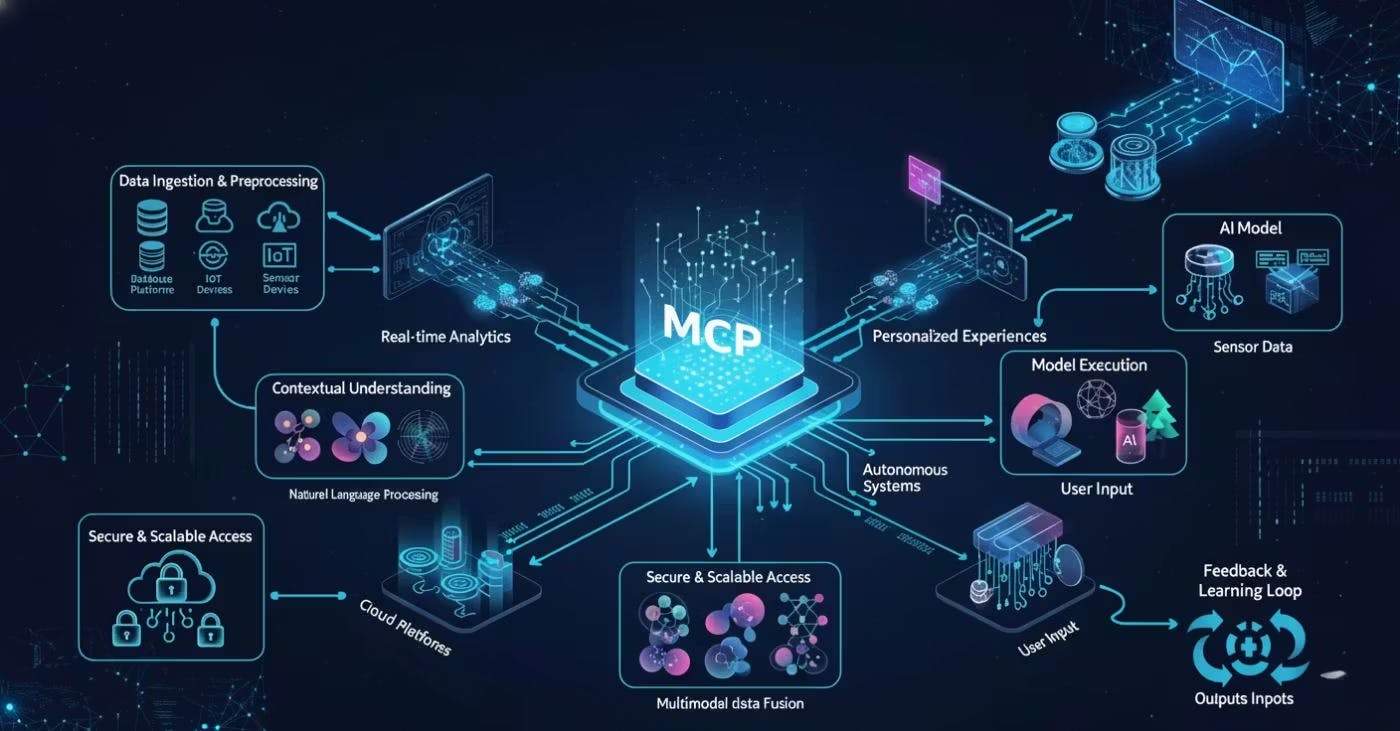
The promise of Artificial Intelligence has long been restricted by a single, critical challenge: connecting powerful Large Language Models (LLMs) to the messy, secure, and constantly evolving world of enterprise data and tools. Traditional methods relying on hardcoded integrations and proprietary plugins have proven to be fragile, difficult to scale, and rife with security risks. These limitations have kept AI systems locked in a "walled garden," preventing them from becoming the truly context-aware, autonomous digital workers we envision.
Enter the Model Context Protocol (MCP). MCP is an emerging open standard that fundamentally redefines this relationship. Acting as a universal bridge, it provides a standardized, secure, and context-driven language for AI agents to discover, access, and interact with external resources, from Salesforce and SQL databases to proprietary APIs. By merging the security rigor of enterprise middleware with the adaptability of LLMs, MCP is not just another API standard; it is the foundational layer for true AI interoperability, enabling secure enterprise reasoning, comprehensive auditability, and the next generation of scalable, agentic AI systems.
What Is MCP?
The Model Context Protocol (MCP) is essentially an emerging open standard designed to be the universal translator between powerful AI models and the complex world of enterprise data and tools. Instead of relying on a mess of custom plugins or fragile, hardcoded integrations, MCP creates a context-driven interface. This allows AI agents to dynamically and securely access, interpret, and interact with everything from databases and APIs to specific software and proprietary systems. Think of MCP as the crucial "middleware protocol" that sits between a large language model (like GPT, Claude, or Gemini) and the entire enterprise environment. By providing a consistent, standardized way to describe what tools are available, what data schemas look like, and what access policies need to be followed, MCP enables AI models to operate with both great flexibility and necessary compliance. It is, in essence, a universal bridge. Developed by Anthropic, it gives applications a common language to securely connect to any external resource they are authorized to use, much like a universal USB-C adapter for AI that connects one device to a multitude of others.
Where Can We Use MCP?
The applications for the Model Context Protocol (MCP) span virtually any area where an AI system needs to interact with real-world data and external systems. Fundamentally, MCP is the key enabler for agentic automation and enterprise integrations. For instance, in a corporate environment, an AI agent can use MCP's secure, standardized interface to perform complex tasks: imagine an agent seamlessly fetching customer history from Salesforce, then updating inventory records in SAP, and finally triggering a support ticket workflow in ServiceNow. This capability makes MCP highly relevant in modern AI architectures, including multi-agent systems, popular frameworks like LangChain or LangGraph, and sophisticated Retrieval-Augmented Generation (RAG) setups where secure, controlled access to contextual data is paramount. The potential use cases break down into three main categories:
- Development & Engineering utilizes MCP to manage everything from connecting to SQL databases and running queries to interacting with GitHub for code management, integrating with internal company APIs (like Jira or Slack), and even accessing local file systems and running terminal commands.
- Business & Productivity leverages MCP to interface with critical platforms, such as connecting to CRM systems (Salesforce, HubSpot), managing documents in Google Drive or SharePoint, scheduling meetings via Calendar & Email, and pulling crucial insights from analytics tools.
- Finally, in Personal & Research settings, MCP facilitates real-time web search, connection to academic databases for research, interfacing with Smart Home/IoT devices, and managing personal knowledge bases like Obsidian or Roam Research.
Why MCP Matters ?
We need the Model Context Protocol (MCP) because the old ways of connecting AI relying on hardcoded plugins or static API integrations are simply too risky, too inflexible, and too hard to scale. These traditional methods are a nightmare to maintain, pose significant security threats, and completely lack the contextual intelligence modern AI needs. MCP fixes this by introducing secure authentication, dynamic tool discovery, and fine-grained access control. This not only ensures strong data governance and auditability but drastically reduces the engineering overhead required to link Large Language Models (LLMs) with complex enterprise systems. In essence, MCP is what transforms an isolated AI system into a truly context-aware, policy-compliant digital worker capable of secure enterprise reasoning.
The necessity of MCP becomes clear when we look at the problems it solves:
- The "Walled Garden" Problem: Without a standard like MCP, every AI platform builds its own silo of integrations, leading to vendor lock-in and vast amounts of duplicated effort. MCP breaks down these walls, fostering a vibrant ecosystem where integrations are reusable and innovation can happen much faster.
- Security and Privacy Concerns: Traditional approaches often require giving AIs broad API permissions and mandate storing sensitive credentials insecurely. MCP mandates explicit user consent, allows for local execution of tool servers, and provides transparent logging of every single AI action, ensuring full audit capabilities.
- Developer Experience and Efficiency: Before MCP, developers faced complex authentication handling and constant maintenance of custom connectors. MCP offers a solution with a standardized interface across all AI clients, allowing developers to build reusable components write once, use everywhere dramatically simplifying their workflow.
- User Control and Transparency: MCP is designed to put the user back in charge. It lets you choose exactly which resources to expose to the AI, provides clear visibility into precisely what the AI is accessing, and enables easy revocation of access at any time.
When to Adopt MCP ?
The Model Context Protocol (MCP) should be used whenever an AI system must bridge contextual knowledge with live enterprise data securely, without directly exposing sensitive internal APIs or credentials. This makes MCP the standard choice for enterprise-grade AI copilots that require deep contextual awareness to be truly useful. It is essential when integrating Large Language Models (LLMs) with highly secure and regulated systems in areas like finance, healthcare, or manufacturing, and for automating complex workflows where autonomous agents must strictly adhere to access policies and governance rules. MCP becomes particularly valuable when organizations transition to agentic AI architectures, allowing multiple autonomous agents to collaborate safely and effectively within strict enterprise constraints.
MCP is specifically valuable in four key situations:
- When You Need Fresh, Specific Data: Use MCP when the AI needs access to real-time information, private organizational metrics, or personal context (such as your files and calendar) to ensure its responses are timely and relevant.
- When You Require Specialized Tools: Implement MCP when the AI needs to perform actions rather than just provide information, such as executing code, running complex database queries, or interacting with specialized software APIs.
- When Security and Control Matter: Choose MCP when your primary concerns are auditability, security, and compliance. It provides the necessary fine-grained control over what resources the AI can access and creates transparent audit trails of all AI actions, actively preventing unauthorized data exposure at an enterprise level.
- When Building Scalable AI Solutions: Adopt MCP when you're looking to create robust, scalable applications. It ensures consistent tool access across projects, allows for the creation of reusable components, and facilitates the development of a broad ecosystem of AI-connected services.
Who Benefits the Most?
MCP is fundamentally designed for AI engineers, enterprise architects, and developers who are actively building agentic or autonomous systems that demand safe, policy-compliant access to real-world data. Any organization adopting modern AI frameworks such as LangChain, LangGraph, or platforms with specific MCP integrations can use the protocol to unify access across countless tools, databases, and APIs. Beyond internal enterprise use, AI researchers and platform vendors leverage MCP to standardize how agents communicate with environments, paving the way for a truly interoperable AI ecosystem.
The value of MCP is realized across four key user groups:
- End Users can dramatically enhance their personal AI assistants by creating custom, localized connections. For example, a researcher can connect their assistant directly to their Zotero library or local PDF collection for enhanced literature review, all while retaining full control over exactly what data the AI can access.
- Developers and Engineers use MCP to move beyond custom scripting. They can build custom MCP servers for internal or specialized tools, contribute to the open-source community, and integrate the standardized protocol into their applications, making resources immediately available to any compatible AI agent.
- Businesses and Enterprises benefit from the secure standardization offered by MCP. They can develop secure internal tooling, ensure compliance and auditability across their AI operations, and build competitive advantages by creating custom, robust integrations.
- AI Application Builders can adopt MCP to achieve instant compatibility with a rapidly growing number of existing servers and tools. By joining this emerging standard, they can focus their efforts on core AI features and user experience rather than wasting time building and maintaining endless, custom integrations.
The Future Is Connected
The Model Context Protocol marks a paradigm shift from isolated AI to connected intelligence. Just as HTTP unlocked the modern web, MCP is set to unlock the AI Web a world where agents safely use the same data, systems, and workflows we rely on daily.
MCP represents the new interoperability paradigm for AI, successfully merging the strict rigor and security of enterprise middleware with the adaptive, fluid nature of large language models. As organizations rapidly transition toward building complex Agentic AI systems, adopting MCP will be absolutely critical to ensuring that this new level of intelligence remains contextual, compliant, and securely connected. The defining characteristic of the AI future isn't just smarter models; it is, above all, about smarter connectivity, and MCPs are leading that essential transformation.