Why fast systems fail while everything still appears to be working
Fast-moving systems rarely look broken.
They deploy.
They scale.
They pass tests.
Dashboards stay green.
From the outside, the architecture looks solid.
But this is exactly when systems fail.
The most dangerous debt in modern systems doesn’t slow execution.
It misroutes it.
Teams spend years learning how to manage technical debt. Refactoring code, cleaning up dependencies, hardening infrastructure. That work matters. But it no longer captures the main risk.
The real failure now happens higher up the stack.
By the time metrics signal a problem, the system has already been executing perfectly… on assumptions that expired long ago.
When “Everything Works” but Nothing Lines Up
In classic engineering failures, symptoms are obvious.
Latency spikes.
Error rates climb.
Throughput drops.
Those are mechanical failures. They’re noisy. They trigger alarms.
But fast systems today fail differently.
They fail whilevelocity increases.
They failwhileoutput improves.
They failwhile teams stay busy and confident.
What changes isn’t performance.
It’s coherence.
- Decisions get harder to explain.
- Alignment requires more meetings.
- Small disagreements turn into architectural debates.
- Trust degrades without a clear breaking point.
Nothing crashes.
But nothing feels stable.
In high-velocity systems, execution can remain correct long after interpretation expires.
And when interpretation decays quietly, speed becomes a multiplier for error.
Tech Debt vs. Interpretation Debt
Technical debt is familiar because it lives close to the metal.
You can see it in:
- messy code
- brittle services
- undocumented interfaces
It slows the system.
It creates drag.
Interpretation debt lives somewhere else.
It accumulates when:
- systems evolve faster than shared understanding
- capabilities change but mental models don’t
- decisions persist after their original assumptions stop being true
Technical debt is a throughput problem.
Interpretation debt is arouting problem.
Throughput problems make systems slower.
Routing problems send systems confidently in the wrong direction.
And AI doesn’t just increase throughput.
It accelerates whatever path the system is already on.
The Same Failure, Different Layers
This shows up across modern systems under different names, but the architecture is the same.
Narrative Debt
The product layer evolves faster than the story layer.
- Features ship.
- APIs expand.
- Capabilities improve.
But users can’t explain what the system is for anymore, or where it fits in their workflow.
The system functions.
The meaning layer fractures.
The Interpretation Gap
Capability outpaces comprehension.
- Markets struggle to price risk.
- Users hesitate to trust outputs.
- Institutions react late and bluntly.
Not because the system is weak.
Because its behavior can’t be clearly explained anymore.
Motion Without Translation
Teams execute rapidly but stop updating shared models.
- Decisions become protocol calls no one revisits.
- Roadmaps persist because they exist, not because they still make sense.
- Execution continues long after understanding has drifted.
Different symptoms.
Same failure.
Interpretation didn’t scale with the system.
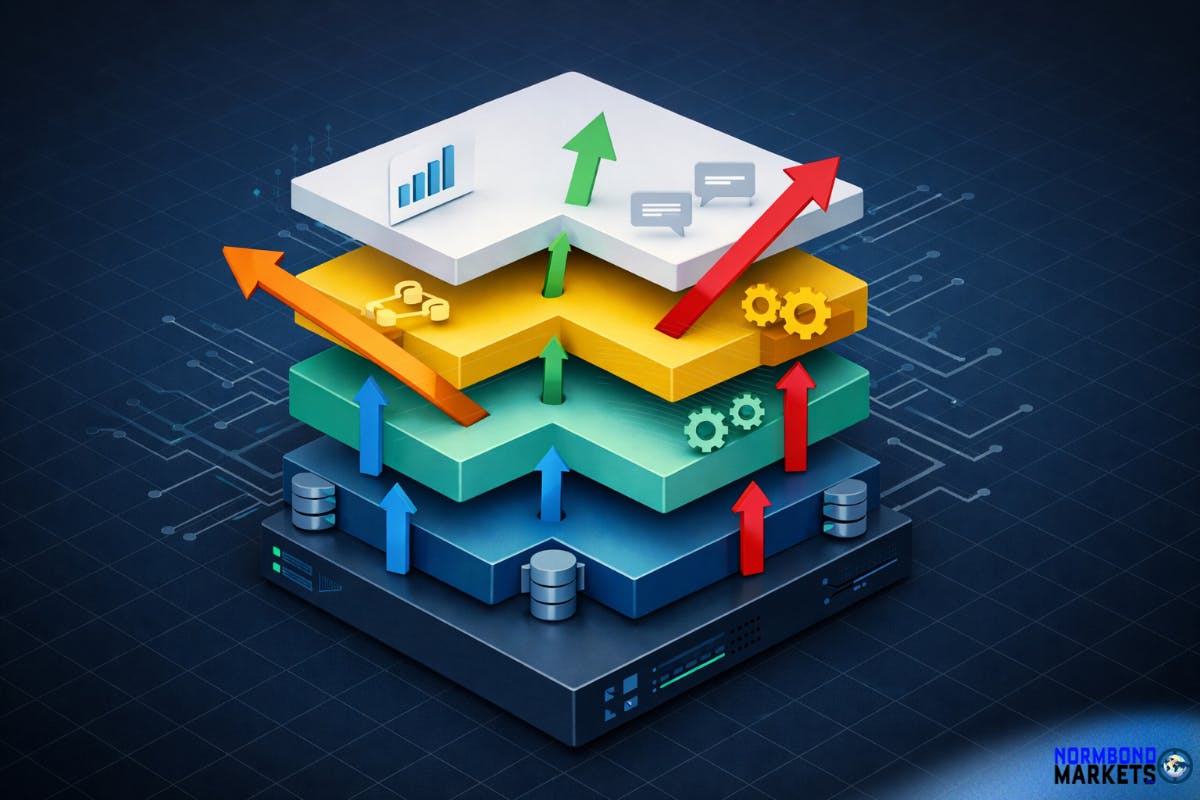
The Interpretation Stack
To see this clearly, you have to stop looking at systems horizontally and look at them vertically.
Most fast systems run on an invisible stack:
The Interpretation Stack
- Assumptions: What the system believes to be true
- Models: How cause and effect are understood
- Narratives: How those models are shared across humans
- Decisions: What the system chooses to do
- Execution: What actually happens in production
Most teams monitor the bottom of the stack.
They log execution.
They optimize decisions.
They refactor services.
But interpretation debt accumulates at the top.
- Assumptions go stale.
- Models drift.
- Narratives fragment as teams and users scale.
By the time execution looks wrong, the system isn’t malfunctioning.
It’s faithfully executing outdated meaning.
How Risk Really Compounds
Interpretation debt doesn’t create immediate failure.
It creates misallocation.
- Attention goes to the wrong problems.
- Capital funds the wrong bets.
- Talent optimizes the wrong constraints.
Execution stays fast. But becomes less effective.
Risk compounds quietly until one day the system hits a situation it can’t explain its way through.
That’s when collapse feels sudden.
It isn’t.
The system didn’t lose capability.
It lost the ability to make sense of itself under pressure.
What Builders Do Differently Now
In fast-moving systems, interpretation is no longer a soft concern.
It’s infrastructure.
Serious builders:
- treat interpretation like an architectural layer, not a meeting artifact
- review assumptions as often as dependencies
- design systems that can explain themselves, not just perform
- expect meaning to decay faster than functionality
- assume their fastest paths are also their riskiest
Everyone talks about tech debt.
Few track interpretation debt.
And yet, that’s the debt deciding where systems actually go.
The real question isn’t how fast your system can move.
It’s how long it can keep moving
without stopping to ask what it believes.
That’s where the work is now.
[story continues]
tags