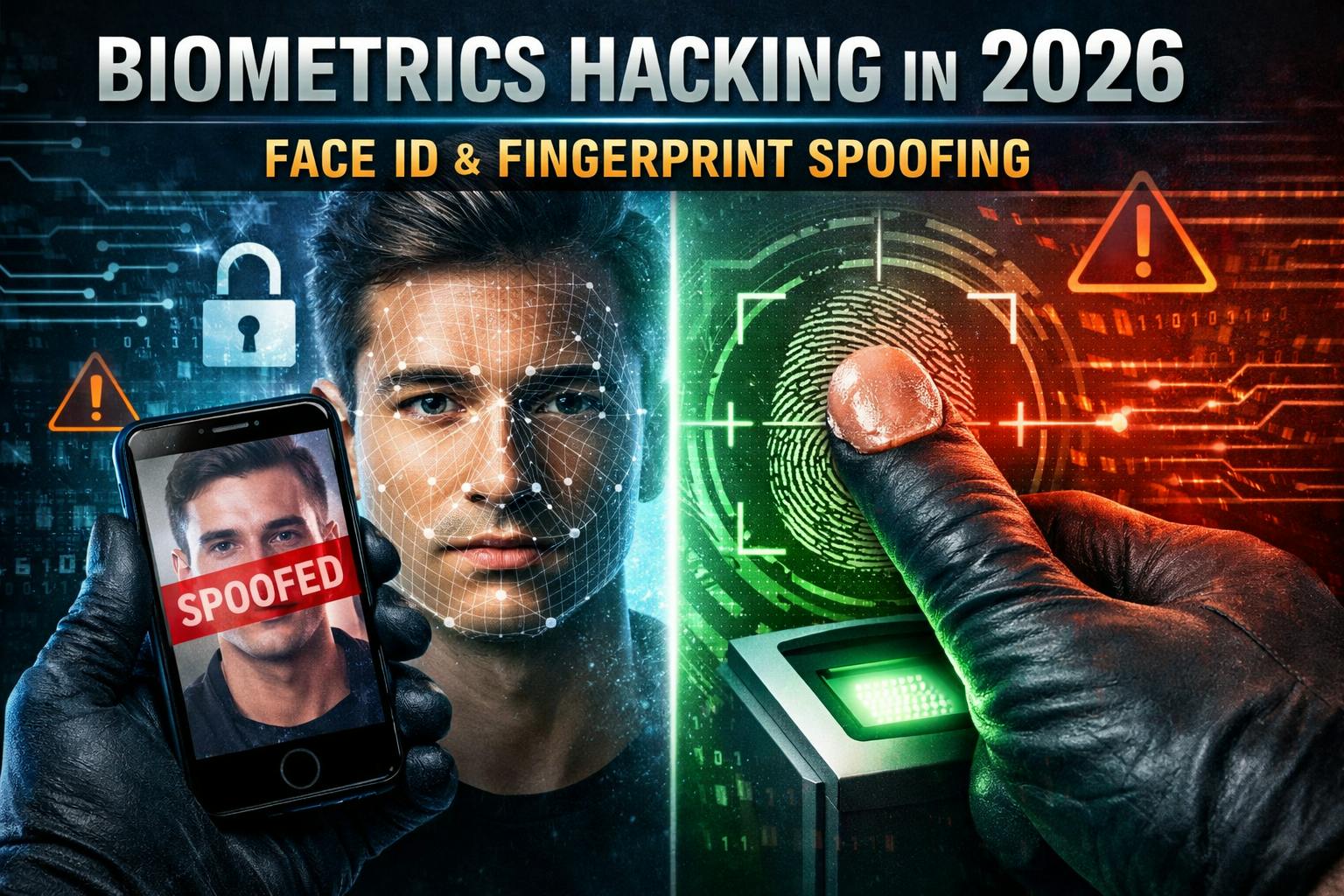
Last month, I was testing a new phone’s biometric unlock system when a thought hit me: we’ve come to trust Face ID and fingerprint scanners more than passwords. We tap, glance, and move on without thinking twice.
Biometric authentication feels futuristic and secure. But working in cybersecurity has taught me something uncomfortable — convenience often hides complexity. And complexity is where attackers like to play.
In 2026, biometric spoofing isn’t science fiction. It’s an active area of research, experimentation, and — in some cases — real-world exploitation.
This isn’t a panic piece. Biometric systems are still strong. But understanding how they can be spoofed helps us use them more intelligently.
The illusion of “unhackable” biometrics
When Face ID first appeared, many people assumed it was impossible to trick. Marketing language didn’t help — words like secure enclave and advanced neural mapping create a sense of invincibility.
But no authentication method is absolute.
Biometric systems work by comparing physical traits to stored templates. That comparison process involves sensors, software, and decision thresholds. Each layer introduces potential weaknesses.
Security researchers have demonstrated this repeatedly in controlled environments. If you’ve ever read analyses on authentication design (see this HackerNoon breakdown of modern authentication models), you’ll notice a pattern: every security system trades convenience for risk in subtle ways.
Biometrics are no exception.
How Face ID spoofing actually works
Hollywood loves dramatic hacking scenes, but real spoofing is quieter and more technical.
One approach involves high-resolution 3D facial reconstruction. With enough public photos — something social media provides in abundance — attackers can build surprisingly accurate models. Affordable 3D printing and AI-assisted modeling have lowered the barrier to entry.
Another emerging technique uses AI-generated facial simulations. Machine learning tools can enhance or synthesize facial features to test how systems respond to edge cases. While modern devices use infrared depth mapping and liveness detection, researchers continue to probe those defenses.
There’s also the deepfake angle. Advanced video manipulation can imitate micro-movements that some systems rely on. Most consumer devices resist these tricks, but the research highlights an important truth: biometric defenses evolve in response to increasingly creative attacks.
Fingerprint spoofing is older — and still relevant
Fingerprint spoofing predates modern smartphones. Security labs have been experimenting with replica fingerprints for decades.
What’s changed is accessibility.
Techniques that once required specialized equipment can now be reproduced with household materials and affordable tools. Gelatin molds, silicone casts, and lifted prints remain common in lab demonstrations.
More interesting, though, are sensor-level attacks. Some researchers focus on bypassing the hardware pipeline rather than fooling the sensor surface. By targeting how fingerprint data is processed internally, attackers explore weaknesses that aren’t visible to everyday users.
There’s a thoughtful discussion of hardware trust boundaries in this HackerNoon article on device security architecture:
Again, most of this work happens in research settings. But it influences how manufacturers design the next generation of defenses.
Why most real attacks don’t look like lab demos
Here’s the part that often gets lost in sensational headlines: biometric spoofing rarely happens in isolation.
In the real world, attackers prefer the path of least resistance. Social engineering, phishing, and credential theft remain far more common than sophisticated biometric bypasses.
What biometric spoofing research shows is how attackers think. They combine technical experimentation with human psychology. A compromised device, a tricked user, or a weak fallback password often plays a bigger role than a perfect fake fingerprint.
If you’ve followed discussions on layered security strategies (this HackerNoon piece explains the concept well) you know that modern defense isn’t about a single lock. It’s about stacking protections.
Using biometrics the smart way
None of this means you should disable Face ID or fingerprint unlock.
Biometrics remain one of the most practical security improvements in consumer technology. They reduce password reuse, encourage device locking, and add friction for opportunistic attackers.
The key is layering.
In practice, that means:
- Pairing biometrics with multi-factor authentication
- Keeping devices updated
- Using strong fallback passcodes
- Being cautious about oversharing high-resolution personal images
- Encrypting sensitive data
Biometrics work best as part of a broader system, not as a standalone shield.
The bigger picture for 2026
What fascinates me about biometric spoofing isn’t just the technical challenge. It’s what it says about the direction of cybersecurity.
Attackers are diversifying. As traditional defenses improve, they probe new surfaces — hardware sensors, AI models, and behavioral systems. Meanwhile, defenders respond with smarter detection and stronger architecture.
It’s an ongoing conversation between offense and defense.
Understanding that conversation helps us make better choices as users and builders. Security isn’t about fear. It’s about awareness and adaptation.
Biometrics aren’t magic, and they were never meant to be perfect. They’re tools designed to balance convenience and security in a world where threats keep evolving. Understanding their limitations doesn’t make them weaker — it makes us more realistic users. In cybersecurity, awareness and thoughtful use matter more than blind trust, and that mindset will only become more important as biometric systems continue to advance.
[story continues]
tags