Fast‑forward to 2025. Most of the world is still running on Governance OS 2.0, an operating system for the nation‑state first deployed centuries ago. Its source code was written in blood and parchment. Its kernel panics are called revolutions.
We’ve upgraded every other critical system in our lives – from communication to finance – but the most important one is running on legacy code.
There are somewhere around 800 billion lines of 60‑year‑old COBOL running mission‑critical government and financial software1. That’s more lines of antique code than there are stars in the Milky Way.
It’s civilizational debt.
My last piece argued that governance is the newest asset class. This piece is a prospectus for builders. If governance is a market, what’s the product?
It’s time for a full refactor. But to build the new, you have to understand the old. You have to see the nation-state not as an ideology, but as a technical architecture.
Governance OS 1.0: The Monolithic Mainframe
The Pitch: Centralized control for a chaotic world.
The Era: Ancient Empires to Absolute Monarchies (c. 3000 BCE - 1700 CE).
The Analogy: An IBM mainframe in a locked, air-conditioned room.
- Architecture: Monolithic. Religion, law, military, and economy were all compiled into a single, inseparable binary.
- Source Code: Closed. The code was "divine right" or "the will of the conqueror." Only one user had admin privileges: the Priest-King or Emperor.
- API: None. To interact with the system, you needed physical proximity to the admin. You couldn't "call" a function; you had to beg for an audience at the court.
- Scaling: Hardware-based. To expand the network you bought more hardware (soldiers) and conquered more territory (nodes).
- The User Experience: Stable, predictable, and completely unfree. The system offered one service: order. The price was your absolute submission.
It worked for millennia. But monolithic don't adapt; they shatter.
Governance OS 2.0: The On-Premise Enterprise Suite
The Pitch: Rights, representation, and a stable currency.
The Era: The Modern Nation-State (c. 1700 - 2008).
The Analogy: An on-premise Oracle or SAP software suite from the 1990s.
- Architecture: A bloated monolith with some APIs. The core functions are still centralized, but you can interact with them through defined protocols.
- Source Code: Partially open-source. We call it a "Constitution." You can read it, but you can't easily submit a pull request.
- API: Clunky and high-latency. We call them elections, courts, and lobbying. The response times are measured in years, and the calls are expensive.
- User Accounts: "Citizenship." Onboarding is mostly done at birth. Off-boarding (exit) is difficult and costly. This is the ultimate vendor lock-in.
- Updates: Patches (legislation) are slow and often introduce more bugs than they fix. A full system upgrade (a new constitution) requires a catastrophic fork – a revolution or a civil war.
300 years later, it has devolved into a system so burdened by its own complexity that patching it is like trying to run Kubernetes on a fax machine.
Governance OS 3.0: The Composable Society
I won’t pretend to have a finished blueprint. Think of OS 3.0 as a library of composable, forkable repositories for building societies.
- Sovereign Identity: A self-custodied identity layer not tied to your birthplace.
- Dispute Resolution: On-chain courts and decentralized arbitration.
- Capital Formation: Tools for community-owned treasuries and venture funding.
- Law & Governance: Forkable constitutional modules and transparent voting systems.
- Social Graph: Verifiable reputation and community-owned social networks.
- Physical Interface: Protocols for interfacing with the physical world, from land leases in Special Economic Zones to pop-up "embassies."
Two Users, Two Pains
The Refugee: Anya has no passport. Fleeing conflict, her state-issued identity vanished with the border she crossed. For OS 2.0, she is a ghost, unable to open a bank account, own property, or legally work. For OS 3.0, her identity is a set of cryptographic keys she controls. Her proof-of-humanity is verified on-chain. She can receive payments, build a reputation, and access a global marketplace, no permission required.
The Founder: David wants to build a biotech startup in Nairobi. He spends 9 months and thousands of dollars navigating bureaucracy just to register his company. Cross-border payments are a nightmare. OS 3.0 offers a DAO LLC registered in minutes. His cap table is on-chain. He can raise capital globally and pay contributors instantly, anywhere in the world.
This new architecture isn't about technical features. It's about human benefits: the ability to move and transact freely, to access swift justice, and to attract capital and talent from a global pool.
I know what you're thinking. The new system feels abstract, and fighting the incumbent seems impossible.
So let me give you one number to focus on: $18 trillion.
That's the approximate annual overhead of our current global OS 2.0, combining government spending and the staggering cost of regulatory compliance. It’s the largest, most inefficient market on the planet, an incumbent running on fumes. This is the prize.
But it’s a prize defended by the oldest moat in history: a monopoly on violence. OS 2.0 has the army and the police. I don’t have a simple answer for how to counter a "physical DDOS" from the legacy system. The path forward isn't a clean, revolutionary fork. It will be a dirty, symbiotic chaos. Our job is to build in the seams, to write the bridge code between worlds, and to facilitate the most peaceful transition possible for the 8 billion people running on the old OS. We will dissect that challenge, piece by piece, in the articles to come.
Stop Debugging. Start Building.
For millennia, we have been living inside someone else’s computer. We’ve been users on an archaic mainframe, running on proprietary code we couldn't read and weren't allowed to change. We filed bug reports—protests, petitions, rebellions—only to be told, "Sorry, that’s a feature, not a bug."
The great project of our time is to build our own machine, write our own code, and, for the first time, to truly own the OS for human flourishing. The legacy system is burning CPU cycles trying to process 18th-century algorithms in a 21st-century world. It’s one cascading failure away from taking us all down with it.
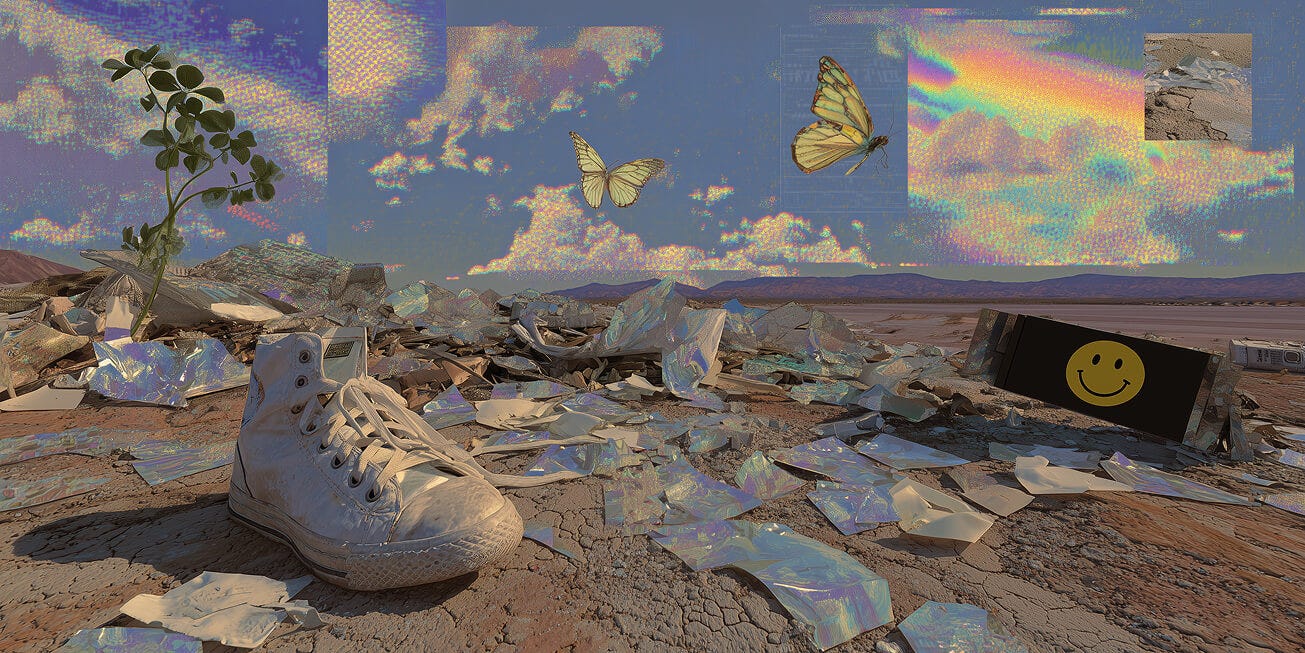
- Stop debugging the old world. Start compiling the new one.
- The discussion is open. Fork this idea. Join the conversation.
Ray Svitla
Stay Evolving 🐌
These transmissions will always be free. But this is a reader-supported operation. My friend Eric was the first to become a paid Member, sending the most valuable signal one can: belief.
If you want to support this mission and join the private guild chat for builders, consider becoming a Paid/Founding Member. Your support fuels this embassy.
[story continues]
tags