


You hit the goal.
The revenue number. The promotion. The follower count. The thing you told yourself would change how you feel.
For about 72 hours, it does. You feel the high. You let yourself celebrate. You tell yourself this was worth it.
Then something familiar creeps back in. That low-grade anxiety. That sense of “now what.” That feeling of standing at the top of a mountain you worked years to climb and realizing... you don’t feel that different.
So you do what you’ve always done. You set another goal. A bigger one. Because if this goal didn’t make you happy, the next one will. If this level of success didn’t feel like enough, the next level will.
You’ve been running this experiment your entire adult life. And it has never worked. Not once.
But you keep running it. Because the only strategy you have for feeling better is adding more.
More goals. More achievements. More stuff. More obligations. More optimizations. More everything.
What if the answer has never been addition?
The Math You’ve Been Getting Wrong
Everyone chasing happiness makes the same mistake. They treat it like a bank account.
Want more happiness? Deposit more good things. Hit more goals. Buy more stuff. Add more experiences. The balance should go up.
It doesn’t work that way.
Happiness isn’t an account you fill. It’s a signal you uncover.
Think about the moments in your life when you actually felt at peace. Not the achievements — those gave you relief, not peace. Not the purchases — those gave you novelty, not contentment. The moments when you felt genuinely, simply good.
For most people, those moments have one thing in common: absence.
Absence of financial stress. Absence of toxic relationships. Absence of obligations that drain you. Absence of the constant noise telling you you’re not enough.
You weren’t adding something. You were finally free from something.
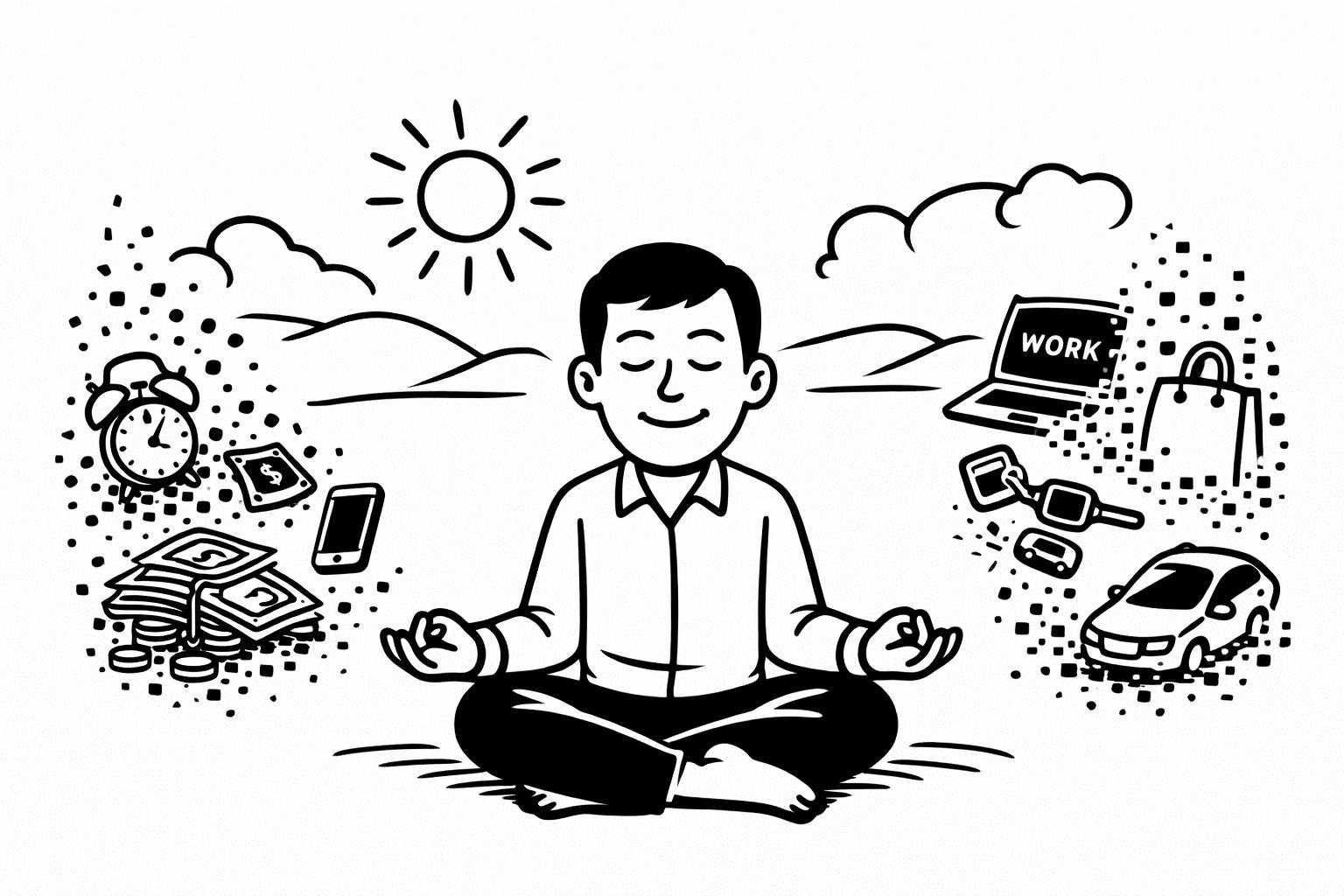
This is the part that ambitious people get completely backwards. You think the path to feeling better is acquiring more. The path to feeling better is removing what’s making you feel worse.
The debt. The draining people. The commitments you said yes to because you couldn’t say no. The goals you’re chasing because someone else told you they mattered.
Happiness isn’t hidden behind the next achievement. It’s buried underneath everything you keep piling on top of it.
The Sculpture Principle
When Michelangelo was asked how he created the David — one of the most celebrated sculptures in human history — he didn’t talk about what he added.
He said: “I saw the angel in the marble and carved until I set him free.”
He didn’t build the David. He removed everything that wasn’t the David.
This isn’t just an art principle. It’s a life principle. And the people who actually achieve peace — not just success, but peace — understand it intuitively.
Warren Buffett has made more money than almost anyone alive. His strategy isn’t finding more opportunities. It’s eliminating almost all of them. He calls it the “20-slot rule” — imagine you only get 20 investments in your entire lifetime. Suddenly you stop saying yes to good opportunities so you can say yes to great ones.
His partner Charlie Munger made it even simpler: “It is remarkable how much long-term advantage people like us have gotten by trying to be consistently not stupid, instead of trying to be very intelligent.”
Not adding intelligence. Subtracting stupidity.
This same principle shows up everywhere you look. The best writing isn’t adding more words — it’s cutting until only the essential remains. The best companies aren’t built by adding more products — Apple nearly died with dozens of products, then Jobs killed 70% of them and built the most valuable company in history. The best schedules aren’t packed with more — they’re protected from everything that doesn’t matter.
Addition is the amateur strategy. Subtraction is how mastery actually works.
But knowing this and living it are two different things. Because you’re carrying weight right now that you’ve stopped even noticing.
The Weight You’ve Adapted To
I realized something was wrong when I was on vacation and couldn’t relax.
We’d planned this trip for months. Beach. No meetings. No deadlines. My fiancée was happy. Everything I’d told myself I was working toward was right in front of me.
And I was miserable.
Not dramatically miserable. Just... tight. Distracted. Unable to be where I was. Checking my phone for problems. Running through mental to-do lists. Carrying this invisible weight that I couldn’t set down even when there was literally nothing I needed to do.
That’s when I understood: the weight wasn’t coming from what was in front of me. It was coming from everything I’d piled onto my life over the years and never taken off.
The client relationships that had turned toxic but I kept because the money was good. The recurring commitments I dreaded every single time but never canceled. The goals I was still chasing because I’d announced them publicly, not because they still mattered to who I was becoming. The stuff in my house, my calendar, my head — all of it accumulating for years, and me just... adapting to it.
You do this too. You adapt to weight until it feels normal.
That relationship that drains you every time? You’ve adjusted. That financial stress humming in the background? You’ve learned to tune it out. That cluttered calendar full of things you don’t want to do? You’ve accepted it as “just how life is.”
It’s not how life is. It’s how your life is. Because you keep adding and never subtract.
And it’s costing you more than you know.
What This Is Actually Costing You
The real cost isn’t your time — although it’s costing you that too.
The real cost is your capacity to feel the good that’s already there.
You have things in your life right now worth enjoying. People worth appreciating. Moments worth being present for. But you can’t feel any of it. Because you’re too depleted from carrying everything you refuse to set down.
The people closest to you are getting the scraps. Whatever’s left after work, obligations, and recovery from being drained all day. Your partner gets the tired version. Your friends get the distracted version. Everyone gets what remains after everything else takes its cut — which isn’t much.
Your health is eroding quietly. The stress. The sleep you’re not getting. The exercise you keep postponing. The recovery you never prioritize. It doesn’t announce itself. It just accumulates. Until one day your body sends you an invoice for everything you’ve been ignoring.
The moments you should be enjoying disappear. The dinner that should feel like a celebration feels like another item on the list. The weekend that should feel like freedom feels like recovery from the week. You’re so weighed down that even the good stuff doesn’t register as good.
And the worst part — you’re not even enjoying the success. The whole point of achieving things was to feel good. But you can’t feel good because you’re too weighed down to feel much of anything. So you achieve more, thinking that will fix it. It doesn’t. It just adds more weight.
This is the trap. Addition is the problem pretending to be the solution.
The Subtraction Audit
Here’s what actually works. It takes 30 minutes. Most people won’t do it because it requires admitting that things they chose are now things they need to cut. The ones who do it wonder why they waited so long.
Part 1: The Drain List (10 minutes)
Write down everything in your life that drains you. Not the hard-but-worth-it things. The draining things that aren’t worth it.
Relationships that leave you feeling worse after every interaction. Recurring commitments you dread. Goals you’re chasing out of ego, not genuine desire. Stuff cluttering your space and mind. Financial obligations that create constant stress. Anything you do because you “should,” not because it aligns with who you’re becoming.
Don’t filter. Don’t justify. Just write.
Part 2: Keep, Kill, Reduce (15 minutes)
Go through each item:
Kill — Remove it completely. End the relationship. Cancel the commitment. Drop the goal. Sell the stuff.
Reduce — You can’t eliminate it, but you can do less. Once a month instead of weekly. Boundaries instead of unlimited access.
Keep — It drains you but genuinely matters. These are rare. Be honest about what actually qualifies.
Most things you want to mark “keep” are actually “kill” or “reduce.” You’re just scared to admit it.
Part 3: One Subtraction (5 minutes)
Pick the single highest-impact removal on your list. The one that — if you eliminated it — would create the most space, energy, and peace.
That’s your entire focus for the next week. Not adding anything. Removing that one thing.
Do this audit every 90 days. Each time you’ll find more to cut. Each time you’ll feel lighter. Not because you achieved something new. Because you finally set something down.
What’s Actually On The Other Side
I want you to imagine your life with the weight gone.
Not all of it — some weight is worth carrying. But the garbage weight. The obligations you resent. The relationships that drain you. The goals that aren’t even yours. The debt. The clutter. The noise.
Imagine waking up without that.
Imagine having actual space in your calendar. Room to think. Room to breathe. Room to be present with the people you built everything for.
Imagine being on vacation and actually being on vacation.
That’s not a fantasy. That’s what’s on the other side of subtraction.
You don’t need to add anything to get there. You need to subtract what’s blocking it. The good life is already in there — buried under years of additions that were supposed to make you happy and never did.
Michelangelo didn’t create the David. He removed everything that wasn’t the David until what remained was undeniable.
Your happiness works the same way.
It’s not something you build. It’s something you uncover.
And you uncover it the same way he did.
By finally stopping the addition. And starting to carve.
Thank you for reading,
— Scott