


I've been watching AI eat the world for the past three years.
Not metaphorically. Literally watching, from the front row. I run a technology summit in Costa Rica that has hosted Nick Szabo, Peter Todd, Phil Zimmermann and hundreds more. I co-founded a developer education platform. I spend most of my waking hours at the intersection of what technology can do and what humans are still doing anyway.
And I've noticed something that nobody in the AI conversation seems to want to say out loud.
AI can write your copy. It can debug your code. It can analyze your market, summarize your contracts, generate your pitch deck, and pass your bar exam. It can do in seconds what used to take weeks. It is, by any honest measure, the most capable tool humanity has ever built.
But I have never, not once, seen an AI be accountable for being wrong.
The Meeting Nobody Talks About
Let me give you a scene.
A founder is in a board meeting. The company is burning cash. He has two options on the table, cut the product team and extend runway, or double down and raise another round in a market that's tightening. Both options were modeled by AI. Both came with projections. Both have a compelling case.
He has to pick one. He has to say the words. His name goes on the decision. If he's wrong, people lose their jobs, investors lose money, and he lives with it.
I've been in that room. Not as a spectator.
No AI was accountable in that room. No AI felt the weight of the decision at 3am the night before. No AI's reputation was on the line. No AI had to look a team member in the eye six months later if it went sideways.
The AI gave him information. Possibly excellent information. But it did not, could not, share the consequence.
That gap. That specific gap. Is what I've been thinking about for three years.
What We're Actually Scared Of
When tech professionals tell me they're worried about AI, they usually mean one of two things.
The first fear is the obvious one: my job disappears. The task I'm paid to do gets automated. I become redundant.
The second fear is subtler and I think more honest: I'm not sure I have anything left that matters. If AI can write, code, analyze, and reason, what exactly am I for?
Both fears are pointing at the same underlying question. But they're asking it the wrong way.
The right question isn't "what can AI do that I also do?" The right question is: "what requires a human to be on the hook for the outcome?"
Those are completely different questions. And the answer to the second one is where I think most people aren't looking.
The Skill Nobody Is Naming
I want to give this thing a name because I think it's been floating around unnamed and that's part of why it keeps getting missed.
I call it agency under consequence.
It's not creativity, though creativity is part of it. It's not empathy, though that matters too. It's not even judgment in the abstract sense.
It's specifically the capacity to make an irreversible decision, under real uncertainty, where you personally bear the cost of being wrong.
A doctor who looks at test results and tells a patient they have six months to live. A founder who kills a product that 40 people built. A journalist who publishes a story they know will make powerful enemies. A parent who tells their child a hard truth.
These aren't just decisions. They're acts of will performed by someone who cannot outsource the consequence.
AI can give you the information that precedes every one of those moments. It cannot step into the moment itself.
And here's what I think most people are missing: that moment, the one where someone has to actually own it, is not a shrinking part of the economy. It is the expanding part.
Why Consequence Is Getting More Valuable, Not Less
Think about what AI is actually doing to organizations.
It is dramatically compressing the cost of execution. Writing, research, analysis, code, design, these are getting cheaper by the month. Tasks that required teams now require prompts.
This means the bottleneck is shifting.
When execution is cheap and abundant, what becomes scarce? Decisions. Specifically, decisions made by people willing to be accountable for them.
The ratio of "things that need doing" to "people willing to own outcomes" is changing in one direction. More things get done faster. But someone still has to sign off. Someone still has to say: I believe in this, I'm staking my reputation on it, if this fails that's on me.
That person is not becoming less important. They're becoming rarer and more valuable because the volume of decisions that need owning is increasing while the pool of people who can execute has effectively expanded by orders of magnitude.
The economic logic here is straightforward: when supply of something increases dramatically, the value of its complement increases. AI increased the supply of execution. The complement of execution is accountability. You do the math.
Four Places This Shows Up Right Now
I spent a year mapping where agency under consequence actually lives, where it's structurally irreplaceable, not just emotionally preferred.
Here's the short version across four domains.
Creativity. AI can generate. It cannot stake a claim. A creative work that matters, that shifts culture, that starts a conversation, that someone will still reference in twenty years, requires an author who put something of themselves into it and defended it against the people who wanted it to be safer. That authorship is not a technicality. It's the whole point. The reader knows the difference between a work that cost something and a work that didn't. They always have.
Governance. Every institution, company, country, community, eventually faces a decision that can't be optimized. It can only be chosen. Values in conflict. Constituencies with opposing interests. No algorithm resolves these because they're not calculation problems. They're will problems. The leader who can hold the room, absorb the disagreement, and make the call anyway is not doing something AI will eventually automate. They're doing something that by definition requires a human to be present and accountable.
Decision-making under genuine uncertainty. Not risk, risk can be modeled. Genuine uncertainty: situations where the data is incomplete, the precedent doesn't apply, and the decision still has to be made. Experienced founders know this feeling. The moment when the spreadsheet ends and something else has to take over. That something else is judgment formed by years of having been wrong and living through it. It cannot be uploaded.
Reputation. Trust in a specific human being, built over years through demonstrated accountability, is not transferable to an AI system. Your clients, your partners, your team, your audience trust you because you showed up when it was hard, because you were wrong and admitted it, because your word has meant something over time. That asset is yours alone. AI cannot hold it and cannot spend it.
The Counterargument I Take Seriously
The smart pushback here is: AI will eventually have consequences too. As autonomous systems make decisions and those decisions affect the world, something like accountability will emerge.
I think this is probably true in a limited technical sense and almost entirely irrelevant to the practical question.
Even if we build systems with meaningful feedback loops, systems that in some sense "pay" for their errors, the social and institutional structures we have for dealing with consequences are built around human beings. Courts, contracts, reputations, relationships. These require a human somewhere in the chain who can be named, held responsible, negotiated with, trusted or distrusted.
That requirement is not going away. If anything it's intensifying. The more automated our systems become, the more desperately we need identifiable humans who will own the outcomes.
This is already happening. "Who's responsible for this AI decision?" is one of the defining legal and political questions of this decade. The answer is always, eventually, a human being.
What To Do With This
I'm not going to tell you to stop learning AI tools. That would be insane advice and I don't believe it.
Use every tool available to you. Automate everything that can be automated. If AI can do it faster and cheaper, let it.
But while you're doing that, ask yourself a harder question: am I building a track record of owning outcomes? Am I developing the kind of judgment that only comes from having been accountable for things that mattered? Am I becoming someone whose word means something because they've demonstrated it over time?
Because here's what I think the next decade actually rewards: people who used AI to execute faster while simultaneously building the irreplaceable thing that AI cannot touch.
Not one or the other. Both.
The people who will be fine are not the ones who resist AI. They're the ones who figured out that AI handles the execution while they handle the consequence.
That's the last skill. The one that isn't on any automation roadmap. The one that compounds the more you practice it.
I've been sitting with these ideas for long enough that I eventually had to write them down properly.
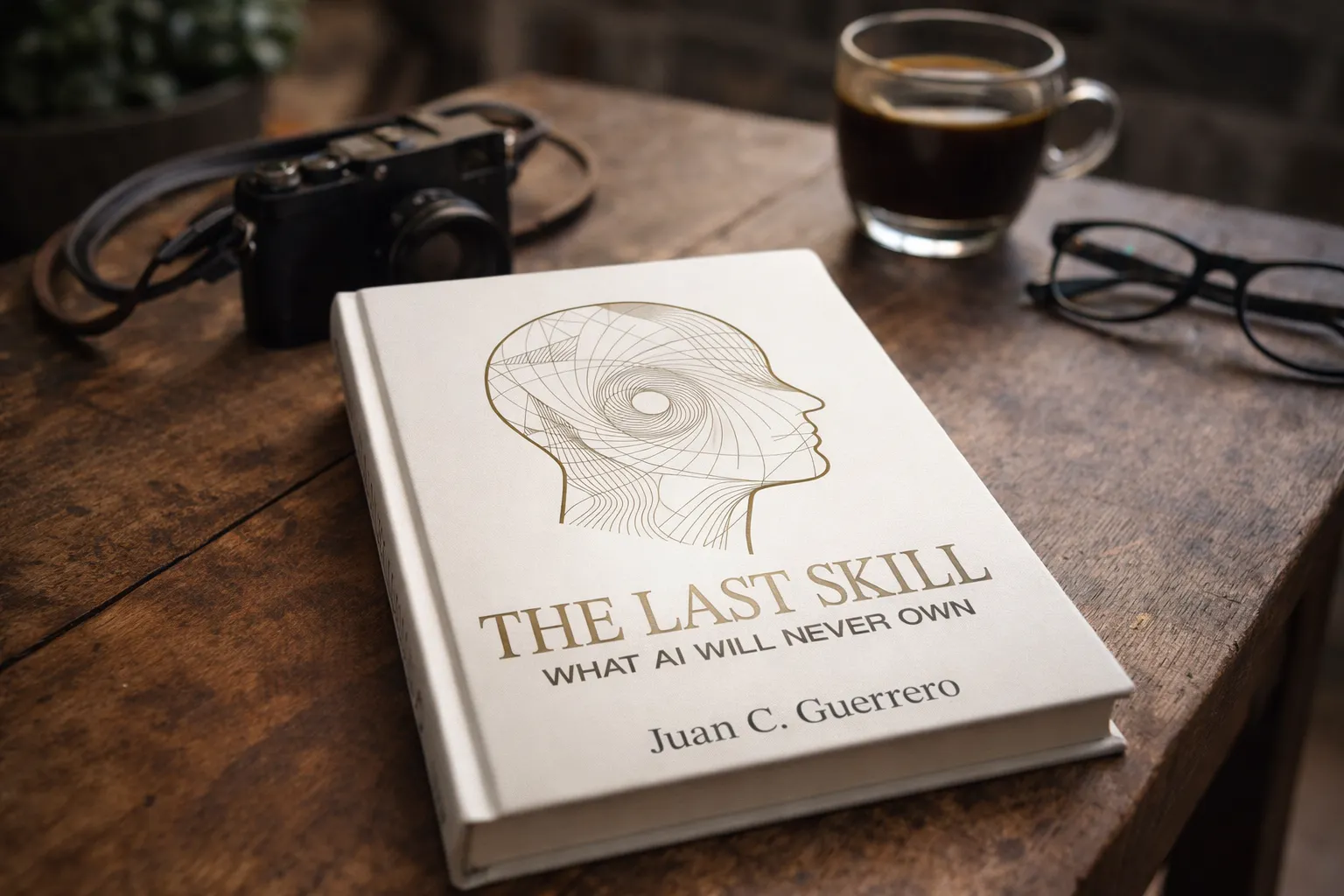
The result is a book, The Last Skill: What AI Will Never Own, published this week. If what I've written here landed for you and you want to go deeper into the framework, the four proofs, and what this means practically for how you build your career and your work, it's available on Amazon Kindle.
No pressure. The argument stands on its own. But if you want the full version, it's there.
The Last Skill: What AI Will Never Own — Amazon Kindle
Juan C. Guerrero is the founder of Blockchain Jungle and the author of The Last Skill. He writes about freedom technology, human agency, and the future of work from San José, Costa Rica.