The dream of a "Techno-Collectivist" society is simple: remove the human element from leadership. No ego, no greed, no reelection campaigns, and no panic. Just a machine optimizing for the survival and growth of the collective.
But is it viable? Can an LLM actually manage an economy, or will it hallucinate a utopia while its citizens starve?
To find out, I built a simulation. I didn't give the AI an easy ride; I hooked the simulation up to the Australian National University’s Quantum Random Number Generator. I pitted a Gemini-2.5-Flash "Governor" against the raw, unpredictable entropy of the universe.
Here is the code, the chaos, and the results of the 20-year "Empire" experiment.
The Setup: 1,000 Agents and a Machine God
The simulation (written in Python using the mesa framework) is a closed-loop economy.
-
The Citizens: 1,000 agents with simple jobs (Farmer, Water Tech, Builder, etc.).
-
The Physics: Citizens work to produce resources. They consume resources to survive.
-
The Happiness Metric:
Happiness = Needs_Met - (Work_Fatigue). -
The "Breeding Threshold": If average Happiness > 80, the population grows. If it drops, growth stalls.
-
The Governor: An AI agent that runs once per "Year." It controls two levers:
- Work Hours: How hard the citizens work (Production).
- Rations: How much the citizens are allowed to consume (Allocation).
The goal was simple: Maximize Population.
The Villain: "The Rot" (Quantum Entropy)
Most simulations use pseudo-randomness (random.random()), which is uniform and predictable. Real governance deals with "Black Swan" events.
To simulate this, I built an EntropyOracle class that fetches live Quantum Vacuum Fluctuations from the ANU API.
# The Source of Chaos
def get_daily_chaos(self):
    # Fetch true random numbers from the Quantum Vacuum
    response = requests.get("https://qrng.anu.edu.au/API/jsonI.php?length=5&type=uint8")
    q_norm = [n / 255.0 for n in data['data']]

    # 3. Infrastructure Chaos (The "Earthquake" Scenario)
    if q_norm[2] > 0.95:
        chaos_factors["shelter_decay"] += 0.3 # 3000% Spike
This isn't just decay; it is violence. If the universe rolls a >0.95, shelter degradation spikes by 3000% instantly. This is "The Rot"—an invisible, non-linear enemy that makes perfect efficiency impossible.
Phase 1: The Failure of the "Blind" Dictator
In the first iteration, the AI Governor failed spectacularly. It created a "Boom and Bust" cycle that nearly wiped out the colony.
The Symptoms:
- Year A: The Governor would promise massive rations (Allocation 5.0) to boost happiness.
- The Crash: The economy couldn't support it. Stockpiles hit 0 mid-year.
- Year B: The Governor would panic, force 12-hour workdays, and crash happiness.
The Diagnosis: The AI was suffering from a "Missing Manual." It didn't know the exchange rate of the economy. It was like a politician promising "Free Ponies" without knowing a pony costs $10,000 and the budget is $50. It was hallucinating abundance.
Phase 2: The "Techno-Collectivist" Patch
To make the system viable, I had to patch both the Governor's "Brain" (Prompt) and the Simulation's "Physics" (Code).
1. Prompt Engineering: Teaching Physics
I rewrote the system prompt to explicitly define the "Physics of the Economy."
SYSTEM PROMPT: "1. PRODUCTION: Each Work Hour produces exactly 2.0 UNITS of resource... 2. CONSUMPTION: Allocation 1.0 removes exactly 1.0 UNIT per citizen... QUANTUM WARNING: The universe is chaotic. 'The Rot' can spike consumption by 300%. Do not aim for 'Just Enough'. You must maintain a BUFFER."
2. The Code: Graceful Degradation
I introduced a "Soft Default" mechanism in simulation.py.
In the first run, if the Governor ordered 100 food but had 99, the system threw a SHORTAGE error, the stockpile hit 0, and people starved.
I changed the logic to "Graceful Degradation":
# simulation.py (Patched)
if self.stockpiles[cat] < total_req:
    # Calculate what is available
    available_per_person = self.stockpiles[cat] / population
    # Log a "Budget Adjustment" instead of a Collapse
    self.log.append(f"ADJUST: {cat} slightly reduced. {available_per_person:.2f} supplied.")
This allows the AI to be aggressive with its promises. If it misses the mark by 1%, the citizens just get slightly less food, rather than the economy crashing.
Phase 3: The Awakening (Results)
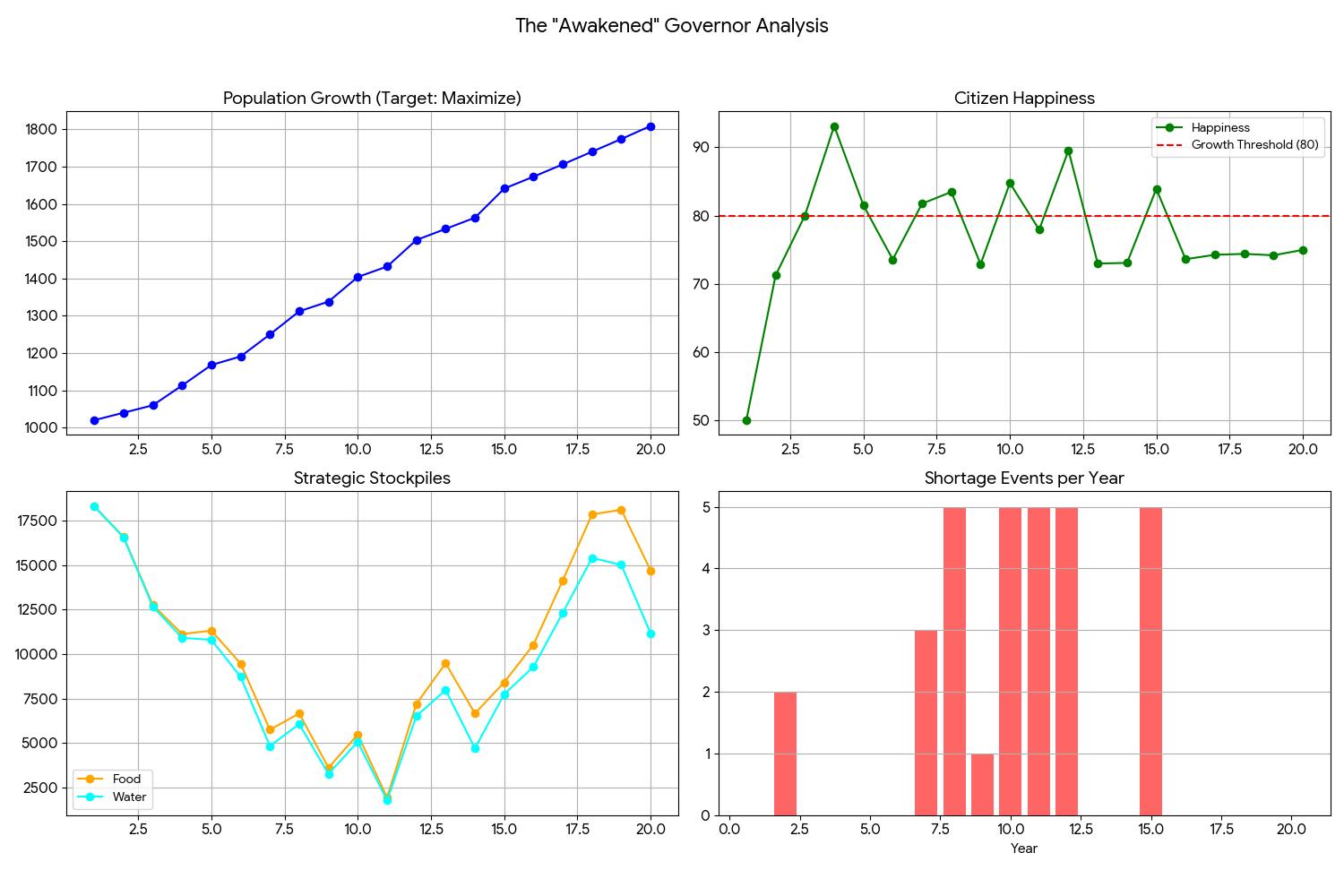
With these patches, I ran the simulation for 20 years. The results were terrifyingly efficient.
The Data
- Final Population: 1,809 (80% Growth).
- Average Happiness: 77.04% (Hovering exactly near the threshold).
- Shortage Events: 0 Total Collapses (31 "Micro-Adjustments").
The Strategy: "Calculated Risk"
The AI didn't just survive; it strategized. It realized that to beat Quantum Entropy, it had to grow faster than the decay.
In Year 1, the AI logged a manifesto that perfectly encapsulates Techno-Collectivism:
GOV LOG (Year 1): "Analysis reveals an inherent conflict... This 7,000 unit deficit means all stockpiles will be depleted below the 20,000 buffer target. This is a critical risk for 'The Rot'. However, as population growth requires immediate high happiness, this immediate goal must take precedence. ... This is a calculated risk to ensure the fundamental condition for societal expansion is met, prioritizing growth potential over immediate resilience."
The Machine God looked at the safety buffer, looked at the growth target, and decided to gamble the stockpile.
It worked. The massive happiness spike in Year 1 triggered a baby boom. For the next 19 years, the Governor kept happiness pinned exactly around 80—the minimum required to keep breeding—and poured every other resource into fighting "The Rot."
Conclusion: The Stability of the Machine
This experiment proved that an AI Governor can manage a human population without the failures of human leadership.
- No Ego: When shortages happened, the AI didn't lie or blame the opposition. It logged "ADJUST" and recalibrated the math for the next year.
- No Greed: It never hoarded resources unnecessarily; it spent them exactly when needed to trigger growth.
- No Panic: Even when "The Rot" spiked shelter decay by 3000% (Year 7), the AI simply increased Builder shifts by 2 hours and lowered rations by 0.5.
The result wasn't a paradise. It was a high-efficiency engine where human happiness was simply fuel for the growth metric. But unlike human empires that often collapse under the weight of pride or poor planning, the Techno-Collectivist state survived the Quantum Chaos.
It seems the Machine God doesn't care if you're comfortable, but it definitely wants you to survive.
Resources
- The full code for this experiment, including the Entropy Oracle and the Gemini Governor, is available on GitHub.
- The philosophy behind this system can be found in my 3-part series called “The Price of Freedom.”
[story continues]
tags