From zero to production in 6–9 months. What to learn, what to skip, and why most tutorials fail.
I’m going to be honest with you.
Most AI agent tutorials are garbage.
They show you how to copy-paste LangChain code, build a demo that breaks the moment you try anything real, and leave you feeling like you learned something. Three months later, you try to build something that wasn’t in the tutorial and you’re completely stuck.
I’ve watched people waste years this way. Chasing frameworks. Collecting certificates. Building toy projects nobody cares about.
This guide is different.
What you’re reading is the result of a lot of trial and error figuring out what matters when learning agentic AI. I’ll tell you how long each phase takes and what “good enough” looks like before moving on. Every resource you need is here. And this path produces people who can actually ship — not just follow along.
Here’s my promise: if you follow this roadmap seriously for 6–9 months, you’ll be able to build and deploy AI agents that work in the real world. Not demos. Systems that solve problems.
What you’ll get:
- The 8 phases from zero to deployed agents (with realistic timelines)
- Which resources are actually worth your time
- The specialization paths that lead to real jobs
- What “good enough” looks like before moving on
- The mistakes I made so you don’t have to
But you have to do the work. Not skim. Not bookmark for later. Not tell yourself you’ll get to the math eventually.
If that’s you, let’s go.
Why Agentic AI Matters Right Now
Traditional AI is reactive. Input in, output out. You ask a question, you get an answer. That’s it.
Agentic AI pursues goals. It looks at its environment, makes plans, takes actions, sees what happened, and adjusts. It can use tools, call APIs, search the web, write code, and work with other agents to get things done.
Here’s a concrete example.
Ask traditional AI to help you research competitors and it’ll summarize what it already knows.
Ask an agentic system and it will search the web for your competitors’ recent moves, pull their press releases and funding announcements, analyze their positioning, cross-reference with industry reports, write up a strategic brief, save it to your drive, and email you when it’s done. While you’re asleep.
This is why companies want people who can build these systems. By 2026, agents won’t be impressive anymore — they’ll be expected. The question is whether you’ll know how to build them.
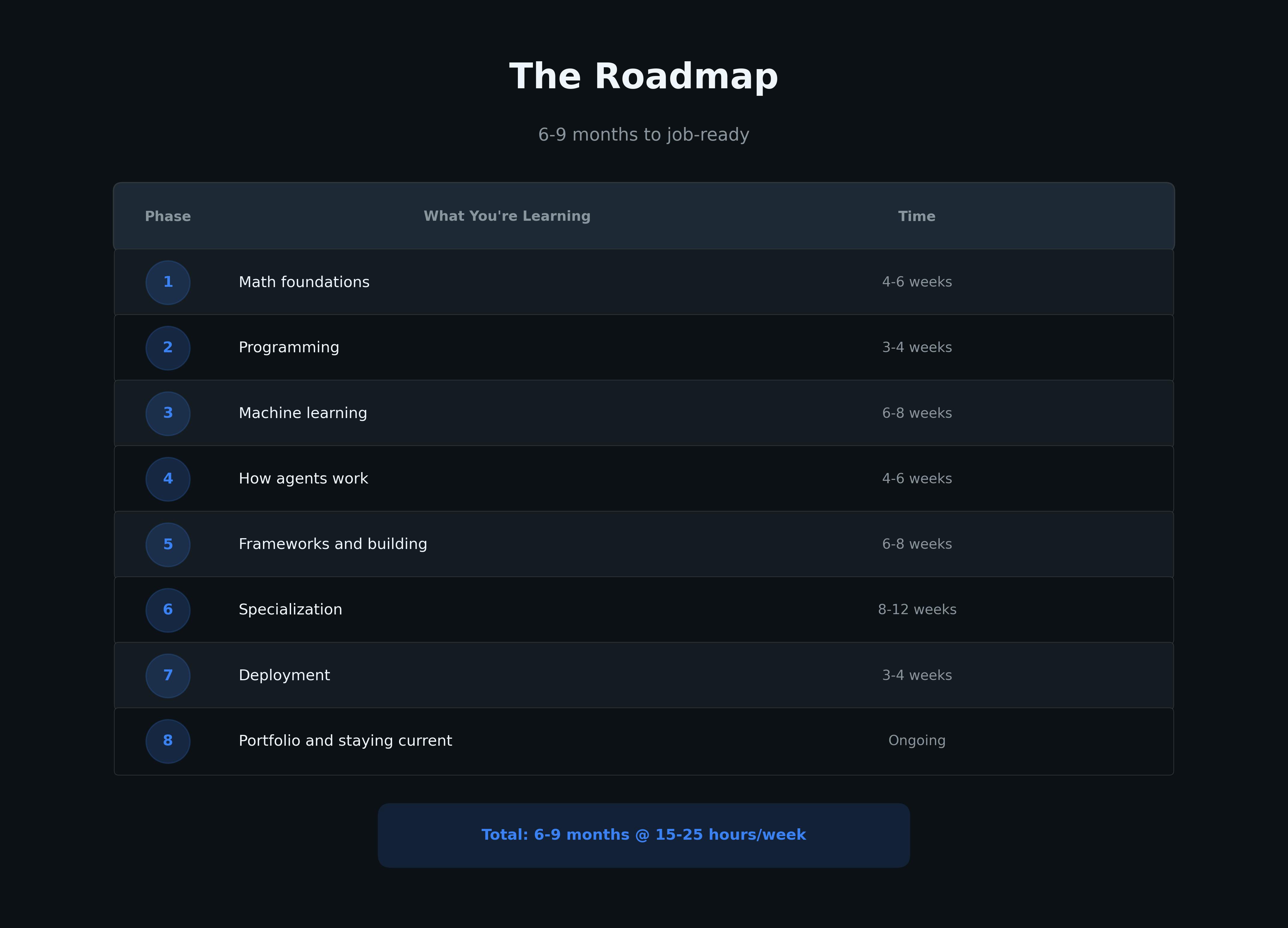
The Roadmap
Here’s the full picture before we get into details:

Phase 1: Math
4–6 weeks
You want to skip this. I know.
But without linear algebra, calculus, and probability, you won’t understand why your agents do what they do. You’ll copy code that works until it doesn’t, and then you’ll have no idea how to fix it.
You don’t need to become a mathematician. You need working fluency in three areas.
- Linear Algebra: Vectors, matrices, eigenvalues, SVD. Neural networks are matrix math. Embeddings are vectors. This is the foundation.
- Calculus Derivatives, gradients, optimization. This is how models learn.
- Probability & Statistics — Bayes’ theorem, distributions, hypothesis testing. Agents reason under uncertainty. This is how.
Resources
Linear Algebra:
3Blue1Brown: Essence of Linear Algebra . The best visual explanation of linear algebra ever made. Grant Sanderson has a gift for making abstract concepts feel intuitive. Start here.Khan Academy Linear Algebra . More traditional, more comprehensive. Good for filling gaps after 3Blue1Brown.Machine Learning Foundations: Welcome to the Journey . Specifically designed for ML, so you’re learning math with a purpose.Math for Machine Learning . Another ML-focused option. Pick whichever style clicks for you.
Calculus:
Calculus for Machine Learning . Targeted and practical. Skips the stuff you won’t need.Khan Academy Calculus 1 . The classic. Thorough and reliable.Calculus 1 Full College Course . If you want the full university experience without the tuition.
Probability:
Khan Academy Statistics and Probability . Covers everything you need at a good pace.StatQuest Statistics Fundamentals . Josh Starmer explains stats like he’s talking to a friend. Genuinely enjoyable.StatQuest: Bayes’ Theorem . Bayes is everywhere in AI. This video makes it click.MIT OpenCourseWare: Introduction to Probability . University-level rigor if you want to go deeper.
Textbook:
- Mathematics for Machine Learning —
free PDF . The comprehensive reference. Dense but complete. Good to have on hand when you need to look something up.
When to move on
You can explain what matrix multiplication does geometrically. You can compute a gradient by hand. You can explain Bayes’ theorem with an example. You don’t need mastery. Just enough that you’re not lost when these concepts show up later.
Phase 2: Programming
3–4 weeks
Python. There’s no alternative.
But knowing Python syntax isn’t the same as being comfortable writing code. You need to be able to read other people’s code without struggling, write your own without constantly Googling, and debug when things go wrong.
You also need the libraries for working with data.
Core Python
Functions, classes, decorators, error handling, async. You’ll need all of it.
Learn Python: Full Course for Beginners . 4+ hours, covers everything. Good if you’re starting from zero.Python Crash Course for Beginners . Faster paced. Better if you’ve programmed in other languages.- Learn Python the Hard Way (textbook). Old school approach: learn by typing code until it sticks. Works for some people.
Data Libraries
- NumPy for arrays and numerical computing. The foundation everything else builds on.
- Pandas for data manipulation. You’ll use this every single day.
- Matplotlib & Seaborn for visualization. You can’t debug what you can’t see.
Resources:
Data Analysis with Python (NumPy, Pandas, Matplotlib, Seaborn) . All-in-one tutorial that covers the whole stack.NumPy, Matplotlib and Pandas tutorials by Bernd Klein . Written format with good depth. Nice complement to video.
Optional: R
If you’re coming from statistics or want research roles, R is useful. Otherwise skip it.
R Programming in One Hour . Exactly what it sounds like. Quick orientation.- R for Data Science (
free online ). The definitive R book. Hadley Wickham knows what he’s doing.
When to move on
You can write a script from scratch without looking up basic syntax. You can load a CSV, clean the data, run some analysis, and plot the results. When you see NumPy code, you understand what it’s doing.
Phase 3: Machine Learning
6–8 weeks
This is where people get stuck forever.
They watch course after course, never feeling ready to move on. Don’t do that. The goal isn’t to become an ML researcher. It’s to understand the main approaches well enough to know which one fits which problem.
The Three Types
- Supervised Learning. You show the model examples with correct answers, it learns the pattern. Algorithms to know: linear regression, logistic regression, decision trees, SVMs, k-nearest neighbors, neural networks. When to use it: classification, prediction, anywhere you have labeled data.
- Unsupervised Learning. The model finds patterns in data without being told what to look for. Algorithms to know: k-means clustering, hierarchical clustering, DBSCAN, PCA. When to use it: grouping similar things, reducing dimensions, finding structure.
- Reinforcement Learning. An agent takes actions, gets rewards or penalties, and learns from experience. Concepts to know: states, actions, rewards, policies, Q-learning.When to use it: sequential decisions, games, robotics, planning. This matters a lot for agents.
Resources
The main course:
Machine Learning Specialization by Andrew Ng . This is the one. Ng is the best teacher in the field. Clear explanations, good pacing, covers what matters. Worth paying for the certificate if you want it on your resume.Same course on YouTube . If you just want to learn without the certificate.
Other options:
Machine Learning for Everybody . More accessible if Ng feels too academic.Kaggle: Intro to Machine Learning . Short, hands-on, gets you building fast. Good supplement.Edureka: Machine Learning Full Course . Comprehensive alternative if Ng’s style doesn’t work for you.Fast.ai Practical Deep Learning . Top-down approach: start building, learn theory as needed. Some people swear by this.
For practice:
Scikit-learn tutorials . Implement what you’re learning. Theory without code is useless.
When to move on
You can explain supervised vs unsupervised vs reinforcement learning and give examples of when you’d use each. You’ve trained a model with scikit-learn and can explain what the metrics mean.
Phase 4: How Agents Work
4–6 weeks
Agents have memory, use tools, and plan ahead. That’s different from a chatbot.
Understanding these parts is what separates people who can glue APIs together from people who can design systems that hold up.
The Basic Loop
Every agent does some version of this:
- Perceive. Take in information (user input, search results, API responses).
- Reason. Process it, figure out what matters.
- Plan. Decide what to do.
- Act. Do it (call a tool, generate text, hit an API).
- Learn. See what happened, adjust.
Concepts You Need
Memory:
- Short-term: what’s in the context window right now
- Long-term: vector databases, stored knowledge
- Episodic: records of past interactions
Reasoning patterns:
- Chain-of-thought: thinking step by step
- Tree-of-thought: exploring multiple paths
- ReAct: alternating between reasoning and acting
Tool use:
- How agents call external tools
- How to handle failures
- Orchestrating multiple tools
Planning:
- Breaking goals into steps
- Search algorithms (A*, etc.)
- Hierarchical planning
Multi-agent systems:
- Multiple agents working together
- How they communicate
- Specialization
Resources
Concepts:
The Power of AI Agents and Agentic AI Explained . Good starting point. Covers the landscape without getting too technical.AI Agents in 5 Levels of Difficulty . Starts simple, gets complex. Full code for each level. Great for seeing how agent complexity scales.The Complete Guide to Building Your First AI Agent . Hands-on walkthrough. Good if you want to build something today.
Reinforcement learning (important for agents):
Hugging Face Deep RL Course . Excellent and free. This is how agents learn to make decisions over time. Don’t skip it.Curated RL Resources on GitHub . Massive collection if you want to go deeper.
When to move on
You can draw the agent loop on a whiteboard and explain each part. You can describe different memory architectures. You understand ReAct and why it works.
Phase 5: Building With Frameworks
6–8 weeks
Now you build.
One thing to keep in mind: frameworks change. LangChain is dominant now; in two years, who knows. But the patterns (ReAct, plan-and-execute, multi-agent) stays. Learn the patterns through the frameworks, not the other way around.
Patterns
- ReAct. The agent thinks about what to do, does it, observes the result, thinks again. Simple and works for a lot of cases.
- Plan-and-Execute. The agent makes a full plan first, then executes step by step. Better for complex multi-step tasks.
- Multi-Agent. Multiple specialized agents working together. One researches, one writes, one reviews.
Frameworks
- LangChain / LangGraph. The current standard. LangChain for simpler stuff, LangGraph when you need complex state management.
- AutoGen. Microsoft’s multi-agent framework. Good when agents need to have back-and-forth discussions.
- CrewAI. Higher-level multi-agent orchestration. Faster to prototype, less flexible.
Resources
Courses:
DeepLearning.AI: Agentic AI . Andrew Ng teaching agent design patterns. Covers reflection, tool use, planning, and multi-agent. Free and worth your time.Master ALL 20 Agentic AI Design Patterns . Covers patterns you’ll use constantly. Bookmark it.
LangChain:
LangChain Crash Course . Quick start. Gets you building in an afternoon.LangChain Mastery: Full 5 Hour Course . The deep dive. Watch this when you’re ready to get serious.LangChain docs . The source of truth. You’ll live here.LangGraph docs . For when your agents need real state management.
Multi-agent:
Simplilearn: How to Build a Multi-Agent System . Practical walkthrough. Good for your first multi-agent project.
When to move on
You’ve built at least three agents: a simple ReAct agent, something with RAG, and a multi-step workflow. You know when to use LangChain vs LangGraph.
Phase 6: Pick a Specialization
8–12 weeks, then ongoing
At some point you need to go deep in one area. Generalists can talk about agents. Specialists get hired to build them.
Pick one of these and commit for at least 3 months before deciding it’s not for you.
Path A: Business Automation
The biggest market right now. Agents that handle research, support, operations. Real budgets, real jobs.
What to focus on:
- RAG (retrieval-augmented generation). Teaching agents to search and use knowledge.
- API integrations. Connecting agents to the tools businesses already use.
- Multi-step workflows. Complex processes with handoffs and error handling.
- Human-in-the-loop patterns. Knowing when to escalate to a person.
Projects to build:
- Email assistant that drafts responses based on context
- Competitor research agent that monitors news and summarizes changes
- Customer support bot that knows when it’s out of its depth
- Report generator that pulls from multiple data sources
Path B: Robotics
Higher barrier, less competition. Agents that operate in the physical world.
What to focus on:
- ROS (Robot Operating System). The standard for robotics software.
- Computer vision. How robots see.
- Path planning. How robots navigate.
- Simulation. Test without breaking expensive hardware.
Resources:
Introduction to Autonomous Robotics . Solid starting point for the field.Robotics and Autonomous Systems journal . Academic but useful for seeing what’s cutting edge.PyBullet for physics simulation,Gazebo for robot environments,OpenAI Gym for RL training loops.
Path C: Research & Model Development
Fewer jobs, higher ceiling. This is for people who want to work on the models themselves, not just use them.
What to focus on:
- Fine-tuning LLMs with LoRA and PEFT. Making models better at specific tasks.
- RLHF and reward modeling. Training models from human feedback.
- Evaluation and benchmarking. Measuring what actually works.
- Reading and implementing papers. Staying at the frontier.
Projects to build:
- Fine-tune a model for a specific domain
- Build an evaluation pipeline for agent outputs
- Implement a recent paper from scratch
- Contribute to an open source model
Resources:
Hugging Face Transformers docs . The reference for working with models.RLHF Course . How to train models from human preferences.arXiv AI papers andML papers . Where new ideas show up first.
Phase 7: Deployment
3–4 weeks
Your agent works in your notebook. Then a user sends an input you didn’t expect and the whole thing crashes. Production exposes every shortcut you took.
- Most self-taught people skip this part, which is exactly why learning it makes you stand out.
What you need
- APIs. Expose your agent as a service. FastAPI is the standard.
- Containers. Package everything so it runs the same anywhere. Docker.
- Cloud. Run at scale. Pick AWS, GCP, or Azure and learn one well.
- Monitoring. Track what your agent is doing in production. You’ll be surprised how often it misbehaves.
- Cost management. LLM calls add up fast. Caching, model selection, prompt efficiency all matter.
Resources
Overview:
Deploying Agentic AI in Production . Big picture of what deployment involves.Why Most AI Agents Fail in Production . Learn from other people’s mistakes. Covers the common failure modes and how to avoid them.Beyond the Prototype: 15 Hard-Earned Lessons . Real lessons from shipping agents. Read this before you deploy.
Hands-on:
Build and Deploy AI Agents with Docker, FastAPI, LangChain . Full walkthrough from code to deployed service.FastAPI docs . Well-written docs. You can learn FastAPI just from these.Docker for Beginners . Containers aren’t optional anymore. Learn this.
Cloud:
Deploy an AI Agent with Amazon Bedrock . AWS-specific but shows the managed service approach.AWS Bedrock Agent docs . Reference for when you’re actually doing it.
Monitoring:
LangSmith . Built specifically for LangChain. Shows you exactly what your agent is doing.Weights & Biases . More general ML tracking. Good if you’re doing custom training.
When to move on
You’ve deployed one agent end-to-end. Containerized, served via API, running in the cloud, with some monitoring. You can explain your setup and why you made the choices you did.
Phase 8: Portfolio and Staying Current
Ongoing
The field moves fast. What’s new today is standard in six months. You need habits, not a one-time study session. If you’re not learning continuously, you’re falling behind. Simple as that.
Your portfolio
Your portfolio is proof you can build. Not certificates. Proof.
What makes it strong:
- Deployed projects. Running systems, not just repos. Anyone can push code to GitHub.
- Real problems solved. Not tutorial recreations. Something you actually needed or that solves a real pain.
- Documented decisions. Why you built it that way. What tradeoffs you made.
- Clean code. Shows you can work on a team.
Aim for 2–3 solid projects, at least one deployed and accessible.
A) Contributing
Nothing shows competence like merged PRs. Contribute to LangChain, AutoGen, or smaller projects. Documentation fixes count. They’re undervalued and maintainers appreciate them.
B) Staying current
Set aside a few hours a week for this.
Where to look:
Trending Papers . See what’s getting attention in the research community right now.OpenAI: Key Papers in Deep RL . Curated list of foundational papers. Good for building depth.
Who to follow:
Andrej Karpathy . His YouTube tutorials explain complex things clearly.Jim Fan . Posts about embodied AI and agents.Lilian Weng . Her blog posts are better than most courses.Simon Willison . Builds with LLMs constantly, shares what works.Swyx . Tracks what’s actually useful in AI engineering.Anthropic’s research blog . How frontier models actually work.
That’s It
This is everything you need.
Not everything that exists. There’s always more. But everything you need to go from zero to building production agents.
A few things to keep in mind as you go:
- Build constantly. Every phase should include projects. Watching and reading isn’t learning. Building is.
- Confusion is normal. If you’re never confused, you’re not pushing hard enough. The discomfort means you’re learning.
- Teach what you learn. Blog posts, videos, explaining to others. This is how you find out what you actually understand.
- Find people. Discord servers, meetups, LinkedIn. Learning alone is harder and lonelier.
- Be patient. 6–9 months is realistic. Some weeks you’ll feel great, others you’ll feel stuck. Both are normal. Keep going.
The gap between people who “want to learn AI agents” and people who actually build them comes down to one thing: starting.
Not starting perfectly. Not having the ideal setup. Just starting.
Six months from now, you could have a portfolio of deployed agents, real skills that companies pay for, and the confidence that comes from actually building things. Or you could still be collecting bookmarks and waiting for the right moment.
The right moment is now. The field is young. The opportunities are real. And you have everything you need right here.
Scroll to Phase 1. Open the first resource. Start today.
Questions? Stuck? Leave a comment.
[story continues]
tags