


Table of Links
-
Prior Work and 2.1 Educational Objectives of Learning Activities
-
3.1 Multiscale Design Environment
3.2 Integrating a Design Analytics Dashboard with the Multiscale Design Environment
-
5.1 Gaining Insights and Informing Pedagogical Action
5.2 Support for Exploration, Understanding, and Validation of Analytics
5.3 Using Analytics for Assessment and Feedback
5.4 Analytics as a Potential Source of Self-Reflection for Students
-
Discussion + Implications: Contextualizing: Analytics to Support Design Education
6.1 Indexicality: Demonstrating Design Analytics by Linking to Instances
6.2 Supporting Assessment and Feedback in Design Courses through Multiscale Design Analytics
3 RESEARCH ARTIFACT / PROBE
To enable the present research, we developed a research artifact—in the form of a functional prototype—extending the technology probe [37] methodology. We developed this research artifact probe in order to: (a) understand instructors’ needs and desires in a real-world setting, (b) collect data through field-testing of AI-based analytics and their presentation, and (c) stimulate instructors’ and our own thinking about technological possibilities. We did not strictly follow the technology probe methodology, in that we did continuously revise our prototype in an iterative design process and in that the underlying multiscale design environment possesses more extensive functionality than typifies technology probes. The functionality we added for the present study, supporting multiscale design analytics and their presentation, was focused and limited in the spirit of technology probes.
We present a research artifact probe presenting AI-based multiscale design analytics with an analytics dashboard linked to design instances that can be viewed and edited in a free-form, multiscale design environment. Through this integration, we sought to make relationships visible between the analytics and particular design element assemblages that they measure.
3.1 Multiscale Design Environment
LiveMâché is free-form, multiscale design environment, which runs in a web browser and integrates an unusual set of capabilities [35]. It is intended to support real-time collaborative ideation, by helping users discover and interpret relationships through visual and conceptual thinking and composing a whole. The environment enables users to act as designers, collecting elements through direct drag and drop from web pages and creating elements through text editing
and sketching. Heterogeneous media elements can be directly collected, including images, text chunks, YouTube and Vimeo videos, Google Docs, Google Sheets, and Google Maps. Assemblage of elements is supported, in a manner similar to Adobe Illustrator, through positioning, resizing, and layering.
More specifically, the multiscale design environment supports designers in invoking the following creative strategies: collect, assemble, sketch, write, shift perspective (pan and zoom), and exhibit [43]. Designers collect elements by dragging and dropping a variety of content from the web, e.g, from news, e-commerce, and social media web pages. The environment extracts and stores semantic information associated with each collected element [62]. The semantic information at least includes the title and URL of the page the element is collected from. Depending on the source, semantics may include additional information. For example, for a news article, the additional information includes authors and publication date.
Designers assemble the collected and self-made elements through transformation operations, such as position, resize, rotate, layer, crop, and blend. These transformations support designers in developing the representation of the whole. Designers invoke the shift perspective strategy, through pan and zoom, in order to navigate across space and scale. Zooming out allows accessing “encompassing contexts” and zooming in allows navigating to “nested details” [51]. Designers annotate ideas through sketching and writing. Each multiscale design is assigned a unique URL, through which designers exhibit their work. Figure 1 shows an example work produced using the environment.
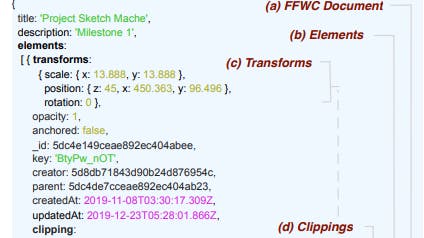
The environment stores design representations in the cloud, as JSON, including semantic information, such as position (x and y), width, height, and any transforms applied to the constituent elements (Figure 2). As Jain et al. [40] describe: [The multiscale design document] consists of a collection (Figure 2.a) of content elements (Figure 2.b), each with graphical transformations (Figure 2.c). The document level (Figure 2.a) also stores properties, including title, description, key (used in web URL), id (a unique internal identifier), settings (visibility and background color), and creator. [The design environment] associates the extracted semantics with a reference to the collected element, which is together referred to as the clipping within an element (Figure 2.d).
Authors:
(1) Ajit Jain, Texas A&M University, USA; Current affiliation: Audigent;
(2) Andruid Kerne, Texas A&M University, USA; Current affiliation: University of Illinois Chicago;
(3) Nic Lupfer, Texas A&M University, USA; Current affiliation: Mapware;
(4) Gabriel Britain, Texas A&M University, USA; Current affiliation: Microsoft;
(5) Aaron Perrine, Texas A&M University, USA;
(6) Yoonsuck Choe, Texas A&M University, USA;
(7) John Keyser, Texas A&M University, USA;
(8) Ruihong Huang, Texas A&M University, USA;
(9) Jinsil Seo, Texas A&M University, USA;
(10) Annie Sungkajun, Illinois State University, USA;
(11) Robert Lightfoot, Texas A&M University, USA;
(12) Timothy McGuire, Texas A&M University, USA.
This paper is