


Disclaimer: The following is a work of fiction; any resemblance to real companies, systems, or individuals is purely coincidental.
The air in the lab smelled of ozone and floor polish. A sterile, charged scent. I clicked the anti-static wrist strap onto the grounding point of the workbench. Habit. On the pallet next to me sat ten thousand gray boxes. Ten thousand XC-77B microcontrollers, the new backbone for our drone guidance systems. My job was simple: verify the shipment is what it says it is.
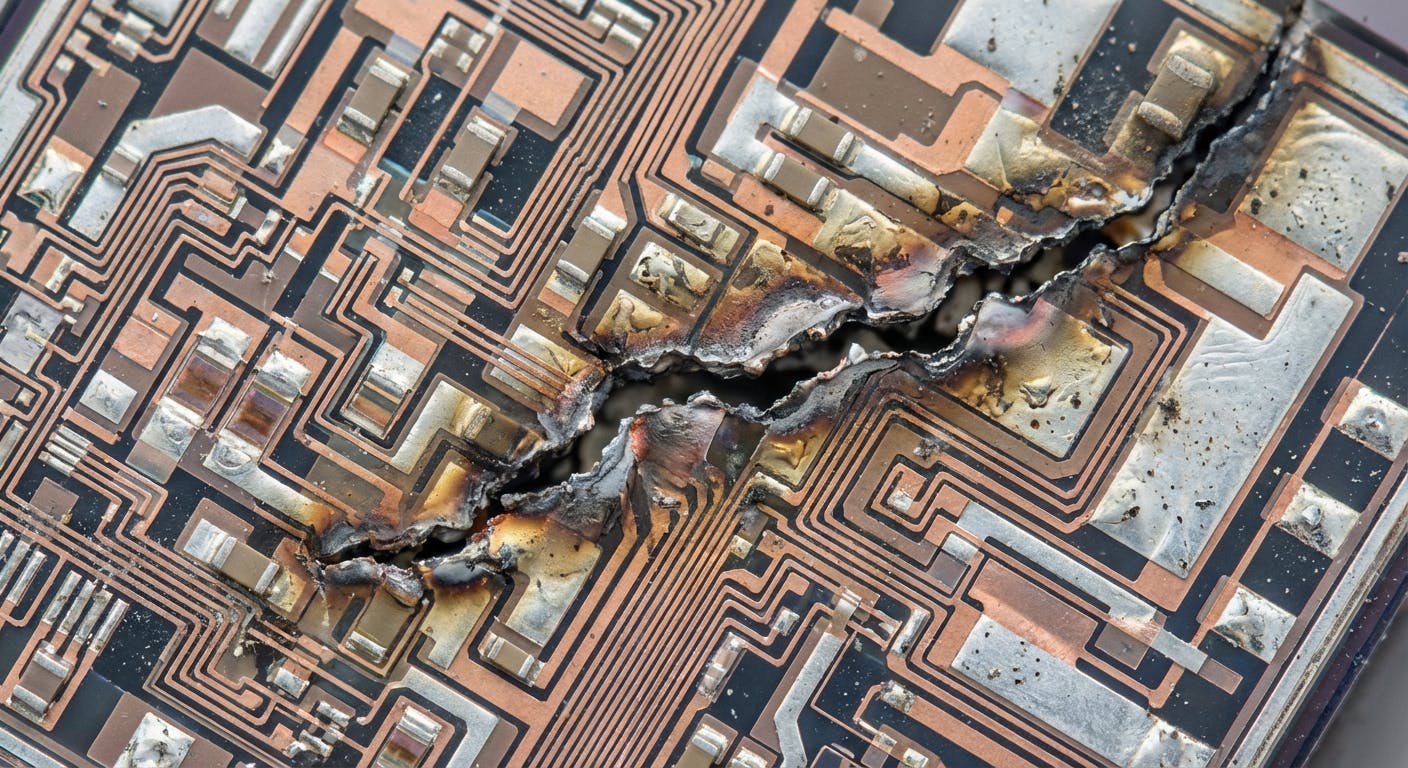
I selected a unit at random, pried the plastic casing open with a spudger, and placed the small, black chip onto the stage of the electron microscope. The machine hummed, focusing. On the monitor, the silicon die resolved into a microscopic city of pathways and gates. The company logo—a stylized falcon—was perfect. The lithography was clean. But something felt wrong. I zoomed in on the batch number etched near the edge. I pulled up the manufacturer's spec schematic on a secondary monitor.
The font was off. The curve of the '5' was a fraction too sharp. The entire string of characters was maybe a single micrometer too condensed. It was nothing. A variance in the etching mask. A new factory. But it was enough.
Paranoia is a survival trait in this business.
I moved the chip to the benchmark rig, my hands steady as I soldered it to the test board. The system booted. All standard diagnostics passed. Green lights across the board. Then I ran the stress test. I pushed the clock speed, watching the thermal sensors and the voltage monitors. The spec sheet for the XC-77B is burned into my memory. It should have started throwing errors at 1.2 GHz. It should have failed completely by 1.3.
It screamed past both without a whisper of protest. It held stable at 1.45 GHz. A full 20% faster than it had any right to be. That's not a manufacturing anomaly. That's a different class of silicon.
My blood ran cold. This wasn't a cheap knockoff. Counterfeits are always worse. They cut corners, use inferior wafers, and fail below spec. This was an upgrade, meticulously packaged and labeled to look like a common, off-the-shelf component. A supply chain injection. But why?
I pulled the data from the benchmark and formatted it into a comparison table. The numbers didn't lie.
|
Parameter |
Manufacturer Spec (XC-77B) |
Observed Benchmark Results |
|---|---|---|
|
Max Clock Speed |
1.2 GHz |
1.45 GHz |
|
Thermal Threshold |
95°C |
92°C |
|
Power Draw (Idle) |
0.05W |
0.03W |
|
Lithography Node |
28nm |
14nm (Est.) |
|
Undocumented Logic |
None |
Detected |
That last line confirmed it. I ran a deep power analysis, a differential test that hunts for logic gates that aren't on the official schematic. The scan revealed a dormant circuit, a secondary path that drew an infinitesimal amount of power only when it received a highly specific, encrypted radio signal. It wasn't a flaw. It was a feature.
A physical kill switch, baked directly into the hardware. A silicon Trojan.
The lab door hissed open. It was Meyers, my department head. He had a chipper, salesman-like energy that always set my teeth on edge. He was the one who had pushed through this new supplier, citing "significant cost savings."
"Morning, Alex," he said, gesturing at the pallet with his chin. "How's our new batch of chips? QC clear yet? Assembly line is waiting."
My heart pounded against my ribs. I looked from the glowing Detected on my screen to the forced smile on his face. If he knew, telling him was a death sentence. If he didn't, I was about to let an enemy army march through our front gate.
"Just finishing the final stress test now, sir," I said, my own voice sounding alien and calm. "Everything is well within spec. No issues."
He clapped me on the shoulder, a little too hard. "Attaboy. Sign the manifest. Let's get them moving." He turned and left.
I stood there for a long moment, the hum of the server racks filling the silence. I picked up the digital stylus, my hand not shaking. On the tablet, I scribbled my signature next to the word APPROVED. Across the room, the status light on the pallet of ten thousand traitors switched from amber to green.
As I stood up, my hand slipped over the workbench, closing around the warm, black square of silicon. The sample. It felt heavy in my palm as I slid it into the pocket of my lab coat. The anti-static baggie made a soft, conspiratorial crinkle.