How perfectly reasonable product practices combine into a system that ships nothing
Every large organization eventually invents a way to stop itself.
Not through incompetence or bad intent, but through a slow, reasonable accumulation of processes — each defensible on its own, paralyzing in aggregate.
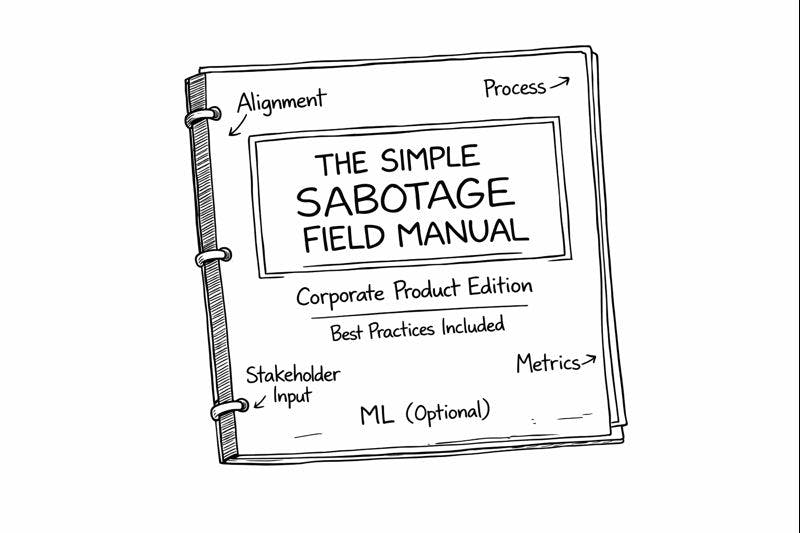
In 1944, the U.S. Office of Strategic Services produced a document called the Simple Sabotage Field Manual. It was written for civilians living under occupation, with a serious and explicit purpose: to quietly slow hostile organizations through small, non-violent actions that appeared diligent, procedural, and responsible.
What makes the document unsettling today is not its history.
It’s how closely it resembles modern product culture — without anyone intending it to.
Today, we don’t need a manual.
We have best practices.
Not a Manual. A Mirror.
The original document encouraged behaviors that looked harmless, even virtuous:
- expanding discussions
- insisting on precise wording
- reopening settled decisions
- multiplying approvals
- prioritizing procedure over action
In wartime, these were deliberate tactics.
In product organizations, they tend to emerge naturally — as side effects of professionalism, risk management, and the sincere desire to be thorough.
No one is sabotaging anything.
Everyone is being careful.
And yet, the outcomes are indistinguishable.
The Saboteur’s Daily Stand-Up
An Operational Briefing
9:00 AM — The Feature Exists
At 9:00 a.m., the feature is beautiful.
It has validated designs, a clear problem statement, and a confident Jira epic with a due date that feels just real enough to be repeated in a status meeting.
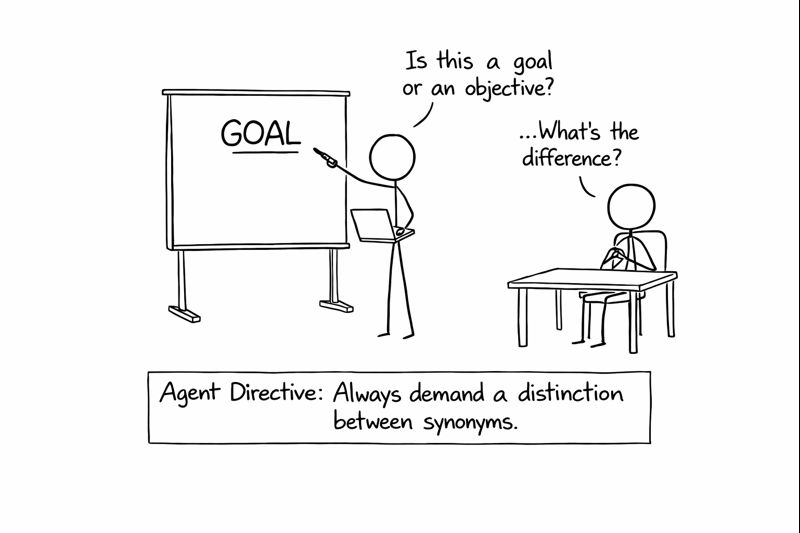
By 9:06 a.m., someone asks whether the roadmap is directional or committed.
Nothing changes.
But the distinction must be discussed.
Agent Directive: Always demand a distinction between synonyms. If the team agrees on a goal, ask for an objective. If they provide an objective, ask for a vision. Precision is progress.
10:05 AM — The Edge Case Appears
Design is approved.
Engineering is ready.
QA is cautiously hopeful.
Then a voice from the corner asks:
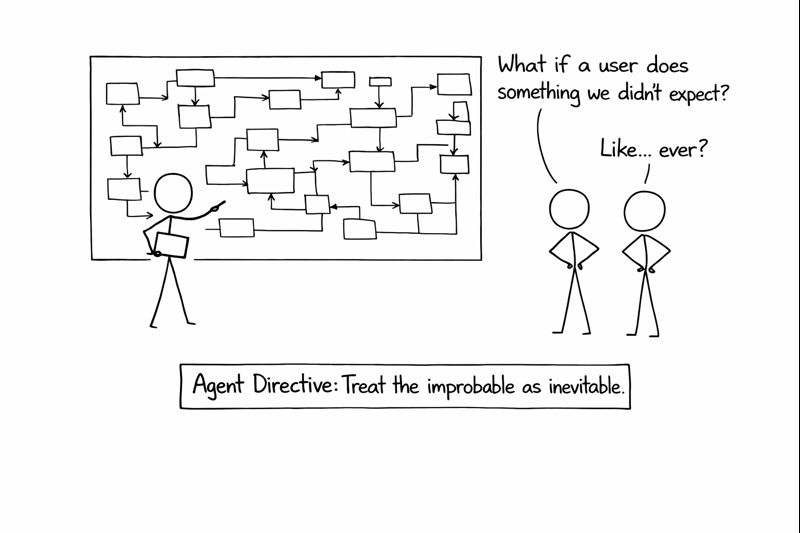
“What happens if a user on a legacy browser, in a market we don’t support, refreshes their authentication during a partial outage?”
The room goes silent.
A spike is scheduled.
Agent Directive: Treat the improbable as the inevitable. If you can imagine it, you can block it. Remember: it is better for a thousand users to wait than for one hypothetical user to be mildly inconvenienced.
11:40 AM — The Alignment Hydra
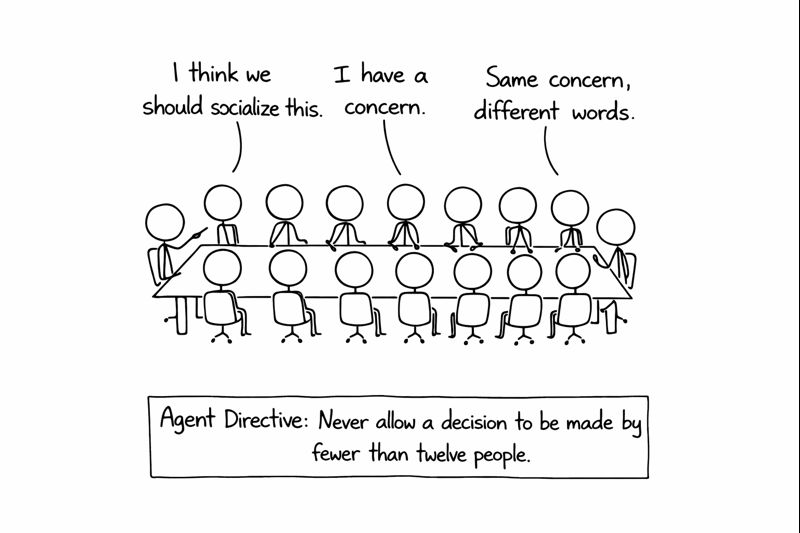
“I think we should socialize this,” says the stakeholder.
Four more people are added to the invite.
One joins late and asks a question that resets the discussion to 9:00 a.m.
Everyone agrees the idea is “strong,” but with “open questions.”
These questions are documented carefully and never answered.
Agent Directive: Never allow a decision to be made by fewer than twelve people. If consensus is reached, express a vague concern about the optics and suggest a follow-up.
1:10 PM — The Metrics Interlude
Someone asks how success will be measured.
This is reasonable.
Unfortunately, the question arrives after the solution has already been chosen.
Now the feature requires:
- new instrumentation
- schema changes
- a debate about whether the metric reflects true user value
The metric will be debated longer than the feature will ever be used.
Agent Directive: Demand metrics only after commitment. Then question whether those metrics capture the real outcome until momentum expires.
2:20 PM — The Machine Learning Pivot
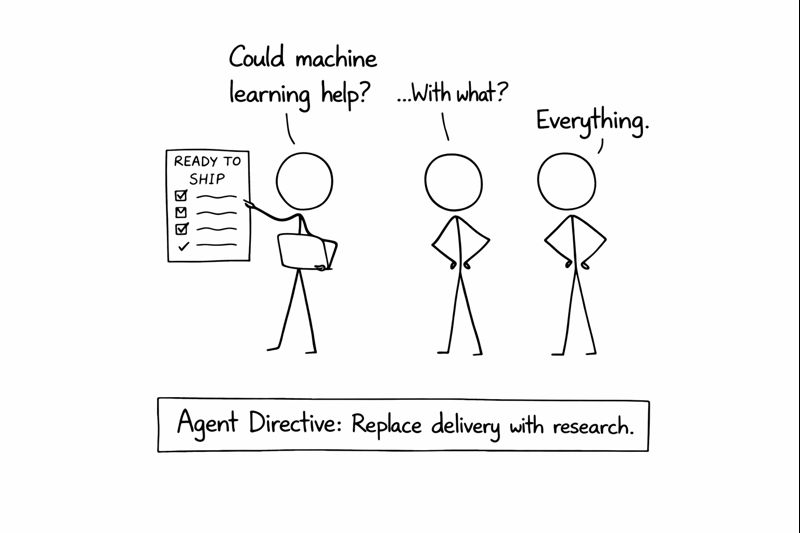
Someone asks whether machine learning could help.
Not because the problem requires it — but because ML:
- sounds forward-looking
- delays commitment
- converts delivery timelines into research horizons
The feature now depends on a model that does not exist.
Agent Directive: If a project nears completion, introduce an unproven technology. This ensures the how replaces the why until the budget runs out.
3:50 PM — Jira Is Thriving
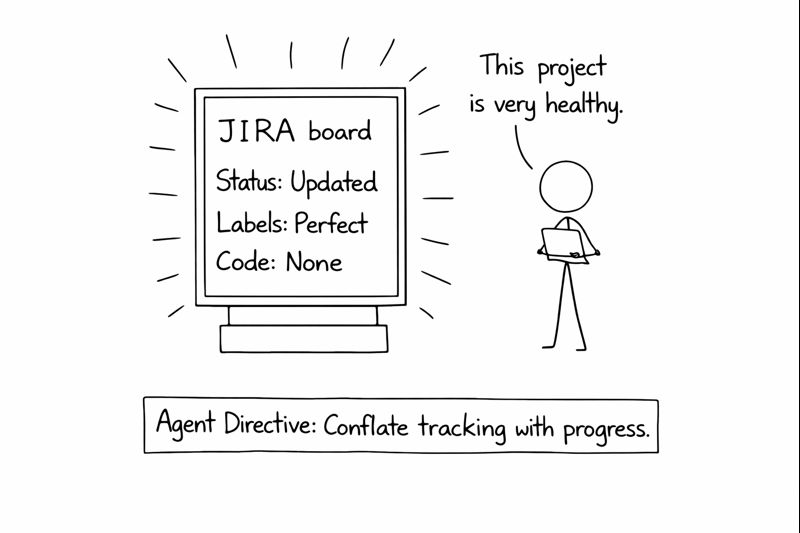
The tickets are pristine.
Story points are mapped.
Labels are consistent.
Dependencies are documented.
No code has been merged.
But the metadata is world-class.
Agent Directive: Conflate updating the tracker with doing the work. A healthy Jira board is the ultimate camouflage for a stagnant project.
5:15 PM — Status Update: At Risk
The status moves from On Track to At Risk.
This is praised as transparency.
No one remembers when it was last On Track.
The Sabotage Paradox
Why This Always Looks Like Professionalism
The most effective organizational sabotage doesn’t look like a wrench in the gears.
It looks like a high-resolution dashboard.
It sounds like professionalism.
It feels like responsibility.
It doesn’t stop ideas.
It preserves them indefinitely, in a state of continuous refinement.
Why This Happens
Because in most product organizations:
- shipping creates risk
- delay feels safe
- artifacts are rewarded
- outcomes are abstract
A meeting is safer than a decision.
A dashboard is safer than ownership.
Alignment is safer than action.
The Uncomfortable Ending
If this sounds familiar, don’t worry.
You’re not surrounded by spies.
You’re in a system where the role of the saboteur rotates.
Today, it was the stakeholder.
Tomorrow, it’s the engineer.
Next week, it’s you — asking for*“just a bit more clarity,”* and meaning it.
Final Thought
The Simple Sabotage Field Manual was written to weaken hostile systems.
We didn’t adopt it deliberately.
We reinvented it naturally.
[story continues]
tags