


There are a lot of translation tools available today, and most of them are free. Open your phone, launch Google Translate, and you already have a perfectly functional solution in your pocket. That’s why devices like the iFlytek AI translation earbuds fall into a category I’m very familiar with reviewing: luxury tech.
Luxury tech is not about necessity. It’s about experience.
Nobody needs a VR headset, an AR headset, or premium peripherals for niche use cases. But for enthusiasts and frequent travelers, the right device can dramatically improve the experience. At roughly $150 USD and up, these translation earbuds clearly aren’t trying to compete with free apps. Instead, they’re trying to make translation feel seamless.
So I approached this review the same way I would approach something like a VR peripheral: judging it not against free tools, but against the experience it promises to deliver.
Disclaimer: I have not been paid or compensated to do this review. These opinions reflect my true experience iwth the product. I have, however, received the product for free to test in this review.
Language Covered: For the purpose of this review I tested the tech’s capabilities translating Japanese to English and vice versa since I live in Japan and speak both languages.
The Packaging
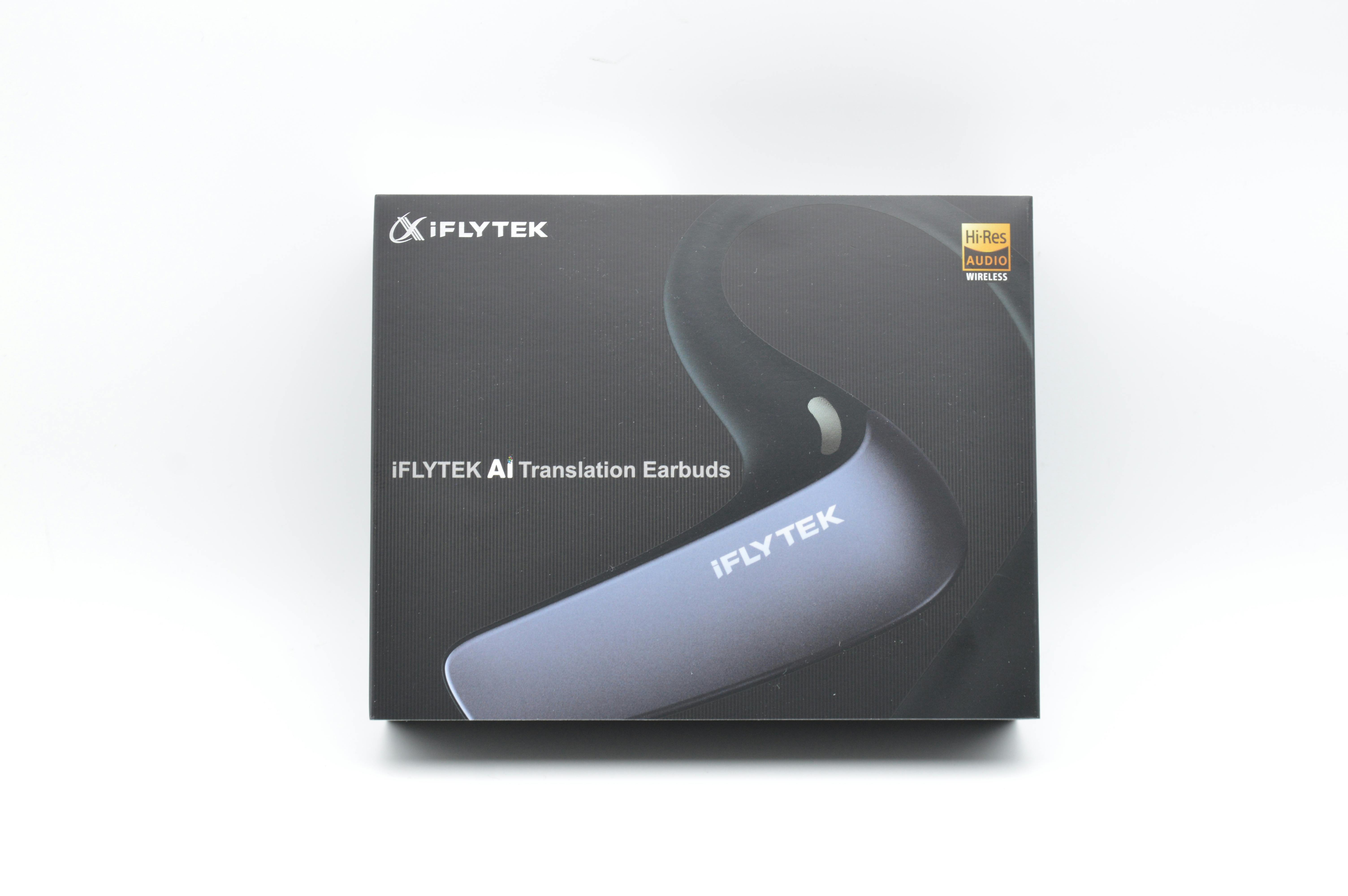
The first thing that stood out to me was the packaging. I know that sounds nitpicky, but when it comes to luxury tech it matters.
I still remember when I first bought the original Oculus Quest, the world’s first standalone VR headset. Before I even opened it, just holding the box felt different. The packaging had this combination of matte and glossy textures that almost felt like holding the case of a luxury watch. There was no cheap cardboard or blurry printed packaging — it immediately signaled that this was a premium product.
iFlytek clearly put effort into their packaging as well.
When you pick up the box, you can immediately feel that iFlytek put real effort into the presentation. The packaging has a noticeable weight to it and uses higher-grade materials than the typical cheap cardboard you often see from mass-produced tech products. It gives off that subtle signal that this is supposed to be a premium device, not just another gadget thrown into a thin box.
That said, it doesn’t quite reach the level of the best packaging I’ve seen in the tech world.
Companies like Angry Miao have set an almost ridiculous standard when it comes to packaging design. Their products feel like you’re unboxing a collector’s item. Even Oculus, back in the early days of the Quest, delivered that same premium feel where the packaging itself felt like part of the experience.
If I had to score it, Angry Miao is a 10 out of 10 when it comes to packaging and presentation.
iFlytek lands somewhere around a very respectable 7.5.
It’s clearly premium, clearly intentional, but it doesn’t quite deliver that “wow” moment when you first open it.
Once you actually start setting the device up though, things get much more impressive.
How The Earbuds Work
For these to work, you must have a modern smartphone (iOS or Android) and download the Bavvo app by iFlytek. This is the app the powers the translation. The earbuds are essentially a speaker and microphone to take in the input language with special features and design to aid translation.
Once the app is setup and the earbuds connected there are 3 main modes:
- Simultaneous interpretation
- Live translation
- Immersive translation
Simultaneous Interpretation
The concept is simple but incredibly clever. Each person wears one earbud, and during setup you assign the input language for each earbud. One earbud listens for one language, and the other listens for the other language. From there, the system translates the conversation in real time.
And surprisingly… it just works.
You can tell a lot of thought went into the UX design of these earbuds.
Once both people are wearing an earbud and the languages are assigned, the system essentially handles the rest. Each earbud listens for its assigned language and outputs the translated result directly into the other person’s ear. There’s no passing a phone back and forth, no awkward tapping through menus, and no interruption to the flow of conversation.
In terms of concept and design, this is exactly what I imagined AI translation would look like one day. And that day is finally here!
The problem isn’t the design.
The problem is speed.
Speed and Performance
In a one-on-one conversation setting, the translation lag is usually around two to three seconds. Technically speaking that’s incredibly impressive. As someone who is developing LLM-powered tech, this feat is outstanding. But in practice to the everyday person, this lag will feel surprisingly awkward.
If you’re sitting across from someone having a conversation, three seconds of silence feels much longer than it actually is. You say something, and then both of you are just sitting there staring at each other while the translation processes.
If a human interpreter isn’t available, this is absolutely the next best thing. In fact, it’s still faster and smoother than using a phone translation app where you constantly pass the device back and forth.
But that moment of silence — even if it’s only a few seconds — makes the interaction feel slightly unnatural.
And that’s where AI translation still has a hurdle to overcome.
To really understand how impressive this device is, you have to look at where translation technology was just a few years ago.
Around three years ago I reviewed the Pocketalk translator, which at the time felt incredible. But the experience was still very much device-based translation. You spoke into the device, waited for it to process, then handed it over so the other person could respond. It worked, but it never felt like a natural conversation.
Fast forward to today and the iFlytek earbuds are doing something much more ambitious: two languages being input and output simultaneously between two people. From a technical standpoint, it’s exactly what we always hoped would be possible, like the Tower of Babel in real life.
The fact that the system can listen, process the speech, translate it, and deliver the result in about three seconds is genuinely impressive.
But here’s the strange reality that AI-tech companies need to face: they’re not competing against where technology used to be.
They’re competing against human experience.
In a normal conversation, people respond instantly with head nods, sounds of acknowledgement, etc.. Even a small pause feels noticeable. So when a device introduces a two to three second delay, it creates a rhythm that feels very unnatural, not slightly, VERY.
Because of that, I don’t think devices like this will become household everyday tech just yet.
This is because human conversation is incredibly fast, and AI translation still has a little catching up to do.
While the delay prevents this from feeling perfectly natural in a face-to-face conversation, there are still plenty of situations where these earbuds make a lot of sense.
In fact, if you’re someone who travels abroad regularly, this might actually be one of the best use cases for the device, because you have no better option other than to learn the language.
Normally when you’re traveling in another country and don’t speak the language, you end up relying on Google Translate. That usually means pulling out your phone, typing or speaking into it, showing the screen to the other person, and then waiting for them to respond so you can repeat the process again.
It works, but it’s clunky.
The iFlytek earbuds remove a lot of that friction. Instead of shoving a phone into someone’s face and asking them to speak into it, you can actually have a somewhat normal conversation. The other person hears the translation in their ear, you hear the translated response in yours, and even with the 2–3 second delay, it still feels much smoother than the back-and-forth of phone translation apps.
But the moment that really blew me away wasn’t during a conversation.
It was when I tried live translation while watching the news.
This is a use case where the small delay suddenly doesn’t matter at all.
Live Translation
This is the mode everyone is used to. You start the app and as things are being said, it is being translated instantly. This is akin to starting google translate while someone is speaking. The main difference is there’s a limit to how much google translate will take in at a time. The iFlytek earbuds can go on indefinitely until the batteries run out.
This is where the tech shined. Using it to listen to the news was a great experience. The tech was accurate and the delay between input and output was minimal enough to be great for this use case.
When I turned on the live translation feature while watching the news, that’s when the device suddenly made a lot more sense.
Unlike a one-on-one conversation, watching something like a news broadcast doesn’t require an immediate response. A couple of seconds of delay doesn’t really matter because you’re not trying to reply to the speaker — you’re just trying to understand what’s being said.
In that situation, the earbuds worked incredibly well. The translated audio came through naturally enough that I could follow along with the broadcast without constantly looking at subtitles or pausing to check my phone.
This also opens up some really interesting use cases.
For example, imagine visiting a museum or planetarium in another country where all the explanations are being given in a language you don’t understand. With something like this, you could listen to the translation directly in your ear and still experience the presentation in real time.
The same goes for things like lectures or educational talks.
However, there are still limits to where this technology works well
Forms of entertainment where timing is critical — like stand-up comedy or movies in a theater — don’t translate nearly as well. A joke that lands three seconds late usually isn’t funny anymore, and hearing dialogue after the moment has already passed can break the immersion of a film.
So while the technology is impressive, context matters a lot.
Translation Quality Japanese - English
When it comes to translation quality, the results were surprisingly solid most of the time.
No translation system is perfect, and that’s true here as well. There were moments where the earbuds misheard a word or repeated a phrase in a slightly awkward way. Occasionally a sentence would come through sounding a bit robotic or structured differently than how a native speaker would normally phrase it.
That said, these situations were relatively rare.
The majority of the time the system was about 90% accurate in terms of both recognizing what was said and producing a correct translation on the other side. In most casual conversations that level of accuracy is more than enough to get the point across.
Immersive translation
This feature was interesting but I didn’t fully grasp when/how it would be useful.
This features allows you to essentially overlay the translation app over your phone screen and translate other apps in real time.
One feature I appreciated was that the app shows the recognized speech on-screen in real time. So if the system mishears something or picks up background noise incorrectly, you can quickly see the mistake before the translation causes an awkward misunderstanding.
If something looks wrong, you can simply pause the translation and start again, which acts as a nice safety net in situations where accuracy really matters.
Unfortunately, the only real technical issue I encountered came during the initial setup.
Unfortunately, I did run into a technical hiccup during the initial setup.
When pairing the earbuds with my iPhone 15 for the first time, the phone recognized each earbud as a separate device instead of a single unit. Because of that, I could only hear audio through one earbud at a time. It was a bit confusing at first and made the device feel like it wasn’t working properly.
After a few resets, disconnects, and reconnecting the Bluetooth pairing process, the iPhone eventually recognized them correctly as one device and everything worked normally after that.
Once the connection issue was resolved, the overall experience was quite smooth. The translation system works reliably, the UX is extremely well thought out, and the idea of two people each wearing one earbud for real-time conversation is honestly one of the most elegant approaches to translation I’ve seen.
The biggest limitation is still the 2–3 second delay. Technologically speaking that’s incredibly impressive, but from a human conversation standpoint it still creates a slightly awkward rhythm.
Because of that, I don’t see devices like this replacing human interpreters anytime soon.
However, for frequent travelers, tech enthusiasts, or anyone who regularly finds themselves navigating foreign languages, the iFlytek AIH 2542 earbuds offer a genuinely futuristic experience that’s far more natural than using translation apps on your phone.
It’s not perfect yet.
But it’s a very exciting glimpse at where real-time AI translation is heading.