(1) Samir Chitnavis, School of Biological and Behavioural Sciences, Queen Mary University of London, Mile End, London E1 4NS, UK & Digital Environment Research Institute, Queen Mary University of London, Empire House, Whitechapel E1 1HH, UK;
(2) Thomas J. Haworth, Astronomy Unit, Queen Mary University of London, Mile End Road, London E1 4NS, UK;
(3) Edward Gillen, Astronomy Unit, Queen Mary University of London, Mile End Road, London E1 4NS, UK;
(4) Conrad W. Mullineaux, School of Biological and Behavioural Sciences, Queen Mary University of London, Mile End, London E1 4NS, UK;
(5) Christopher D. P. Duffy, School of Biological and Behavioural Sciences, Queen Mary University of London, Mile End, London E1 4NS, UK & Digital Environment Research Institute, Queen Mary University of London, Empire House, Whitechapel E1 1HH, UK (Email: c.duffy@qmul.ac.uk).
Table of Links
- Abstract and Introduction
- 2 Methodology
- 2.1 Local spectral irradiance as a function of stellar temperature
- 2.2 Thermodynamic model of an oxygenic light-harvesting system
- 2.3 Lattice model of an oxygenic light-harvesting system
- 3 Results
- 3.1 Orbital distances and incident spectral fluxes
- 3.2 Thermodynamic antenna model: Increasing antenna size in limited PAR
- 3.3 Lattice antenna model: Increasing the size of a “flat” antenna in limited PAR
- 3.4 Lattice antenna model: Improving antenna efficiency with an energetic ’funnel’
- 4 Discussion
- Acknowledgements, Author Contribution Statement, Authors disclosure statement and References
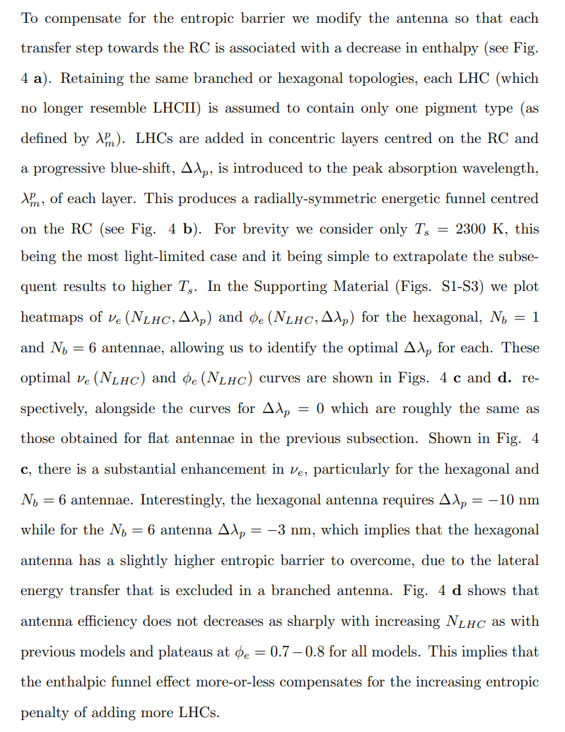
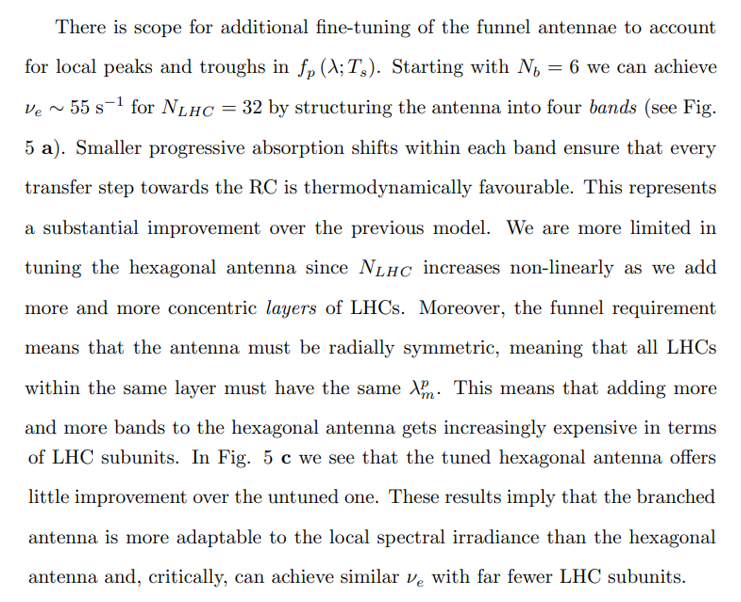
3.4 Lattice antenna model: Improving antenna efficiency with an energetic ’funnel’
This paper is available on arxiv under CC 4.0 license.
[story continues]
tags