


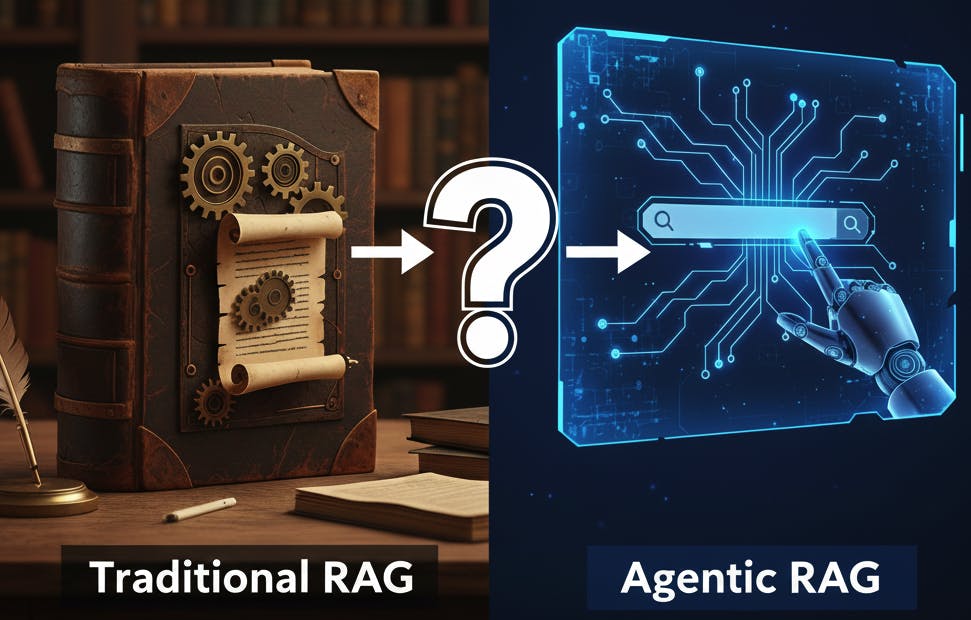
Retrieval-Augmented Generation (RAG) has emerged as a foundational architecture for grounding large language models (LLMs) using external knowledge. However, as tasks become more complex, traditional RAG pipelines show structural limitations: static retrieval, single-step generation, and an inability to refine or reason over multi-stage tasks. Enter Agentic RAG, an upgraded version of traditional RAG. The agentic RAG blends RAG with agentic AI autonomy.
This article provides a comparative analysis between Traditional RAG and the emerging Agentic RAG paradigm.
If you’re new to RAG or Agentic RAG, this article provides an overview and key differences in under 5 minutes.
Introduction
RAG systems were initially designed to correct one critical failure mode of LLMs: hallucination. By grounding the model with retrieved documents, RAG improves factual accuracy and domain alignment. Yet, as LLM applications extend into research assistance, multi-source evidence synthesis, and iterative reasoning, the deficiencies of traditional retrieval-then-generate pipelines become evident.
Agentic RAG extends the architecture with a higher-order control layer—agents capable of planning, tool use, multi-step refinement, and adaptive retrieval. Rather than treating retrieval as a one-time action, agentic RAG incorporates retrieval as an iterative and dynamic component.
Traditional RAG Architecture
Stages
Traditional RAG is fundamentally a static two-stage pipeline:
- STEP 1: Query → Retrieve relevant documents
- STEP 2: Documents + Query → Generate answer
A typical traditional RAG generally has the following components:
- Embedding model: Converts query into a dense vector.
- Vector database: Returns top-K similar documents.
- LLM: Consumes retrieved documents to generate output.
Strengths
Like everything, traditional RAG has some strengths, such as:
- Simple to implement
- Low latency
- Predictable computational cost
- Effective for FAQ-style or direct knowledge lookup tasks
The main advantage would be: low latency and predictable cost.
Limitations
And, like everything, traditional RAG also suffers from some limitations, such as:
- Retrieval happens once, even if the initial retrieval is poor
- Cannot decompose multi-step tasks
- No reasoning feedback loop
- Treats retrieval and generation as passive components
- Weak for ambiguous, exploratory, or multi-document synthesis tasks
Agentic RAG Architecture
While traditional RAG stays popular, the agentic RAG comes into the picture to address some of the limitations observed in traditional RAG.
Agentic RAG introduces an active control loop. Instead of “retrieve then generate,” it turns RAG into a multi-agent reasoning system with planning, reflection, and tooling. Unlike traditional RAG, which had two fixed steps, Agentic RAG doesn’t have a defined number of steps. Agentic RAG takes as long as it needs to come up with a good response. Nobody can predict how much time it’ll take, or how many times it’ll iterate before a satisfactory answer is obtained or some limits are hit.
In short, Agentic RAG means autonomous RAG.
Core Characteristics
Agentic RAG systems can:
- Plan multi-stage tasks
- Decide when to retrieve more information
- Evaluate whether the retrieved data is sufficient
- Call external tools (search engines, APIs, databases)
- Refine output iteratively
- Use memory or intermediate scratchpads
Architecture Overview
The agentic RAG architecture is significantly more complex compared to traditional RAG. Agentic RAG consists of several agents that play their specific roles in arriving at a satisfactory answer to the user’s query. There are no standard components in Agentic RAG architecture.
Typical components in agentic RAG are:
- Planner agent
- Retrieval agent
- Reasoning agent/LLM
- Tool-calling layer
- Feedback loop that evaluates the adequacy of knowledge
The diagram depicts the architecture in a simplified way. The order of agents need not be like this. Likely, there would be a coordinator/orchestrator between these agents. However, the main idea is that the Agentic RAG is autonomous. It keeps working on the problem till a satisfactory solution is reached.
As mentioned earlier, there are no well-defined steps, but there is a loop:
Strengths
Though Agentic RAG is significantly more complex than traditional RAG, it does have some advantages:
- Adaptive retrieval improves factual accuracy
- Handles multi-step reasoning and decomposition
- Can synthesize across multiple knowledge sources
- More resilient to noisy or incomplete retrieval
- Supports tool use (calculators, search APIs, domain systems)
Limitations
Likewise, there are limitations too:
- Higher latency due to iterative loops
- Greater complexity in design and debugging
- Harder to guarantee deterministic workflows
- Requires careful guardrails to avoid unnecessary tool calls
- Computationally more expensive
Comparative Analysis
Having understood the basics of traditional vs agentic RAG motivation, architecture, and design, let’s go over some point-by-point comparison between them.
Retrieval Behavior
Traditional RAG
- Static retrieval: One query, one vector search
- No internal mechanism to assess retrieval quality
- Retrieval errors propagate directly to the final answer
Agentic RAG
- Iterative retrieval: Agents can refine or expand queries
- Retrieval processes can branch or self-correct
- Retrieval quality is evaluated through reflective or utility-based checks
Reasoning Process
Traditional RAG
- Mostly reactive
- LLM reasons once with available documents
- No task decomposition
Agentic RAG
- Supports planning, sub-goal creation, and task breakdown
- Uses chain-of-thought or tool-based reasoning
- Can orchestrate multi-step evidence gathering
Tool Integration
Traditional RAG
- Tools (if any) are manually integrated
- The pipeline is rigid
Agentic RAG
- Tools become first-class citizens
- Agents decide which tool to invoke
- Enables hybrid knowledge workflows (API → retrieval → LLM → reasoning)
Latency & Performance
Traditional RAG
- Lower latency
- Suitable for real-time or near-real-time systems
- Predictable cost
Agentic RAG
- Latency varies with the number of iterative steps
- Higher compute and retrieval load
- Requires optimization (limits, timeouts, step caps)
Complexity & Maintainability
Traditional RAG
- Simple to maintain
- Fewer dependencies
- Single-point debugging
Agentic RAG
- Requires monitoring each agent's decisions
- Emergent behaviors can complicate debugging
- Requires orchestration frameworks
Use Cases
At this point, it is understandable that both traditional RAG and Agentic RAG have their own places. Agentic RAG, due to its non-deterministic nature, is unlikely to replace traditional RAG in a sweep. The use case must demand that level of sophistication. Agentic RAG is promising, but at a cost.
Now that we’ve learnt a great deal about them, let’s turn to some use cases where they shine:
|
Task Type |
Traditional RAG |
Agentic RAG |
|---|---|---|
|
FAQ chat |
Excellent |
Overkill |
|
Document lookup |
Excellent |
Good |
|
Research assistance |
Weak |
Excellent |
|
Data synthesis |
Medium |
Excellent |
|
Workflow automation |
Not suitable |
Ideal |
|
Complex analysis |
Weak |
Strong |
When to Use Each Approach
Use traditional RAG when:
- Tasks involve direct retrieval
- Latency requirements are strict
- Infrastructure simplicity matters
- User queries are predictable and similar
Use agentic RAG when:
- Tasks require multi-document synthesis
- Retrieval needs refinement (e.g., ambiguous queries)
- Applications call external tools or APIs
- Tasks involve reasoning beyond one-shot answers
- Human-like research or investigation workflows are needed
Conclusion
Traditional RAG remains a robust, efficient, and production-ready approach for tasks centered on direct knowledge retrieval. Its simplicity and predictability make it the right fit for many mainstream applications.
Agentic RAG, while more complex, represents the natural evolution of RAG systems. By introducing dynamic retrieval, planning, tool use, and iterative refinement, it enables LLMs to handle tasks that mirror human research and reasoning processes. However, organizations must carefully evaluate complexity, latency, and cost before adopting agentic architectures.