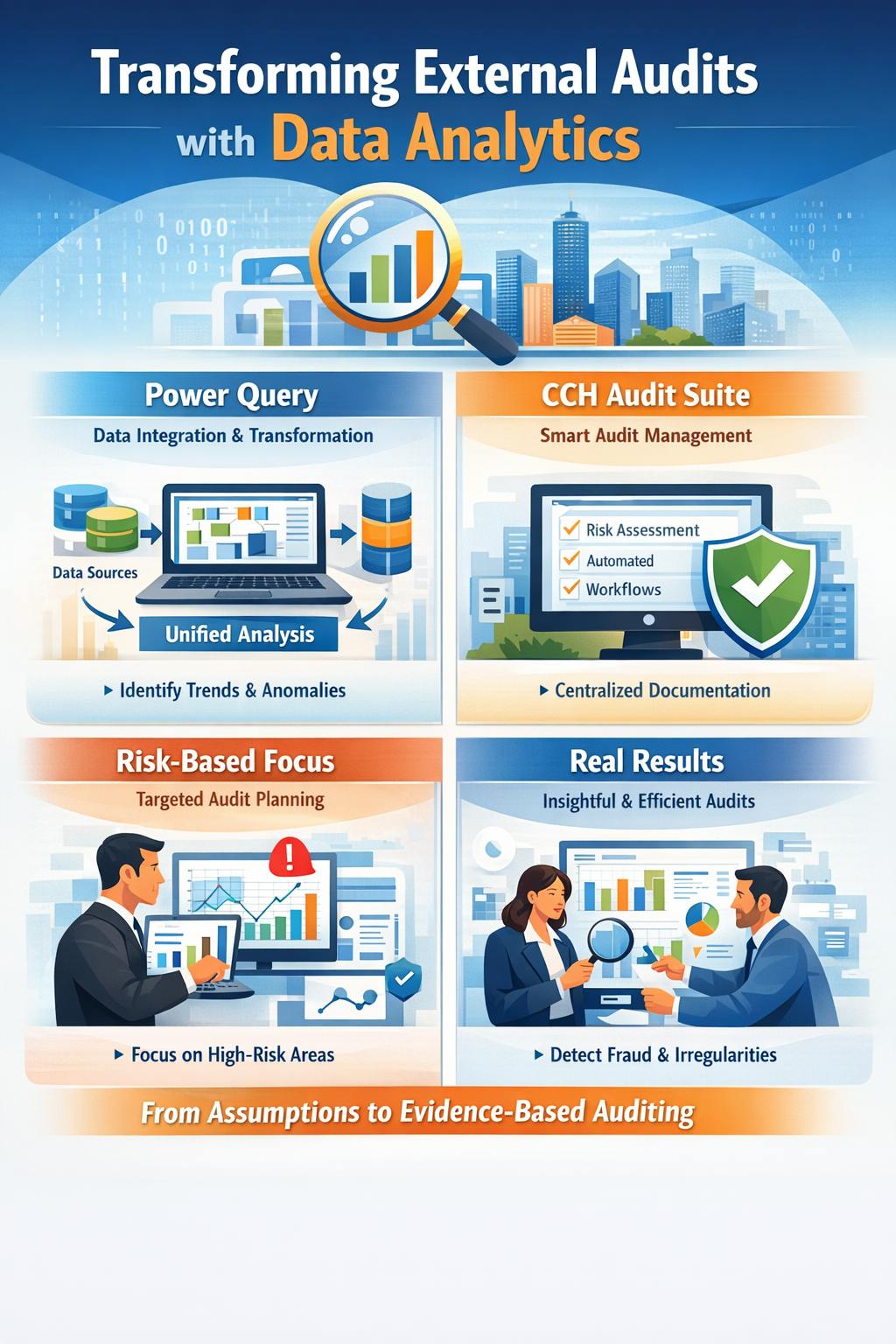
One of the factors of financial management that is important is the external audit since it gives an independent assurance that the financial statement of an organization is accurate and reliable. The process of finding the audit planning was traditionally carried out by using past workpapers, assumptions and sampling. The general approach adopted by these teams was the experience and gut feeling, which was inefficient and often overlooked risks. But this is changing. Data analytics is also making the auditors reconsider planning and carrying out the auditing process. They are no longer applying guesswork, but instead use data to tailor audit plans which are more accurate, less time-consuming, and smarter to guide their audits.
From Assumptions to Evidence
There is no need now to make narrow samples or use outdated records of the past years in order to carry out external audit. The analytics will allow the auditors to initiate full data digging before the fieldwork is conducted. The tendencies previously hidden are brought out. The variation in the expense accounts, the period of the recognition of the revenue, the number of transactions were not the ones that can be ascertained manually anymore. They are done at the acute youth level on an automatic basis. Such a plan will result in improved discussion with clients, more targeted audit plans, and risk evaluation based on current realities rather than assumptions.
The data analytics allow the auditors concentrate on the high risk transactions or accounts with irregularities compared to the rest rather than random sampling on transactions in the regions. The data analytics will allow the auditors to concentrate on the problems that matter. It anticipates and funds are saved in case of deviation of a given account. What has been actualized is rather a history planning process with the current risk profile and in comparison to attachment to the past.
Power Query: The Quiet Workhorse
The most significant thing about the transition is the data transformation tool which is effective and known as Power Query from Microsoft. It does not specifically emphasize taking it in the audit procedure, but it is one of the key tools the contemporary audit teams should keep in mind, as it is flexible and possibilities to work with it. It enables the auditors to create information with a high number or significant number of sources, summarize and convert them to a format that is easy to analyze without a lot of strain. There are five systems of clients, and each of them exports their financial data differently. Power Query will help an auditor to unify and access data from different systems in a single form and identify trends and anomalies that can serve as indicators of areas of concern. This freedom of degree will be invaluable in the interaction where the complex business or global organization is involved.
The capability to process full datasets is among the finest qualities of Power Query as it is free from the flaws of small-sample analysis. In the traditional sampling, in most cases, the red flags can be walked off without being realized because the selected sample is not focusing on the red flags. Through the assistance of Power Query, it will demonstrate the option to explore the entire data set and not to remain focused on the serious threats. It also removes subjectivity that will always be encountered through the manual selection and this makes the auditors more confident with their findings.
The CCH Advantage in Audit Planning
So long as the interest of auditors in acquiring a specific solution tailored to external audits is high, the CCH suite will provide an integrated system that simplifies risk assessment, documentation, and resource management. It does not just mean that the checklists will be automatized. It also co-locates all the requirements of risk assessment, resource management, and documentation control to be under one environment. This system also facilitates the concerned risk analysis that allocates the risk scores to the audit areas and that the abnormalities are determined with the help of the supplied intelligence that allows the teams to prioritize their work and do it efficiently.
An opportunity to assemble the list of document requests and it is anchored on the identified risks is one of its strongest points. The system also aids the auditors in establishing what they need to answer certain areas of risks compared to general or blanket requests by auditors to the clients. This saves time and documents that may have been lost are evaded and contribute to the maintenance of the audit schedule.
CCH also allows auditors to reuse the audit plans from the previous year and update them dynamically with new client information. This helps in saving time, new standards are adhered to and also audit methodology is adapted to the changing profile of client risks. The historical information will be an asset and not a support on the basis of dynamism. The system continues to experience increased changes throughout the engagement. Along with the new introduction of data, changes of risk profiles are occurring. This has been credited to the ongoing feedback that makes sure that the audit plan is not fixed on what is actually occurring and not what was originally forecasted at the beginning of the planning session.
Real Risk, Real Results
All these innovations create a more refined, progressive approach to external audits. The auditors can now put their energies in a different area, which is in demand as opposed to squandering it. It can be a case of finding a vendor, or a customer, whose buy record can be matched with the signature of an established fraud, or change in the cash flow, which would be better tracked down, but saved by the tools. They do not replace the professional judgment on which the process relies, but rather enhance it.
So is the manner in which the outside audits are evolving. They are no longer characterized by predetermined plans, quite evident examples, and backward analysis. They are turning into ubiquitous, insightful, and objective. Such benefits are self-explanatory to the firms that are ready to embrace the change. The end result of it will be more efficient and faster audits that will be more value-added and insightful to the clients. The external audit teams are now in a better vantage position where they can identify, quantify, and respond to actual risk with the help of the relevant tools and a data-driven mindset.
[story continues]
tags