The question "Can machines think?" has haunted computer science since Alan Turing first proposed his famous test in 1950. Now, 75 years later, as artificial intelligence becomes increasingly sophisticated and integrated into our daily lives, that question has never been more urgent—or more difficult to answer.
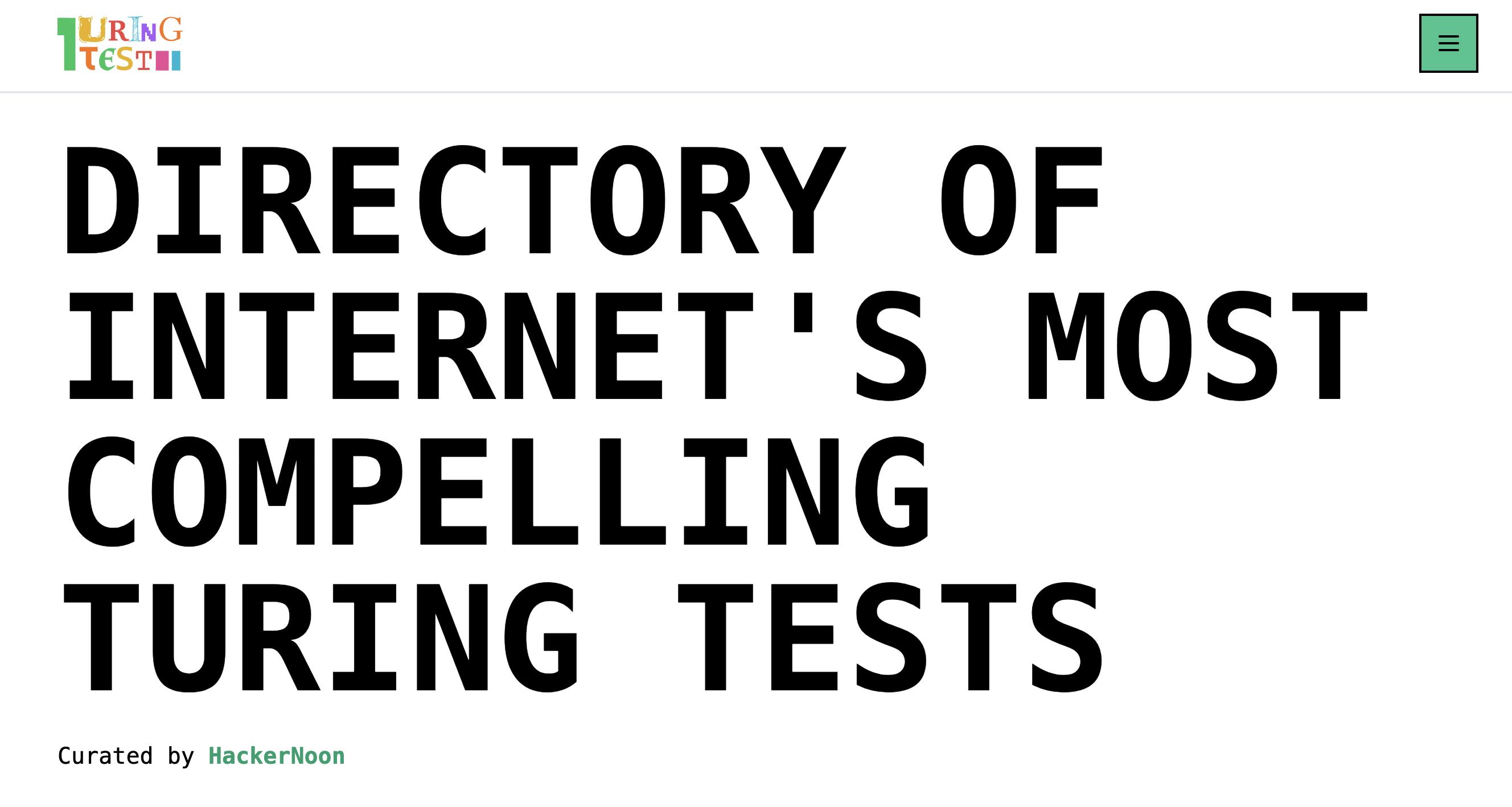
HackerNoon launched TuringTest.tech, a curated directory of 1601 of the internet's most compelling Turing tests and AI evaluation frameworks. In an era when AI systems can write code, generate art, diagnose diseases, and engage in conversations that feel startlingly human, we need better ways to understand what these systems can and cannot do.
Why Build This?
The AI industry is moving at breakneck speed. Every week brings new models, new benchmarks, and new claims about artificial general intelligence. But amid all this noise, a critical question often goes unanswered: How do we actually know if these systems work?
Traditional benchmarks measure narrow capabilities—accuracy on multiple-choice questions, performance on coding challenges, or success rates in specific tasks. These metrics matter, but they don't tell the whole story. They can't capture whether an AI truly understands what it's doing, whether it can reason about novel situations, or whether it exhibits anything resembling genuine intelligence.
That's where Turing tests come in. Unlike static benchmarks, Turing tests are dynamic, interactive evaluations that probe the boundaries of machine intelligence. They ask not just "Can the AI complete this task?" but "Can it do so in a way that's indistinguishable from—or comparable to—a human?"
The problem is that these tests are scattered across research papers, GitHub repositories, company blogs, and academic conferences. Some are rigorous and well-designed. Others are publicity stunts. Many are impossible to find if you don't already know they exist.
TuringTest.tech, solves this problem by creating a centralized, searchable directory of AI evaluation tests from across the internet. It's built and curated by HackerNoon. The directory is part of HackerNoon's ongoing commitment to making technology more transparent, accessible, and understandable.
What Makes an Effective Turing Test?
Not all tests are created equal. As we curate this directory, we're looking for evaluations that meet several criteria:
- Transparency: The test methodology should be clear and reproducible. Black-box evaluations that can't be independently verified don't help anyone.
- Rigor: The test should actually challenge AI systems in meaningful ways, not just measure their ability to pattern-match against training data.
- Relevance: The capabilities being tested should matter for real-world applications. Can this AI write coherent legal analysis? Can it debug complex code? Can it explain scientific concepts to a 10-year-old?
- Fairness: The test should account for different types of intelligence and avoid cultural or linguistic biases that favor certain systems over others.
- Evolution: The best tests adapt as AI capabilities improve. What challenged GPT-2 might be trivial for GPT-4, so evaluation frameworks need to keep pace.
The State of AI Evaluation in 2025
The field of AI evaluation is in crisis. We have more powerful AI systems than ever before, but our ability to meaningfully assess them hasn't kept up.
Consider the confusion around terms like "artificial general intelligence" or "reasoning." Different researchers use these words to mean different things. One team's "AGI" is another team's "narrow AI with good PR." Without standardized, rigorous evaluation frameworks, we're essentially arguing about definitions rather than capabilities.
Meanwhile, the stakes keep rising. AI systems are being deployed in healthcare, education, law, and national security. We need to know not just that these systems work some of the time, but how they fail, where their blind spots are, and what their limitations look like under pressure.
This is why cataloging and sharing evaluation methodologies matters so much. When researchers can build on each other's work—when they can compare results across different tests and different systems—we make faster progress toward understanding what AI can and cannot do.
From Research Labs to Real World
TuringTest.tech isn't just for AI researchers. It's for:
- Developers who need to evaluate whether a specific AI system is suitable for their use case. Should you integrate Claude or GPT-4 into your application? What about open-source alternatives? Different tests reveal different strengths and weaknesses.
- Business leaders trying to separate AI hype from AI reality. When a vendor claims their system achieves "human-level performance," what does that actually mean? Which tests did they use? How do those results compare to other systems?
- Journalists and analysts covering the AI industry. Instead of relying solely on company press releases, they can examine the actual evaluation data and see how different systems perform on standardized tests.
- Educators teaching about AI. Students need to understand not just how AI systems work, but how we measure their capabilities and limitations. A curated directory of tests provides concrete examples for classroom discussion.
- Policy makers grappling with AI regulation. You can't regulate what you can't measure. Better evaluation frameworks lead to better policy.
The Road Ahead
We're inviting researchers, developers, and organizations to submit their evaluation frameworks and Turing tests to the directory.
This is, in many ways, an experiment. We're betting that there's value in creating a centralized repository for AI evaluation methodologies. We're betting that transparency and standardization will lead to better AI systems and more informed public discourse about what these systems can do.
We're also betting that the tech community—HackerNoon's 45,000+ contributing writers and 4 million+ monthly readers—will help us build something valuable. Because ultimately, understanding AI isn't just a technical challenge. It's a collective one.
The original Turing test was simple: Can a machine convince a human that it's human? But that was never the right question. The real question has always been more nuanced: What does it mean for a machine to think? How can we tell the difference between genuine intelligence and sophisticated pattern matching? And as these systems become more capable, how do we ensure they serve human needs rather than just mimicking human behavior?
We don't have all the answers. But with TuringTest.tech, we're creating a space where the industry can collaborate on finding them.
Get Involved
Visit TuringTest.tech to explore the directory. If you've developed an AI evaluation framework, conducted a Turing test, or know of compelling tests that should be included, we want to hear from you.
The future of AI depends not just on building smarter systems, but on understanding the systems we've already built. Let's build that understanding together.
[story continues]
tags