
Modern economic decisions are no longer born into the extremes of intuition or the pure mathematics. It is situated in the space where Statistics Meets Strategy reasoning turns to strategic thought. Today’s organizations aren’t deficient in data or models; they’re beset by something more insidious, the difficulty of transforming an incompletely organized, chaotic information into policies, market-building decisions, and long-term outcomes. We introduce a narrative methodology for solving economic problems using data. Instead of enumerating tools or approaches, it elaborates how statistics becomes strategy when uncertainty, causality, and risk are among the first-class citizens in the calculus of decision-making.
Statistics as a Strategic Orientation, not a Reporting Instrument
Unlike some conventional analytical problems, economic problems are rooted in choice with a consequence. Whether a firm is setting prices, deploying capital or launching a new product, it is not simply predicting a future, it is building one. When it comes to the past, classical analytics tends toward summarization; in strategy, however, it may demand anticipation, trade-offs, and enduring over time amidst uncertainty. Statistics offers disciplined approaches to reasoning in situations where outcomes are unknown, incentives are unbalanced and behavior shifts. When wielded intentionally, it tells us not just what is likely to happen but also what we should do in the situation.
From Economic Questions to Statistical Decisions
Each data driven strategy that works starts with reframing the problem. Think about a company that is worried about its revenue growth slowing. More than that, an analytical mindset may mean asking for a prediction of next quarter’s sales. A strategic statistical mindset, on the other hand, inquiries about how other actions (pricing cuts, marketing investments or product features) change the distribution of the potential outcomes.
This shift in framing is a little subtle but powerful. It shifts the problem from one of prediction to one of decision-making under uncertainty where trade-offs are defined and risk can be quantified.
Modeling Reality as Uncertainty, Not Certainty
The economic system is volatile by nature. Demand from consumers ebbs and flows, competitors respond, and external shocks alter incentives. If forecasts are considered as single-point estimates, this sort of complexity is masked, and fragile strategies are encouraged.
A strategic statistical perspective treats outcomes as probability distributions and not numbers that are guaranteed to happen. These distributions encode not only what is most likely to happen, but also how wrong we might be. This perspective permits decision-makers to envision downside exposure, upside potential, and the stability of outcome results across scenarios.
The custom chart shown above shows this notion. Two strategic options can be expected to achieve the same outcome with very different levels of uncertainty. One option concentrates outcome near the mean, while the other leaves the organization exposed to extreme losses in rare but consequential cases. Without this type of visualization, they don't see risk.
Causality: The Bridge Between Analysis and Action
Because to devise a strategy you need to know about cause-and-effect. Economic figures are replete with correlations that seem convincing but fizzle out when you do something with it. A marketing campaign might run alongside revenue increase, but coincidence does not always indicate impact.
Causal statistics introduce counterfactual analysis: what would have been if a decision hadn’t been made would have developed and what would have taken place had a certain amount of effort been taken. This means they can assess policy, investment or intervention in terms of actual economic impact and not just surface-level correlation.
By integrating causal reasoning into the process of strategic analysis, decision makers move from reactive explanations of economic consequences (what happens) to actively designing economic outcomes.
Risk as a Quantitative Design Limitation
Then we model uncertainty and causality, and strategy is most important: selecting among alternatives. Statistically, here, is how to balance reward and risk in principle. A general expression of this balance can be formulated as:

In this formulation, expected economic outcomes are expressly penalized by uncertainty, scaled according to risk tolerance. This formula captures a central lesson of strategic economics: to maximize expected value alone is insufficient when volatility can threaten long-term stability. In contrast to optimizing blindly for growth, organizations are optimizing for robustness.
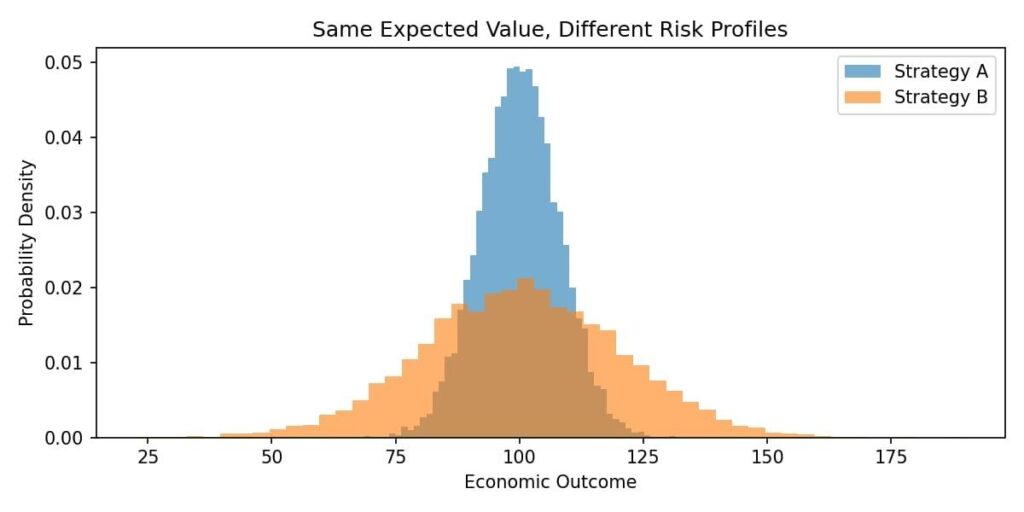
Fig: This visualization shows two strategies with the same expected economic value but very different risk profiles, which directly supports the core argument of your article.
Aligning Statistical Methods with Strategic Intent
The table below illustrates how different statistical approaches naturally align with different strategic questions. The emphasis is not on technical sophistication, but on decision relevance.
|
Strategic Intent |
Statistical Focus |
Economic Value |
|---|---|---|
|
Anticipate future conditions |
Probabilistic forecasting |
Scenario awareness |
|
Explain observed changes |
Actionable insight |
|
|
Evaluate interventions |
Counterfactual modeling |
Policy effectiveness |
|
Manage uncertainty |
Variance and tail analysis |
Downside protection |
|
Choose among options |
Optimization under uncertainty |
Robust decisions |
Use Learning as a Strategic Feedback Loop
A decision does not conclude economic strategy. Markets come into play, behaviors change and assumptions weaken. A statistical strategy regards decisions like experiments: new sources of data that help improve future decisions. By ensuring that post-decision outcomes are updated with regularity in models, organizations turn statistics into a learning system for making decisions, not the hard-and-fast planner.
Conclusion: The Strategic Development of Statistics
When statistics are limited to dashboards and reports, their impact is limited. It is transformative if embedded into the logic of strategy. At this juncture, data no longer explains yesterday, but shapes tomorrow. Decisions become transparent, defensible, and robust to uncertainty. The combination of the statistical and strategy integration needed to make economic decisions sustainable cannot be left to the past in an economy that is defined by volatility and complexity.
References
Box, G. E. P. (1979). Robustness in the strategy of scientific model building. Robustness in Statistics, 201–236.
Gelman, A., Hill, J., & Vehtari, A. (2020). Regression and other stories. Cambridge University Press.
Pearl, J. (2009). Causality: Models, reasoning, and inference (2nd ed.). Cambridge University Press.
Taleb, N. N. (2018). Skin in the game: Hidden asymmetries in daily life. Random House.
[story continues]
tags