


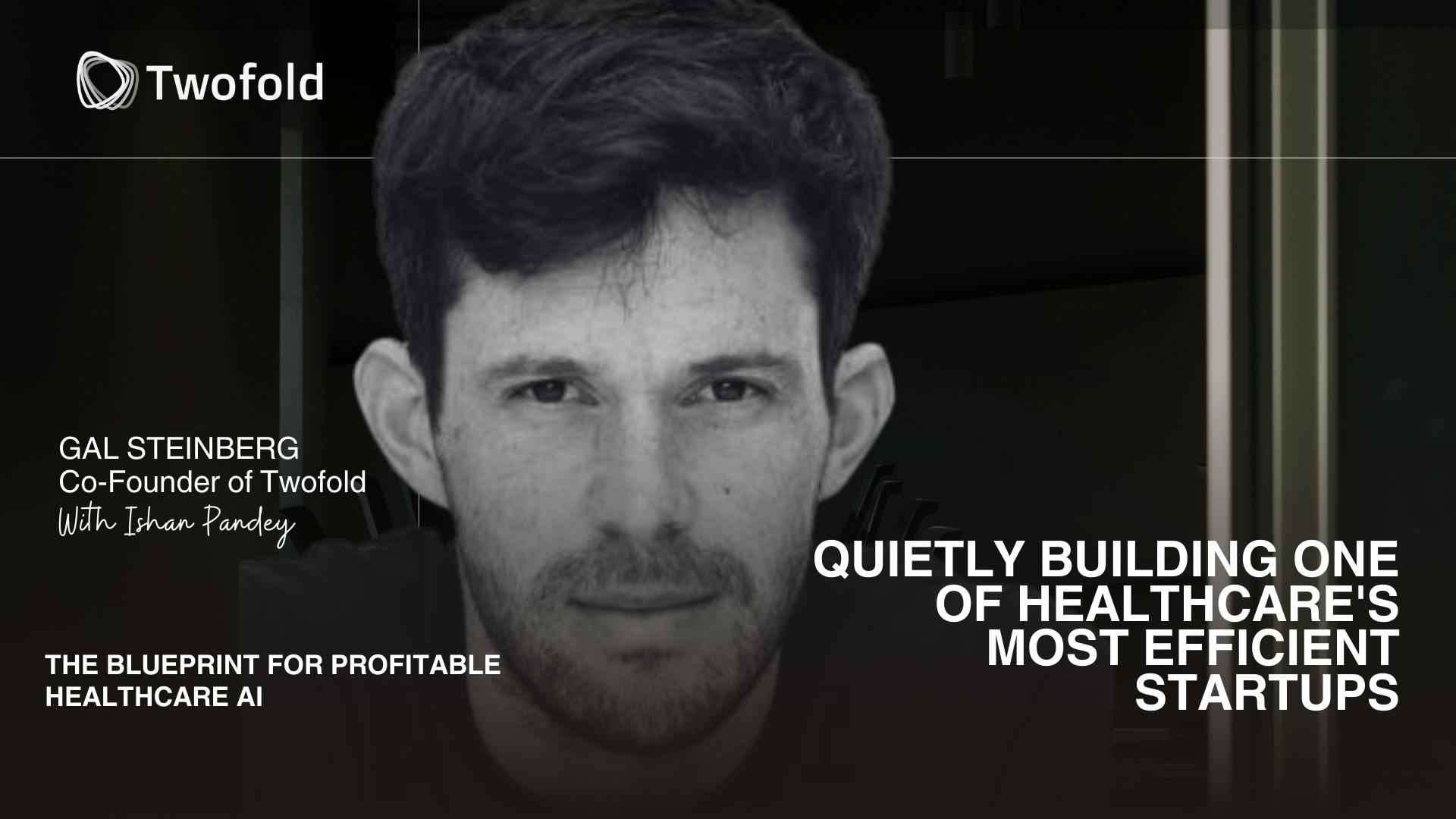
Bootstrapped to multi-million ARR with three co-founders and no venture backing, Twofold is quietly building what may become the defining AI infrastructure layer for outpatient healthcare. In this edition of "Behind the Startup," Ishan Pandey sits down with Gal Steinberg, co-founder and CEO of Twofold, to discuss why the AI scribe market is the wrong frame, what it actually takes to earn clinical trust, and how a three-person team is running a platform used by over 3,000 practices across the United States.
Ishan Pandey: Hi Gal, it's great to have you on our "Behind the Startup" series. Before we get into Twofold, could you give our readers a brief introduction about yourself and what led you to building AI infrastructure for healthcare?
Gal Steinberg: Thank you, Ishan, really glad to be here. I'm the co-founder and CEO of Twofold. My background spans software engineering and cybersecurity, and I later went on to earn my MBA from INSEAD. Before Twofold, I had already built and exited a company, so I came into this with a clear sense of what it takes to go from zero to something real. That experience shapes how I think about building:
with discipline, close to customers, and without losing sight of the fundamentals.
Today, my full focus is on building AI infrastructure that actually works inside healthcare practices.
Ishan Pandey: Most AI healthcare companies raise tens of millions before a single line of code is written. The fundraising story often precedes the product. You chose a completely different path with Twofold, staying bootstrapped and reaching multi-million ARR with just three co-founders. What was the strategic logic behind that decision, and do you think the venture-heavy model in healthcare AI is fundamentally broken?
Gal Steinberg: We built Twofold without venture funding because we wanted to build a real business before building a fundraising story.
In healthcare, it is easy to create excitement around AI, but much harder to create something clinicians trust enough to use every day. Staying bootstrapped forced us to stay close to customers, charge early, and focus on real product-market fit instead of vanity growth.
It also gave us the freedom to build with discipline. We think the best proof point in healthcare is not how much money you raised, it is whether customers use the product, keep using it, and pay for it.
Ishan Pandey: Let's talk about the trajectory. Twofold is roughly eighteen months old, and the product today looks quite different from where it started. Walk us through what the first six months actually looked like, what was the initial wedge, what did you learn from early users, and what caused the vision to expand into what Twofold is now?
Gal Steinberg: In the first six months, Twofold was much narrower. We started with a focused wedge around documentation and used that to learn where AI could create immediate value in real clinical workflows. A large part of that traction came from behavioral health, which remains a very important market for us, but the broader opportunity was always bigger than a single specialty.
https://youtu.be/--ibh8rRmx4?si=lYc-frJ5nb1b_zvh&embedable=true
Today, Twofold is an AI-native care partner that sits on top of legacy EHR, RCM, and practice management systems to enable AI-driven workflows. That includes documentation, chart audits, clinical decision support, and staff retention benefits. What started as a documentation wedge has evolved into a broader AI layer for outpatient care. The vision expanded as we learned from customers: practices do not want another disconnected point solution. They want AI that makes their existing stack smarter and helps the entire organization operate better.
Ishan Pandey: You've reached multi-million ARR from zero in eighteen months with a three-person team and no outside funding. Those numbers will raise eyebrows, both impressed and skeptical ones. Can you give us the actual metrics? And what does the growth curve tell you about the demand signal in this market?
Gal Steinberg: We founded the company about 1.5 years ago, and in that time we've grown from zero to multi-million dollars in ARR while reaching breakeven financials. We now serve more than 3,000 practices across the U.S.
Because we started from zero just 18 months ago, the year-over-year growth rate is effectively in the thousands of percent. The more meaningful point, though, is that we have reached multi-million ARR very quickly with just three co-founders, no venture funding, and a product-led, self-serve go-to-market motion. It is rapid growth, but efficient growth.
Ishan Pandey: From the outside, the AI scribe market does look crowded, Nuance, Abridge, Nabla, and a dozen well-funded startups are all competing for the same clinical attention. A skeptic would ask why healthcare practices should care about Twofold. What is the honest answer to that, and how do you define the competitive boundary that others are missing?
Gal Steinberg: The market only looks crowded if you define it narrowly as note generation. We think that misses the real opportunity. Most players are still selling a better note-taking tool. We are building a broader AI workflow layer for healthcare practices.
Behavioral health is a major market for us, but the underlying problem exists much more broadly across outpatient care. Legacy systems are deeply embedded, switching costs are high, and practices are not looking to rip everything out. They want an AI-native layer that sits on top of what they already use and meaningfully improves how the practice runs. That is the opportunity we see, and it is much larger than the scribe category alone.
Ishan Pandey: There's a gap between what AI can do in a controlled demo and what it can do in a real clinical environment with messy workflows, edge cases, and high-stakes consequences. From a technical and operational standpoint, what does it actually take to build AI that clinicians trust enough to rely on daily and what do most people building in this space fundamentally underestimate?
Gal Steinberg: The hardest part is not making a demo look impressive. The hardest part is building something reliable enough to be trusted in a high-stakes, regulated environment. In healthcare, accuracy alone is not enough. You need consistency, auditability, workflow fit, and trust.
Outsiders often underestimate how messy real-world clinical workflows are. Every practice is different, every clinician works a little differently, and the downstream consequences of bad output are real. Building production-grade AI for healthcare means handling edge cases, structuring information correctly, fitting into existing systems, and earning trust over time. That is very different from building a flashy consumer AI product.
Ishan Pandey: Profitability at this stage in a venture-dominated sector is unusual enough to warrant a detailed explanation. Walk us through the actual mechanics, how does a three-person team run a platform for over 3,000 practices without burning cash? What does your internal automation stack look like, and where are the limits of that model?
Gal Steinberg: A big part of it is focus. We picked a clear pain point, built around real customer demand, and designed the company to be product-led and self-serve from the beginning. That gave us a very efficient growth engine without needing a large sales team or heavy overhead.
The other major factor is automation.
Twofold is run by just three co-founders, and we use automation across product development, growth, onboarding, support, analytics, and operations.
That lets us operate with a level of leverage that would normally require a much larger team. We are not trying to look big. We are trying to be fast, efficient, and compounding.
Ishan Pandey: Three co-founders running a company at this scale is an organizational model that most operators would call unsustainable. At what point does staying lean become a constraint rather than an advantage and how do you think about the deliberate tradeoffs you are making by not hiring?
Gal: The company is still just the three co-founders. That surprises a lot of people given the scale we've reached, but it is intentional.
We each operate across multiple functions, and we use automation heavily to multiply output. That includes product, growth, support, analytics, and internal operations. We are not trying to build a large organization for the sake of it. We are trying to build an extremely effective one. So far, staying lean has been a real competitive advantage.
Ishan Pandey: Let's close on the roadmap. You've described Twofold's ambition as becoming the AI operating layer that sits above legacy healthcare software, which is a significantly larger claim than building a documentation tool. What does 2026 actually look like in concrete terms, and what would have to be true about the market and about Twofold for that broader vision to materialize?
Gal: 2026 is about continuing to expand from a wedge into a much broader AI operating layer for healthcare practices. That means deeper capabilities across chart audits, clinical decision support, workflow automation, and practice performance. Behavioral health is a major part of that story for us, but the long-term vision is broader: helping practices work smarter on top of the systems they already have.
The ambition is much bigger than building another AI scribe. We believe healthcare organizations will increasingly rely on an AI-native layer that sits above legacy software and helps improve care delivery, reduce administrative drag, improve compliance, and support staff retention. Our goal is for Twofold to become that layer. We think this can become one of the defining healthcare AI companies, and we believe we can get there with just three co-founders by using AI and automation to rethink what scale looks like.
Don’t forget to like and share the story!