If you've worked with Ethereum and then tried Solana, you probably felt confused by how different everything looks. The account model especially feels strange. But here's the thing: it's not just different for the sake of being different. Ethereum and Solana made completely opposite choices about how to organize data, and these choices matter a lot.
Let's break down what makes Solana's account model unique and why it works the way it does.
The Big Picture: Two Different Ways of Thinking
The best way to understand Ethereum versus Solana is this simple comparison:
Ethereum is like one computer where everything is stored in the same place. Solana is like an operating system that manages lots of separate files and folders.
Let me explain what this means in practice.
In Ethereum, things are simple and unified. You have one address (your public key, which comes from your private key). That single address holds everything: your ETH, all your tokens, your transaction history. If I look up your Ethereum address, I can see exactly what you own. Smart contracts work the same way—they keep all their data stored inside themselves.
Solana works completely differently. Imagine you have one main wallet, but attached to it is a keychain with many smaller, specialized wallets. Each type of thing you own lives in its own separate container. This isn't just about organizing things neatly—it's a fundamental design choice that changes how everything works.
Why Solana Programs Don't Store Anything
Here's something that surprises most people: smart contracts in Solana don't store any data at all. They only contain instructions and logic.
Think about it this way. In Ethereum, when you create a token contract, it has two parts: the code that handles transfers, and the storage that remembers who owns how many tokens. Both parts live together inside the contract.
In Solana, the program (that's what we call smart contracts here) only has the logic part. It's just code. The actual data
—who owns what, how many tokens exist, all the important information, it lives somewhere completely separate.
This is why every Solana developer writes initialization functions. You need to create separate containers to hold the data because the program itself won't store anything. The program stays "stateless" (meaning it has no memory), while special data accounts handle all the storage.
This might seem weird at first, but it's actually one of Solana's biggest strengths. We'll see why in a moment.
The Five Types of Solana Accounts
Solana recognizes five different types of accounts. Each one has a specific job:
1. System Account
This is your everyday wallet—Phantom, Solflare, whatever you use. Your system account holds your SOL and represents you on the network. It's also where you pay rent to keep your data alive. In Solana, if you keep a minimum balance (Rent Exempt), you don't actually lose money over time, and you can recover this SOL if you ever close the account. Think of it as your main identity and your base of operations.
2. Program Account
This is where the smart contract code lives. It's pure executable logic with zero data storage. Imagine a calculator—it can do math for you, but it doesn't remember anything after you're done. The program account works the same way. It's marked as "executable" and contains only the compiled code.
3. Data Account
This is where everything gets stored. Here's the really important part: even though you might create a data account and pay for it, you don't actually own it. The program owns it. Only the program's code can change what's inside. You can't manipulate it directly, even if you wanted to. The code controls everything.
4. Associated Token Account (ATA)
When you buy a token, Solana doesn't just add it to your main account. Instead, the system creates a special Associated Token Account—basically a dedicated box for that specific token. Every different token you hold gets its own ATA. And yes, each one requires you to pay rent. This is why your wallet address looks different when you're receiving different types of tokens.
5. Program Derived Address (PDA)
This is fascinating. A PDA is an address that holds assets and can do things, but it has no private key. Nobody controls it—not you, not me, not anyone. Only the program's code can make it do things. It's like a vault that only opens when specific conditions in the code are met. No human has the keys because there are no keys to have.
One thing ties all these account types together: code is law. Once the rules are set and the program is deployed, nobody can cheat or change how things work.
Why This Breaks What You Know from Ethereum
If you're coming from Ethereum, you probably have certain expectations about how blockchains work. Solana breaks a lot of these assumptions.
Assumption 1: "Data Lives Inside the Contract"
In Ethereum, you look at a token contract and all the balances are stored right there inside it. You ask the contract a question, and it answers based on what it knows.
In Solana, the contract doesn't know anything. It has no memory. After you deploy it, it stores zero data. The information lives in separate data accounts. The program reads from these accounts and writes to them, but it never holds onto the information itself.
Assumption 2: "One Address Per User"
Ethereum keeps it simple: one address holds everything. Your ETH, your USDC, your NFTs—all connected to one address that you control with one private key. It's like having a regular wallet with paper money and coins all mixed together.
Solana separates everything. Your main address is just the keychain. Each token lives in its own dedicated compartment with its own address. You're not carrying one wallet—you're carrying a keychain with lots of small specialized wallets, each holding one type of thing.
Assumption 3: "You Need Private Keys for Everything"
In Ethereum, if you want to move something or change something, you must sign with your private key. That's how access control works—you either have the key or you don't.
Solana has PDAs—addresses with no private keys that can still hold and move assets. Control is purely based on program logic. This enables things that are impossible in Ethereum. A smart contract can hold funds with literally zero risk of someone stealing the private key, because there is no private key to steal.
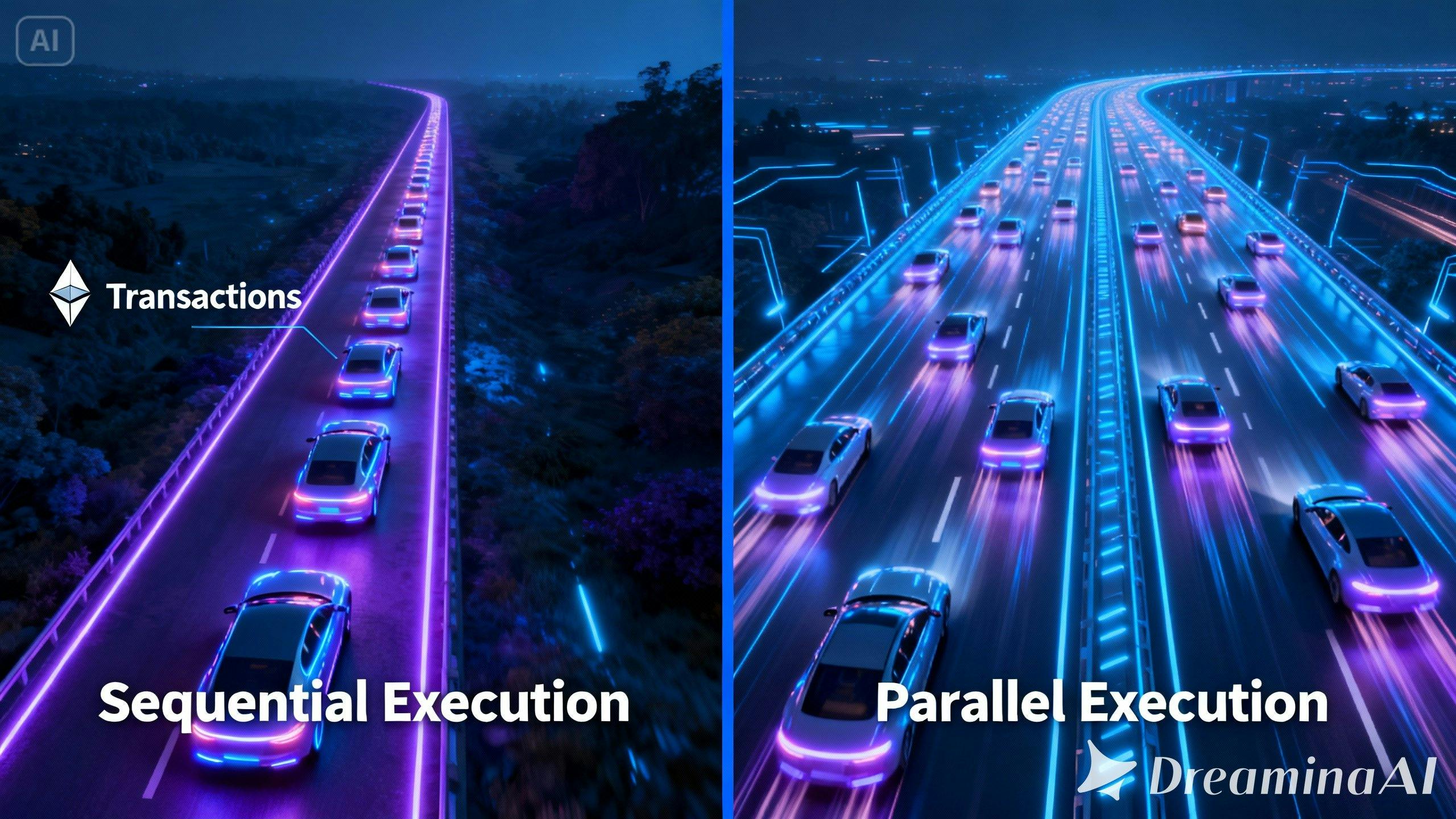
Assumption 4: "Transactions Happen One at a Time"
Ethereum processes transactions sequentially—one completes, then the next one starts. Everything shares the same state, so you can only do one thing at a time. It's single-threaded.
Solana uses something called Sealevel that separates programs and data. This means the system knows exactly which accounts each transaction will touch. If two transactions don't overlap in what they're accessing, they can run at the same time. Solana can process thousands of transactions in parallel without them conflicting with each other.
Wrapping Up
Solana's account model isn't just a different implementation of the same idea. It's a completely different way of thinking about how a blockchain should work.
By separating code from data, creating multiple types of accounts, and allowing parallel execution, Solana makes different trade-offs than Ethereum. Neither approach is "better"—they're just different, with different strengths and weaknesses.
If you're building on Solana, you need to forget some of what you learned from Ethereum. The one-address model doesn't apply here. Smart contracts don't store data. Private keys aren't the only way to control things. Transactions don't always wait in line.
These aren't just technical details. They're design choices that change what you can build and how you need to think about security. The "operating system" approach of Solana needs a different mental model than the "unified computer" approach of Ethereum.
Understanding this difference is your starting point for actually building something solid on Solana.
[story continues]
tags