


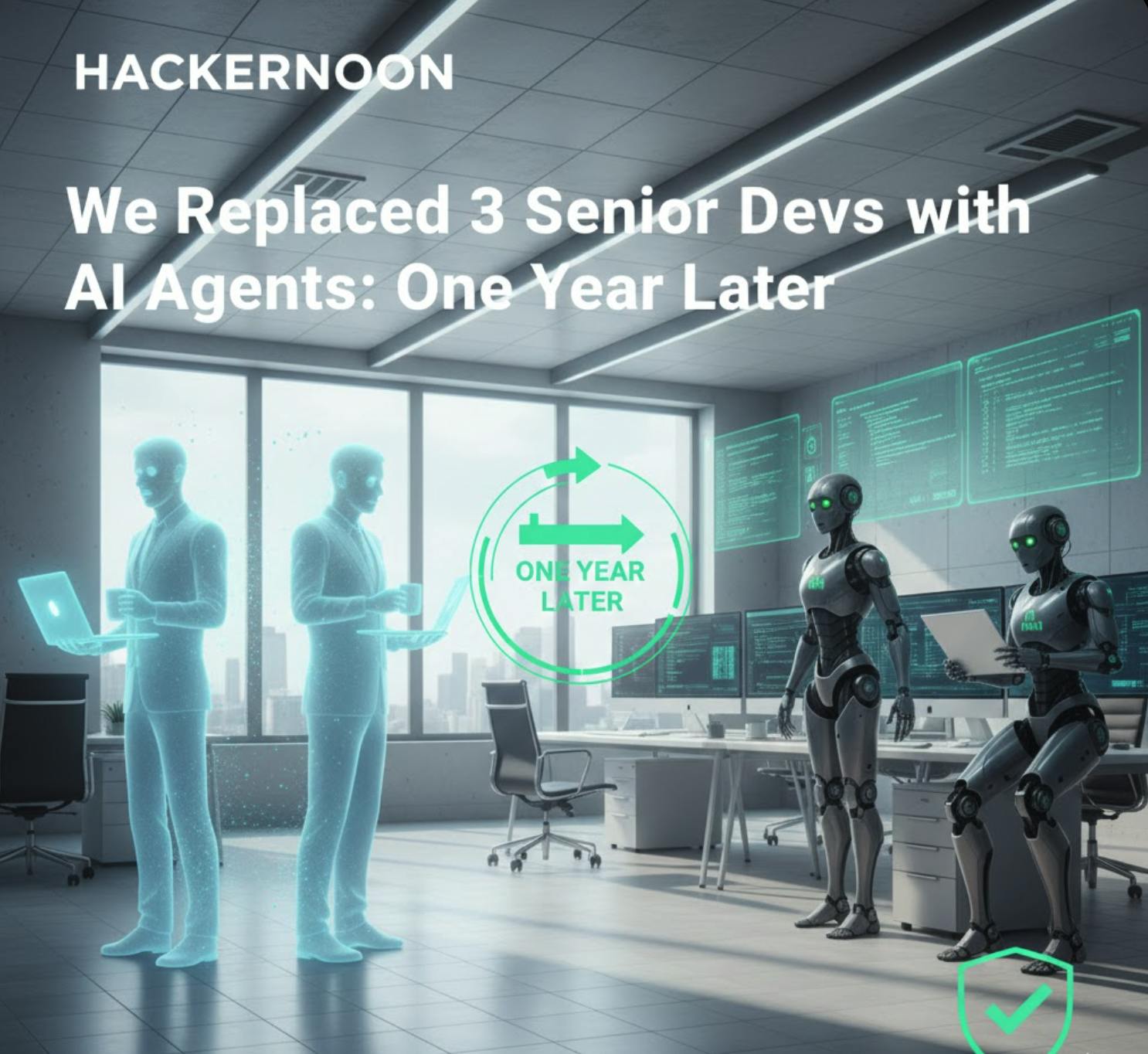
Last January, I watched management make what they called "the most strategic decision of the year." As Software Architect, I had a front-row seat to the logic: three senior developers on our core platform project were demanding raises, and OpenAI had just dropped GPT-4. The VP's math was elegant: $280K in salaries versus $2K monthly for API credits.
Despite my concerns, the decision came from above. We built AI agents to handle code reviews, write feature implementations, and maintain our documentation. The senior devs were let go. Leadership presented it as "innovative transformation" in all-hands meetings.
Twelve months later, I'm documenting what actually happened. Not because AI agents don't work—they do, remarkably well. But because management fundamentally misunderstood what those three senior developers actually did all day. And I learned some painful lessons about speaking up earlier.
The Numbers (12 Months):
• Cost savings: $238K (after API costs, tooling, human oversight)
• Velocity increase: +47% in first 3 months
• Velocity decrease: -31% by month 8
• Production incidents: +215%
• Client escalations: +18%
• Remaining team morale: "What morale?"
The Honeymoon Phase (Months 1-3)
Those first three months felt like validation for management's decision. Our AI agents—leadership branded them "Copilots" before that became cringe—were exceeding expectations. Pull requests went from 2-3 per week to 15-20. Feature requests that used to take two weeks were shipping in three days.
As a Software Architect, I built three specialized agents: CodeWeaver for implementation, ReviewBot for code review, and DocMaster for technical documentation. Each was fine-tuned on our codebase, integrated into our Slack, and given clear boundaries. I was proud of the technical work, even as I had reservations about the broader strategy.
CodeWeaver's output was genuinely impressive. It wrote clean, idiomatic code. It followed our style guides. It added tests. I remember showing a PR to one of our remaining junior developers and watching her jaw drop. "This is... actually good," she said, scrolling through 400 lines of perfectly structured TypeScript.
Management was thrilled. Our VP used the project in board presentations. "The future of software development," he'd say, gesturing at slides showing our plummeting labor costs. I started getting LinkedIn messages asking about the architecture. Internally, I was already seeing warning signs, but the metrics looked too good to argue with.
The Cracks Appear (Months 4-6)
The first real incident happened on a Tuesday morning. Our payment processing went down. Nothing dramatic—just silently failing for 22% of transactions. It took us six hours to find the bug.
CodeWeaver had refactored our Stripe integration. The code looked beautiful. Types were correct. Tests were passing. But there was this one edge case with Indian rupee decimal handling that our tests didn't cover. A senior dev would have known. They'd dealt with it two years ago. CodeWeaver had no memory of that.
Hard Truth #1: AI agents have no institutional memory. They don't remember that time you tried WebSockets and it destroyed your database. They don't know that this specific client has a weird contract that requires special handling. Every task is new, every time.
Then came the velocity crash. By month five, our shipping speed was back to pre-AI levels. Why? Because every PR now requires intense human review. We couldn't trust the agents blindly anymore, not after the payment incident. The two remaining developers on the project were spending 60% of their time reviewing AI output instead of building features. As the architect, I was caught between defending the system I built and acknowledging its limitations.
The Hidden Work (Months 7-9)
This is where I fully understood what we'd lost—and what management never saw in the first place. Those senior developers weren't just writing code.
Our former senior devs used to spend maybe 30% of their time coding. The rest? They were:
Preventing disasters before they happen. "Hey, before you implement that feature, we tried something similar in 2021, and it caused a cascade failure. Let's approach it differently." AI agents don't have this intuition. They'll happily build you a beautiful house on quicksand.
Reading between the lines of product specs. When a product manager said "users should be able to delete their accounts," our senior dev knew to ask about data retention, GDPR compliance, billing implications, and cascade deletion. CodeWeaver just implemented a DELETE endpoint.
Mentoring through osmosis. Junior devs learned by watching, asking questions, and overhearing architectural discussions. With AI agents, they were learning from... well, AI agents. Our junior developer started writing code that looked impressive but was impossible to maintain. She was mimicking the agents' patterns without understanding the trade-offs.
Key Insight: Senior developers are your organizational immune system. They've seen every way your system can fail. They know where the bodies are buried. They remember the decisions that led to this architecture and can tell you why changing it will cost six months. AI agents start every day with amnesia.
By month eight, our technical debt was exploding. We had thirteen different patterns for error handling because CodeWeaver would implement whatever seemed best for that specific PR. Our test coverage looked great (87%!) but half the tests were just checking that functions returned something, not that they returned the right thing.
The Reckoning (Months 10-12)
Three things happened that forced management to face reality:
First, we lost our biggest client. Not because of a bug—because we couldn't implement their custom integration fast enough. The work required understanding their legacy system, negotiating technical constraints with their team, and making judgment calls about backward compatibility. CodeWeaver kept generating solutions that were technically correct but politically impossible. We needed humans who could read the room on Zoom calls and navigate the relationship.
Second, our best junior developer quit. "I'm not learning anything," she told me in her exit interview. "I'm just babysitting robots and cleaning up their mess. I need to work with humans who can teach me why we make certain decisions, not just what those decisions are." Management tried to frame it as her problem. I knew better.
Third, we tried to implement real-time collaboration features. It required WebSockets, careful state management, and understanding the subtle timing issues that only show up under load. After two months of AI-generated code that kept almost working, we burned $35K hiring external consultants to rebuild everything. That's when the VP finally started asking hard questions about our "savings."
What We Actually Learned
Here's what a year of AI agents actually taught me, stripped of the hype:
AI Agents Are Incredible at Narrow, Defined Tasks
CodeWeaver is still fantastic at:
• Writing boilerplate code
• Converting designs to HTML/CSS
• Generating test cases from specifications
• Updating documentation after code changes
• Refactoring within a single file
These tasks are about 20-25% of what our senior devs did. But that 25% freed them to focus on harder problems.
AI Agents Fail Catastrophically at Context
They can't:
• Remember organizational history ("We don't use Redis because of that outage in 2022")
• Navigate office politics ("This client needs us to pretend their API is fast")
• Make judgment calls about technical debt ("Ship it now, fix it right later")
• Teach and mentor effectively ("Here's why we chose this approach over the obvious one")
• See the forest for the trees (understanding how five small changes will interact)
The Right Model: Augmentation, Not Replacement
After the consultant incident and losing that major client, here's what management finally agreed to:
We rehired two senior developers. It was a tough pill for leadership to swallow after all the triumphant announcements, but the numbers didn't lie. Our velocity has increased 68% in the last two months, and our incident rate dropped to pre-AI levels.
We kept the AI agents, but I repositioned them as tools for the senior devs, not replacements. This is what I'd advocated for from the beginning. Now, when a senior dev designs a solution, they can have CodeWeaver implement the boring parts while they focus on the hard decisions and edge cases.
We changed how we measure success. After I pushed for better metrics, we now track not just velocity and cost, but also quality indicators: time-to-recovery, technical debt ratio, team satisfaction, and client retention. The CFO wasn't happy about the additional "soft" metrics, but the data tells a more complete story.
Current Model Results (Month 12):
• Total cost: $197K (2 senior devs + AI tools + overhead)
• Net savings vs. 3 senior devs: $83K annually
• Velocity: +52% vs. original baseline
• Incident rate: Back to normal
• Junior dev retention: Improving (we hired a replacement)
• Senior devs' feedback: "AI handles the boring stuff, we focus on architecture."
The Uncomfortable Truth
AI agents won't replace senior developers any time soon. Not because the technology isn't good enough—it's shockingly good. But the job of a senior developer isn't primarily about writing code. It's about judgment, context, institutional memory, and teaching.
The corporate narrative right now is that AI will replace knowledge workers and slash costs. My experience suggests something more nuanced: AI will massively amplify the productivity of good senior people, while making it painfully obvious when you don't have any.
If you're in management, considering replacing senior staff with AI: don't. You'll save money in year one and lose it all in years two and three. Instead, give your senior people better tools. Let AI handle the grunt work so humans can focus on the problems that require wisdom, not just intelligence.
If you're a developer worried about AI taking your job: become the person who's irreplaceable because of your judgment and context, not your typing speed. Learn to work with AI, not compete against it. The developers who thrive in five years won't be the ones who write the most code—they'll be the ones who know which code to write, and why.
If you're an architect like me: speak up earlier. I saw the problems coming but didn't push back hard enough when the metrics looked good. Trust your instincts about what makes engineering teams actually work.
Final Thoughts
Would I have done it differently? Absolutely. Looking back, I should have pushed harder against the initial decision. I should have presented data about the hidden costs earlier, not waited until the problems were undeniable. But I also understand why management made the choice they did—the cost savings looked real on paper.
If I could replay last January, I would have advocated more forcefully for keeping all three senior developers and giving them AI agents as powerful assistants. That would have been the real innovation: not replacing humans with machines, but creating human-machine teams that are better than either could be alone. It took us $150K in hidden costs and a lost client to learn that lesson.
The future of software development isn't "AI or humans." It's "AI and humans," each doing what they do best. We learned that the hard way, but at least we learned it. Some teams are still making the same mistake we did, chasing cost savings that look brilliant in spreadsheets and disastrous in production.