


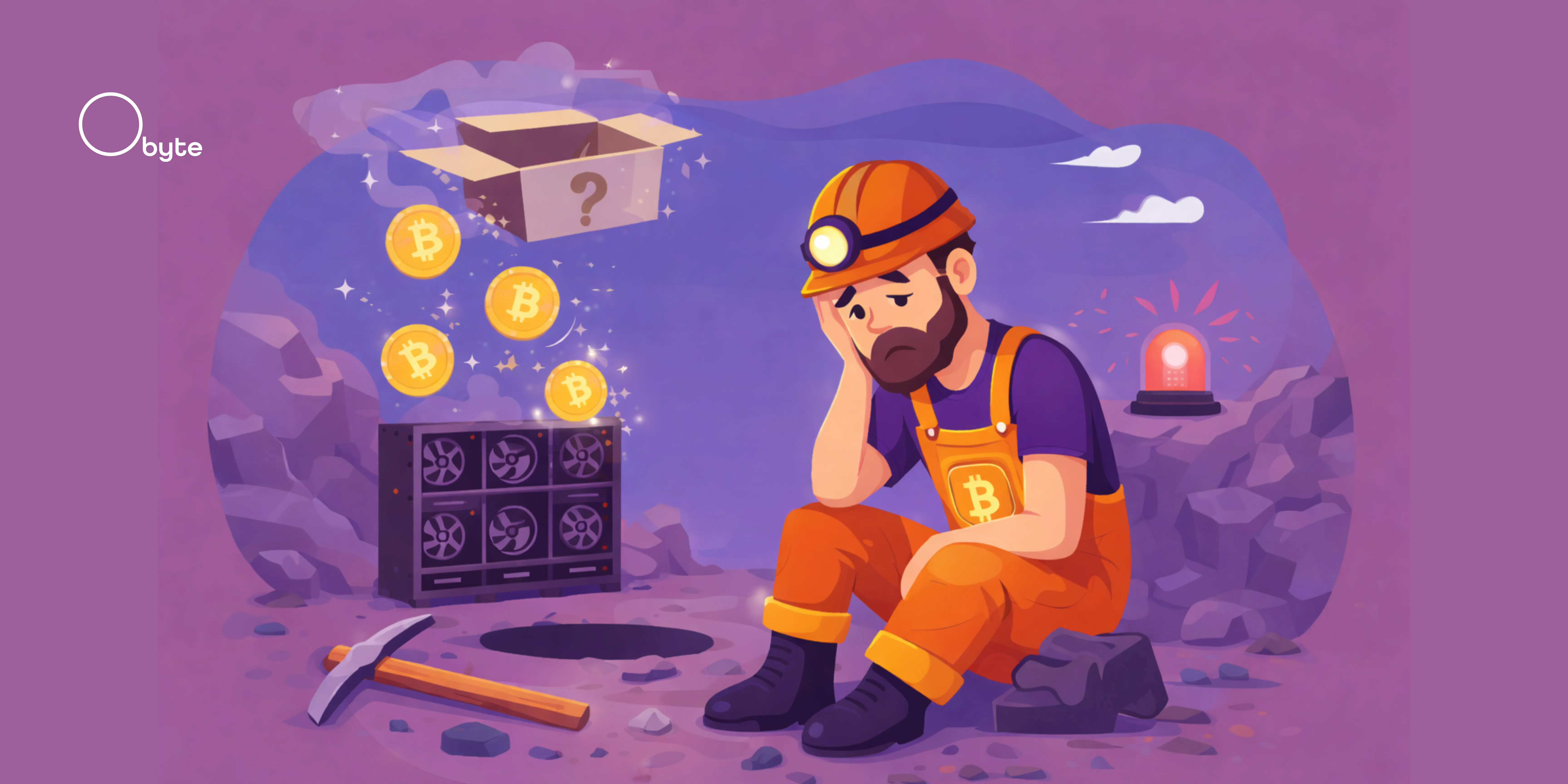
Let’s start with the basics. Cryptocurrency mining is the process where computers compete and “work” to solve mathematical puzzles in order to add new transactions to a distributed ledger. In return for helping secure the network and confirm payments, miners earn newly created coins and transaction fees. The mechanism behind this is called Proof-of-Work (PoW), and many coins use it, including very popular ones like Bitcoin, Monero, and Litecoin.
We would say anyone can be a miner, but that really depends on their resources. Bitcoin is especially difficult to mine at this point: you’d need specialized machines called Application-Specific Integrated Circuit (
Mining can be very expensive, but so far, it’s been very profitable in many cases. Currently, a Bitcoin block offers a reward of 3.125 BTC, equivalent to around $212,500 —and there’s a new block to solve every ten minutes, more or less. Other networks offer different rewards, and you can mine more than one coin at the same time.
However, what happens if you shrink the bounty? That’s what the code of some currencies will do eventually.
Why Mining Can Become Unaffordable
Bitcoin and many other coins were designed with a maximum supply already ingrained into their code. This means only a certain number of coins will ever exist, and for that to happen, they can’t mint new units forever. Instead, they have
https://youtu.be/Ye9ckbN_lqc?si=SP6aqcKJgitRVvuA&embedable=true
So, for miners, it’s like your salary decreases by 50% every four years. But they’d still need to pay for electricity, hardware, and everything else. And let’s talk about mining difficulty, which adds another layer of complexity. This is a parameter that controls how hard it is for miners to solve the puzzle needed to add a new block. If many miners join, difficulty rises to keep blocks steady, and a greater difficulty means that your current machines could no longer work to mine properly. Smaller operators with older machines are often the first to unplug.
A Future Problem
That’s for today’s overview. Eventually, in cases like Bitcoin or Litecoin, there won’t be newer coins to mine. This will happen around the year 2140; a little far from here, but still planned. From that point forward, miners will earn only transaction fees. The issue is that, at least to date, fees are only a smaller portion of total miner revenue compared to the block subsidy. In Bitcoin, they’re at around 0.02 BTC
Will miners stay, anyway? Well. If users compete for limited block space, fees rise, and miners remain motivated to secure the network. If demand stays low and fees remain modest, many miners may power down, reducing total hashrate (mining power) and thus, also network security. But at least mining difficulty will decrease, too. The fewer miners, the lower the difficulty —and the lower the cost to mine.
Difficulty adjustment will keep blocks coming, but security depends on the economic cost of attacking the chain. Lower rewards mean lower protection unless fees compensate. Despite this, there’s a reason why Bitcoin (and similar coins) were designed this way: the supply, planned to be fixed in the future, aims to
Not All PoW Networks Are Equal
Among the coins that have halvings, besides Bitcoin and Litecoin, we can mention
Dogecoin went fully inflationary,
These design choices show two philosophies: one prioritizes scarcity and a fee-driven future, while the other treats ongoing issuance as the price of long-term security. Who’s right? We can't really know at this point. Maybe they're just different, and both will work out in the end.
What about Non-PoW Networks?
Not all PoW coins are equal, and not all cryptocurrencies use PoW. This concern about unaffordable mining only applies to systems that rely on computational work, but we have to admit that most currencies have their own version of block producers or similar, and they expect some kind of compensation or benefit for their work.
Ethereum, for instance, uses Proof-of-Stake (PoS). In this type of system, “validators” are selected instead of miners to approve transactions, based on the amount of ETH they stake. They earn transaction fees and new coins for their job (there’s no fixed supply), while misbehavior will cost them their stake. Neither PoW nor PoS is the most decentralized method, though. Miners and “validators” can still cherry-pick and censor transactions, and, in the worst cases, they can collude and
As we’ve seen, a moment when no one can afford to mine or, in any case, partake in the security of crypto networks is unlikely. There are many different methods to attract participants, although some are more cost-efficient, decentralized, and sustainable than others.