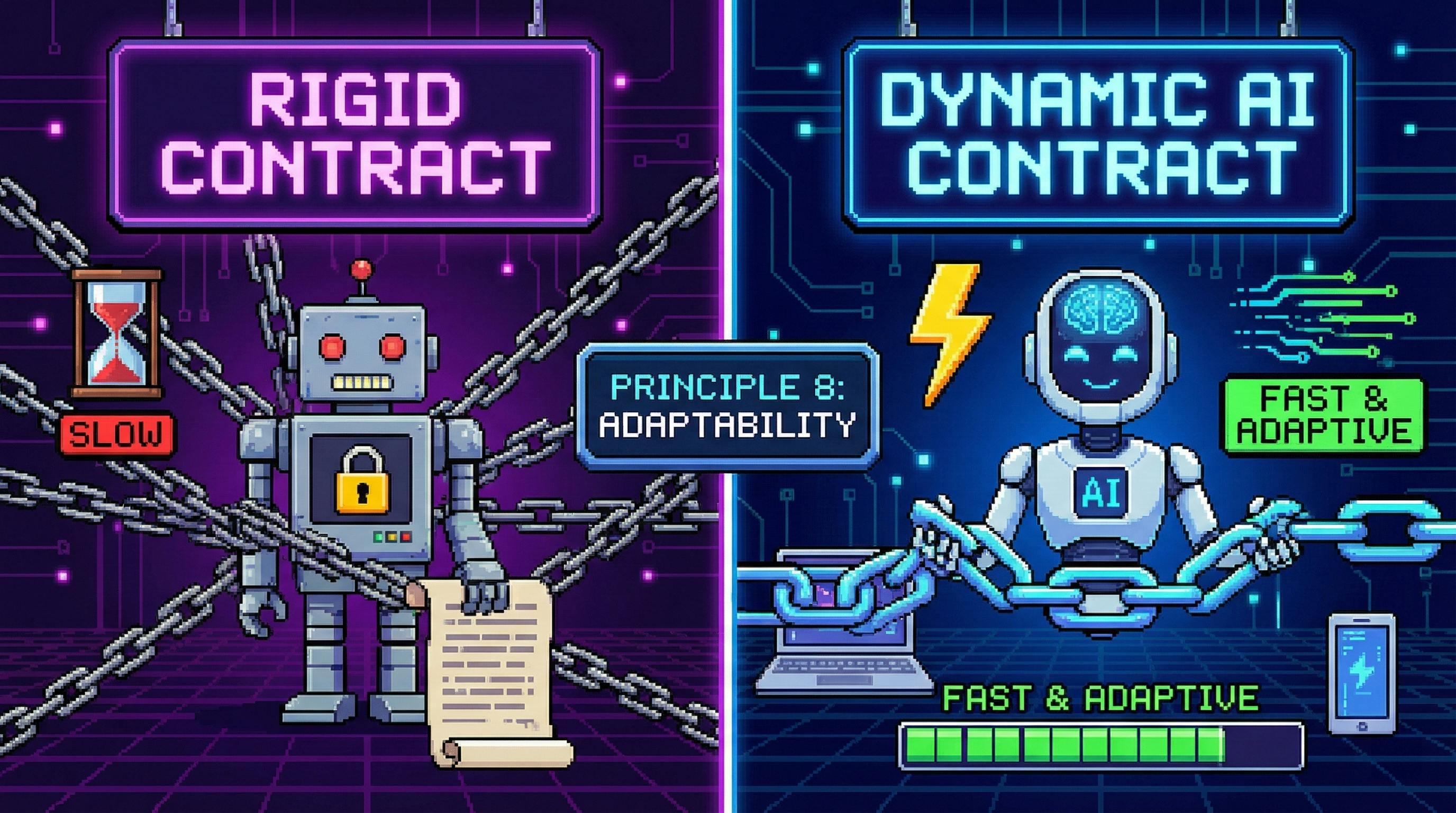
The “Perfect Decision” Trap
We’re entering the era where AI doesn’t just answer questions — it selects actions.
Supply chain routing. Credit risk. Fraud detection. Treatment planning. Portfolio optimisation. The pitch is always the same:
“Give the model data and objectives, and it will find the best move.”
And in a narrow, mathematical sense, it can.
But here’s the catch: optimisation is a superpower and a liability.
Because if a system can optimise perfectly, it can also optimise perfectly for the wrong thing — quietly, consistently, at scale.
That’s why the most important design problem isn’t “make the AI smarter.” It’s “make the relationship between humans and AI adaptive, observable, and enforceable.”
Call that relationship a dynamic contract.
1) Why “Perfect” AI Decisions Are a Double-Edged Sword
AI’s “perfection” is usually:
- statistical (best expected value given assumptions),
- objective-driven (maximise what you told it to maximise),
- context-blind (it doesn’t feel the consequences).
A model can deliver the highest-return portfolio while ignoring:
- reputational risk,
- regulatory risk,
- long-term trust erosion,
- human welfare.
A model can produce the fastest medical plan while ignoring:
- quality of life,
- patient preferences,
- risk tolerance.
AI can optimise the map while humans live on the territory.
The problem is not malice. It’s that objectives are incomplete, and the world changes faster than your policy doc.
2) Static Rules vs Dynamic Contracts
Static rules are how we’ve governed software for decades:
- “Do X, don’t do Y.”
- “If this, then that.”
- “Hard limits.”
They’re easy to explain, test, and audit — until they meet reality.
2.1 The limits of static rules
1) The world changes, your rules don’t
Market regimes shift. User behaviour shifts. Regulations shift. Data pipelines shift. Static rules drift from reality, and “optimal” actions start producing weird harm.
2) Objective–value mismatch grows over time
A fixed objective function (“maximise conversion”, “minimise cost”) slowly detaches from what you mean (“healthy growth”, “fair treatment”, “sustainable outcomes”).
3) Risk accumulates silently
When the system makes thousands of decisions per hour, small misalignments compound. Static constraints become a thin fence around a fast-moving machine.
2.2 Dynamic contracts (the upgrade)
A dynamic contract is not “no rules.” It’s rules with a control system:
- goals can be updated,
- constraints can be tightened or relaxed,
- the system is monitored continuously,
- humans can intervene,
- accountability is explicit.
Think: not a fence — a safety harness with sensors, alarms, and a manual brake.
3) What a Dynamic Contract Actually Looks Like
A dynamic contract has four components. Miss one, and you’re back to vibes.
3.1 Continuous adjustment (rules are living, not laminated)
A dynamic contract assumes:
- objectives evolve,
- risk tolerances evolve,
- incentives evolve.
So the system must support:
- updating thresholds,
- changing objective weights,
- enabling/disabling actions by context.
This is not “moving goalposts.” It’s acknowledging that the goalposts move whether you admit it or not.
3.2 Real-time observability (decisions must be inspectable)
If the system can’t show:
- what it decided,
- why it decided,
- what data it used,
- what constraints were active,
…then you don’t have governance. You have hope.
Observability means:
- decision logs,
- feature/inputs snapshots,
- model version and prompt version tracking,
- anomaly alerts (distribution shift, rising error rates, unusual outputs).
3.3 Human override (intervention must be executable)
A contract without an override is a ceremony.
You need:
- pause switches (kill switch / degrade mode),
- policy overrides (block a class of actions),
- manual approvals for high-risk actions,
- rollback to a previous safe configuration.
3.4 Responsibility chain (power and risk must align)
If AI makes decisions, who owns:
- outcomes?
- regressions?
- incidents?
- compliance?
Dynamic contracts require a clear chain:
- who approves contract changes,
- who monitors alerts,
- who signs off on high-risk domains,
- how you do post-incident review.
This is less “ethics theatre,” more on-call rotation for decision systems.
4) Dynamic Contracts as a Control Loop (Not a Buzzword)
At a systems level, this is a closed loop:
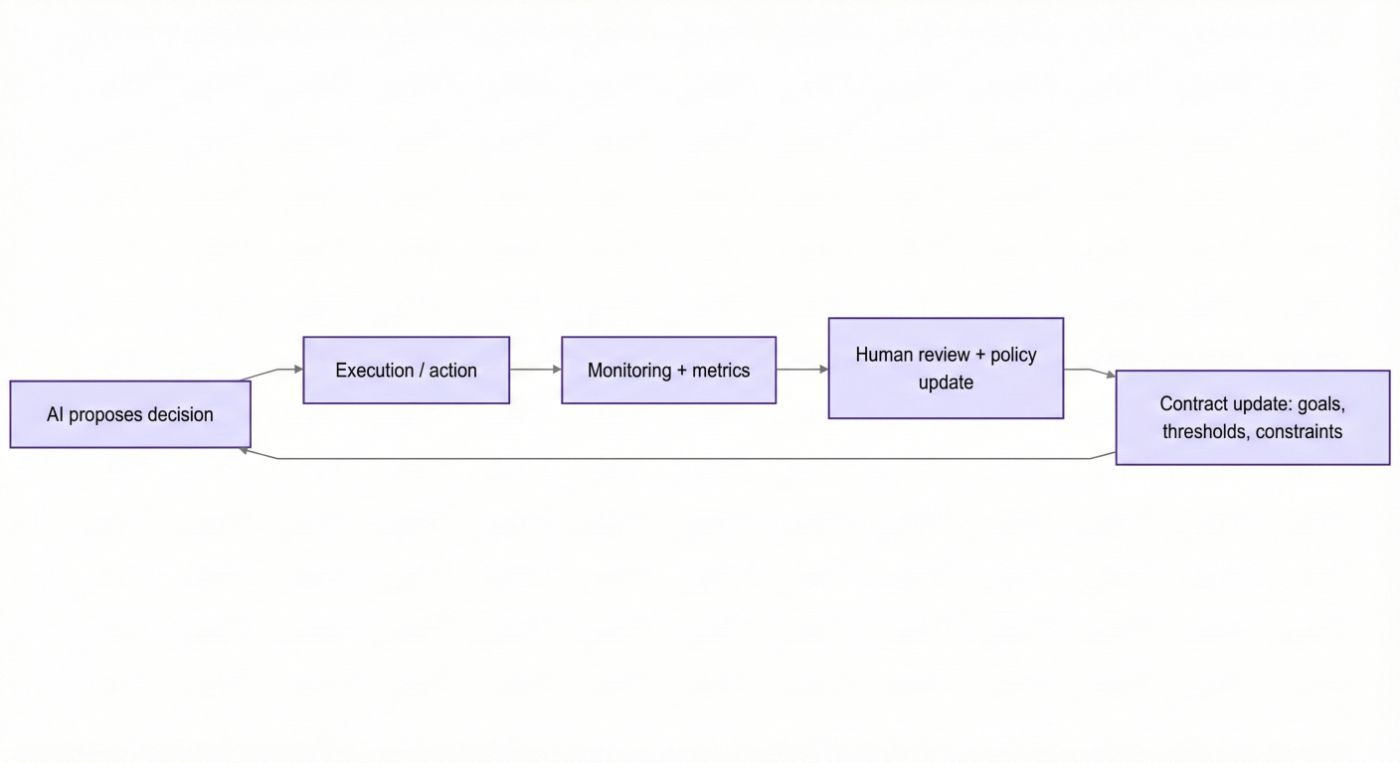
This loop is the difference between:
- “it worked in staging” and
- “it survives the real world.”
5) Three Real-World Patterns Where Dynamic Contracts Matter
5.1 Supply chain: “lowest cost” vs “lowest risk”
A routing model might optimise purely for cost. But real operations have constraints that appear mid-flight:
- strike actions,
- supplier delays,
- customs bottlenecks,
- seasonal demand spikes.
Dynamic contract move: temporarily reweight objectives toward reliability, tighten risk limits, trigger manual approval for reroutes above a threshold.
5.2 Finance: “best return” vs “acceptable behaviour”
A portfolio optimiser can deliver higher returns by exploiting correlations that become fragile under stress — or by concentrating in ethically questionable exposure.
Dynamic contract move: enforce shifting exposure caps, add human approval gates when volatility spikes, record decision provenance for audit.
5.3 Healthcare: “fastest recovery” vs “patient values”
AI can recommend the most statistically effective treatment, but “best” depends on:
- side effects tolerance,
- personal priorities,
- comorbidities,
- informed consent.
Dynamic contract move: require preference capture, enforce explainability, and make clinician override first-class, not an afterthought.
6) How to Implement Dynamic Contracts (Without Building a Religion)
Here’s the pragmatic blueprint.
6.1 Start with a contract schema
Define the contract in machine-readable form (YAML/JSON), e.g.:
- objective weights
- hard constraints
- approval thresholds
- escalation rules
- logging requirements
Treat it like code:
- version it
- review it
- deploy it
- roll it back
6.2 Add a “policy engine” layer
Your model shouldn’t directly execute actions. It should propose actions that pass through a policy layer.
Policy layer responsibilities:
- enforce constraints,
- require approvals,
- route to safe fallbacks,
- attach provenance metadata.
6.3 Add monitoring that’s tied to actions, not dashboards
Dashboards are passive. You need alerts linked to contract changes:
- “False positive rate increased after contract v12”
- “Decision distribution drifted post-update”
- “High-risk actions exceeded threshold”
6.4 Build the incident playbook now, not after the incident
At minimum:
- stop-the-world switch
- degrade mode (smaller scope, higher human review)
- rollback to last safe contract
- postmortem template (what changed, what broke, how detected, how prevented)
7) A Quick Checklist: Are You Actually Running a Dynamic Contract?
If you answer “no” to any of these, you’re still on static rules.
- Can we update objectives without redeploying the model?
- Can we see why each decision happened (inputs + policy + version)?
- Do we have a kill switch and rollback that works in minutes?
- Do we have approval gates for high-risk actions?
- Can we audit who changed what and when?
- Do we measure harm, not just performance?
Final Take
AI will keep getting better at optimisation. That’s not the scary part.
The scary part is that our objectives will remain incomplete, and our environments will keep changing.
So the only sane way forward is to treat AI decision-making as a governed system:
- not static rules,
- not blind trust,
- but a dynamic contract — living guardrails with observability, override, and accountability.
Because the future isn’t “AI makes decisions.” It’s “humans and AI co-manage a decision system — continuously.”
That’s how you get “perfect decisions” without perfect disasters.
[story continues]
tags