


In enterprise AI programs, there’s a familiar moment: the model works, the pilot succeeds, and managers declares victory. It’s an understandable moment of relief. A lot of effort goes into getting AI to work at all like aligning data, training models, validating results, convincing stakeholders. When something finally performs as expected, it feels like the hard part is behind you.
What I’ve learned, though, is that this is often where the nature of the work quietly changes. Once AI moves into production, it stops behaving like an experiment or a project. It starts behaving like infrastructure. And infrastructure has a way of revealing gaps you didn’t know were there.
The subtle shift from success to risk
AI systems rarely fail dramatically in production. They don’t crash or raise obvious alarms. Most of the time, they continue to function but just slightly differently than before.
I’ve seen situations where outcomes started drifting, but nothing appeared “broken.” Metrics looked acceptable in isolation. Each team could point to their own dashboards and say things were fine. And yet, something about the overall behavior of the system didn’t sit right.
That’s when questions begin to surface: Who owns this decision now that it’s automated? Was this output meant to support a human, or replace one? When did the inputs change, and who evaluated the impact of that change? What stands out is that these are not modeling questions. They’re coordination questions.
A moment that changed how I think about AI programs
One example, in particular, reshaped how I think about managing AI in production. The system itself had been built carefully. A classification model was trained, validated, and deployed to automate a high-volume operational decision. Early performance was stable. There was no immediate signal that anything was wrong. Then a downstream team noticed an increase in suppressed outcomes that didn’t align with historical behavior. The response was thorough, but fragmented. Data science teams reviewed accuracy. Engineering teams traced pipelines. Project teams revisited thresholds. Everyone looked closely at their own part of the system.
It took time to understand what had actually happened. A small upstream input change had altered how certain edge cases were categorized. The model adapted as designed. From a technical standpoint, it was doing its job. But the broader business context around those decisions hadn’t been revisited, and there was no mechanism to flag the shift or pause automation for review.
Nothing failed in a traditional sense. The system didn’t break, it simply evolved, unnoticed. That experience made something very clear to me: once AI is live, the challenge isn’t building intelligence. It’s staying aware of how that intelligence behaves over time.
Why familiar program tools start to fall short
Traditional program management works well when systems are stable. You define scope, timelines, ownership, and success metrics, and then you execute.
AI doesn’t fit neatly into that model. It learns from new data. It interacts with real users. Small changes can compound in ways that aren’t obvious until they show up in outcomes. I’ve seen teams follow every best practice from a delivery standpoint and still be surprised once automation is operating at scale.
In this environment, the role of the program manager shifts. The work becomes less about tracking progress and more about anticipating behavior: What signals will tell us the system is drifting? Where does human judgment still matter? Which decisions should never happen without review? These questions don’t usually appear in project plans, but they matter deeply in production.
Thinking in terms of control, not completion
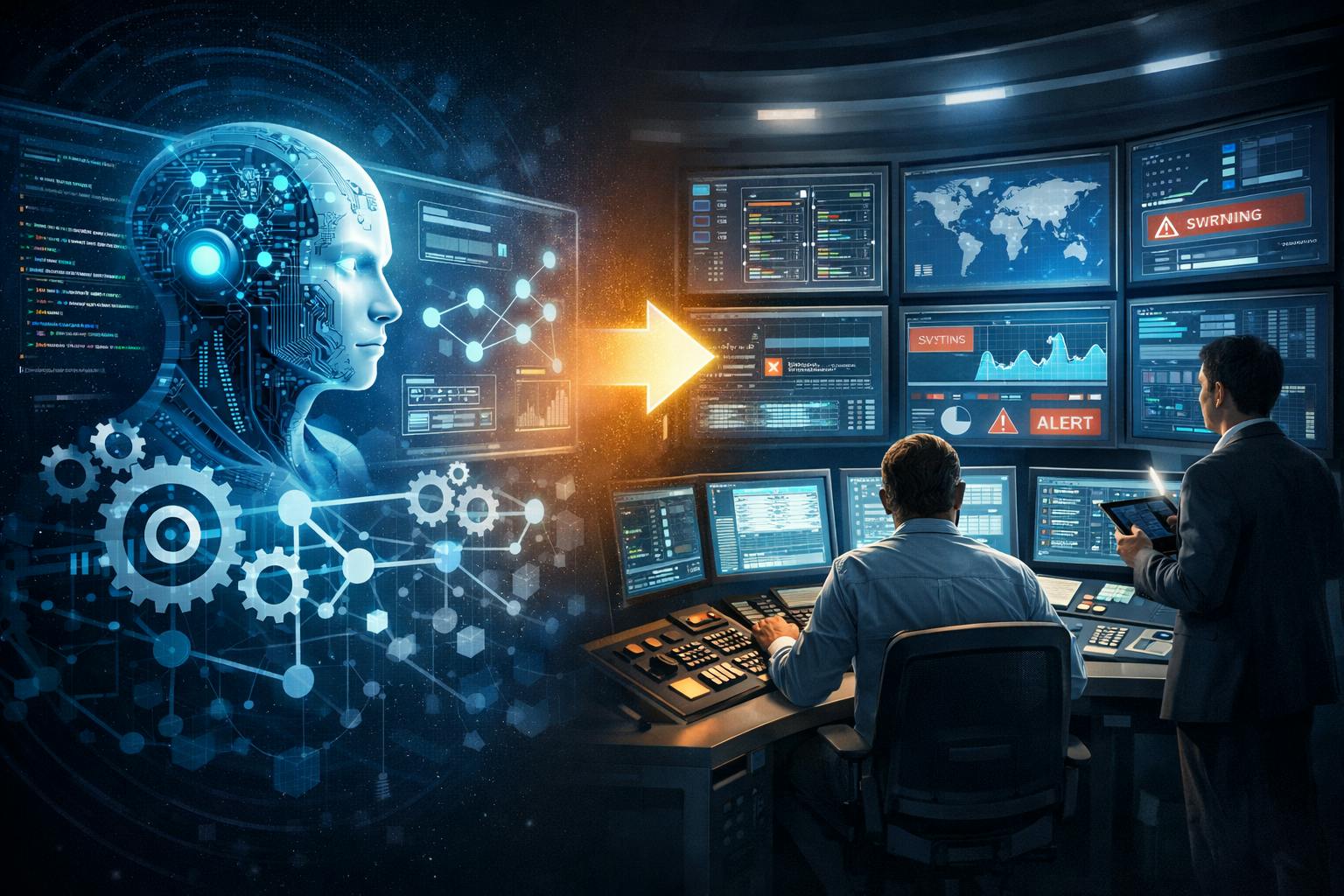
Over time, organizations often move toward what I think of as an AI control plane which is not a specific platform or tool, but an operational mindset.
In practice, this means designing for visibility into real outcomes, not just model performance and feedback that’s captured deliberately with clear paths for intervention when behavior changes. What makes this different from traditional oversight is that it runs continuously. It doesn’t depend on periodic reviews or post-incident analysis. It assumes the system will change and plans for that. When this layer exists, AI feels less fragile. Not because it’s perfect, but because its behavior is observable and correctable.
Trust is the first thing to erode
One of the most important lessons I’ve learned is that AI systems don’t usually fail because of a single bad decision. They fail when people stop trusting them.
That loss of trust is gradual. Teams add manual checks “just in case.” Automation gets bypassed for edge cases. Over time, those exceptions become the norm. The system may still perform well statistically, but confidence fades. Trust, I’ve come to believe, is an operational metric. It has to be designed for and actively maintained. That means surfacing anomalies early, making ownership explicit, and ensuring humans retain meaningful control when automation reaches its limits.
Program management as the connective layer
Program managers naturally sit at the intersection of engineering, compliance, and business operations. As AI becomes more autonomous, that position becomes increasingly important. What changes is the posture. Instead of managing static plans, effective program leaders start thinking in terms of feedback loops: observe, decide, act, learn. Their role is to shape how those loops operate, where humans step in, and how risk is surfaced before it becomes visible to customers. At that point, program management becomes less about oversight and more about orchestration.
What this shift really asks of us
As enterprises move toward more autonomous AI systems, the hardest challenge won’t be improving model accuracy. It will be maintaining alignment between what systems optimize for and what the business actually intends. That alignment doesn’t happen automatically. I’ve seen it drift when no one is clearly responsible for watching how intelligence behaves once it’s live.
This is why program management is no longer a supporting function in AI transformation. It’s becoming the layer that keeps machine intelligence understandable, governable, and trusted and not by controlling every decision, but by shaping the conditions under which decisions are made.