


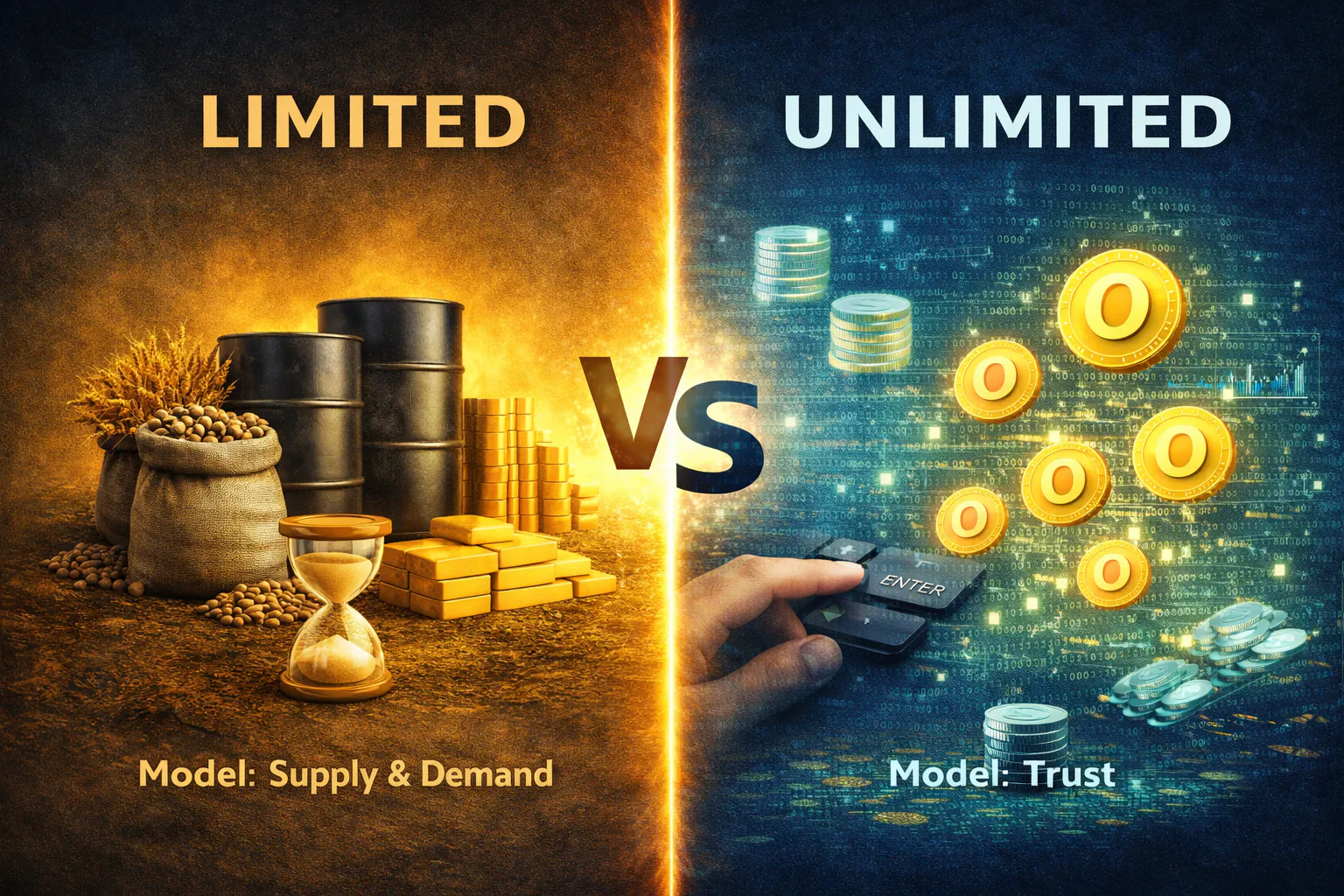
The Original Principle of Supply and Demand: Built on Scarcity
The classic supply and demand story is simple:
- Supply is limited by physical constraints (how much exists, how fast we can produce it).
- Demand is what people are willing to buy at a given price.
- The market price emerges where supply and demand meet.
This works extremely well when:
- Assets are physically limited (land, oil, gold, wheat).
- Production is costly and slow.
- Scaling supply requires time, capital, and effort.
In that world, supply is a real constraint. You cannot print more land. You cannot mine gold faster than your machines allow. You cannot harvest wheat in December if the fields are empty.
The whole principle of supply and demand assumes one basic truth: There is a hard limit on how much you can put on the market in a given time.
But what happens when that limit disappears?
Enter the Digital Era: Supply Is Just a Line of Code
In today's digital era, creating new units of value is often as simple as:
Change a number in a database or create a transaction. Run a line of code.
This is true for:
- Bank deposits (created when banks issue new loans).
- Central bank reserves (created by monetary policy operations).
- Fiat money (printed physically or credited digitally).
- Cryptocurrencies and tokens (created by smart contracts or protocols).
Supply and demand can’t be blamed for the value and instability of our currencies because they’ve been disconnected from any limited physical asset for over a century. The principle of supply and demand is based on limited assets.
In today’s digital era, creating wealth is as simple as running a line of code, pending government approval based on their objectives.
Technically, our currencies already have the potential to be unlimited. However, instead, they compete against each other for investors's trust, forcing governments to limit them in order to control debt and maintain confidence.
In other words:
- The technical limit on supply is gone.
- The political and psychological limits (confidence, inflation fears, market reactions) remain.
We still talk about supply and demand for money, but we are no longer talking about barrels of oil or tons of wheat. We are talking about numbers in a ledger and about trust.
A Short History of Money: From Scarce Metal to Pure Ledger
To see why this matters, it helps to look at how money evolved.
1. Commodity Money: Supply Was Physical
The earliest forms of money were:
- Gold, silver, and other metals
- Salt, shells, and other rare objects
Supply here was physically constrained:
- You could only mine so much gold.
- You could only gather so many shells.
If demand for money rose faster than supply, the price of the money-commodity went up. Supply and demand applied in the purest way, because money was itself a scarce asset.
2. Gold-Backed Paper: Supply Still Anchored to a Physical Asset
Then came:
- Paper notes representing gold stored in vaults.
- Early bank deposits redeemable for metal.
Even if you could print paper easily, the convertibility constraint anchored supply:
- Each note promised a claim on a limited quantity of gold.
- Issue too many notes, and people would try to redeem them.
- If the gold wasn't there, the system collapsed.
Supply of money was limited by the backing metal. The principle of supply and demand still made sense, because there was a warehouse with a finite inventory in the background.
3. Bretton Woods and the Dollar: One Last Physical Anchor
After World War II, the Bretton Woods system pegged many national currencies to the US dollar, and the dollar to gold.
- The dollar was convertible to gold at a fixed rate.
- Other currencies were convertible to dollars.
Again, even if the system was more complex, there was still a physical anchor in the background.
4. Fiat Currencies: The Anchor Disappears
In the 1970s, major currencies left the gold standard. Since then:
- Currencies are no longer redeemable for metal.
- They are backed by law, tax authority, and trust.
- Central banks can create or destroy money digitally at will.
We entered the era of pure fiat:
- No physical constraint on supply.
- No commodity warehouse in the background.
- Only policies, models, and politics limiting how much is created.
From that moment, treating money like a scarce commodity became more a metaphor than a reality.
Why Fiat Currencies Compete for Monetary Value
If money is no longer backed by a scarce physical asset, what gives it value?
Primarily:
- Trust in the issuer (government, central bank).
- Demand for the currency (to pay taxes, settle debts, price assets).
- Perception of stability (inflation expectations, political risk).
Modern fiat currencies compete on:
- Store of value: Will this hold purchasing power over time?
- Medium of exchange: Is it widely accepted and easy to use?
- Unit of account: Are goods and contracts priced in it?
Because there is no physical constraint, the game becomes:
- Issue enough to support growth and finance governments.
- But not so much that confidence collapses and inflation explodes.
This is not a supply and demand story in the traditional sense. It's a confidence management story:
- Too little issuance: Deflation, unemployment, political backlash.
- Too much issuance: Inflation, currency flight, loss of trust.
The currencies themselves behave like brands competing for trust, rather than like scarce commodities competing for buyers.
Digital Assets: Infinite Supply Potential, Artificial Limits
Cryptocurrencies and digital tokens make this even clearer.
Hard-Capped Coins (Like Bitcoin)
Some assets, like Bitcoin, deliberately re-introduce scarcity:
- Fixed maximum supply.
- Predictable issuance schedule.
Here, the supply is limited by code, not by nature. It's an artificial scarcity designed to mimic gold in a digital world.
Supply and demand narratives feel natural:
- Only 21 million coins ever.
- More demand means higher price.
But this is still a design choice, not a physical law. The scarcity exists because someone wrote it into the protocol creating appeal for gain and helping the promotion of this new concept.
Unlimited or Elastic Supply Tokens
Other digital assets:
- Can be minted or burned at will (stablecoins, governance tokens).
- Have no fixed cap and can expand based on debt or collateral or contract based on rules.
Here, supply is even more clearly:
- A policy variable, not a natural limit.
- Adjustable depending on goals (stability, incentives, UBI, funding).
Trying to reason about these assets with classic supply and demand intuition misses the point. The key questions are:
- What are the rules of issuance?
- What is the purpose (store of value, payments, governance, UBI)?
- How is trust maintained?
When Supply Is Not the Problem, Trust Becomes the Only Real Scarcity
If supply can be changed with code, the real scarce resource is:
Trust in the system that controls the code.
For both fiat currencies and digital assets:
- The hard part is not adding zeros to a database.
- The hard part is persuading people that those zeros mean something.
That depends on:
- Transparency of rules.
- Quality of governance.
- Stability of value over time.
- Fairness of distribution.
In that sense, we are not in a world where:
- More supply automatically means less value.
We are in a world where:
- Badly governed supply destroys trust.
- Well-designed supply, aligned with a clear purpose, can be unlimited without being unstable.
The principle of supply and demand does not disappear, but it changes focus:
- Demand is still about how many people want to hold or use the asset.
- Supply is no longer a fixed external constraint—it becomes part of the design space.
Why Applying Old Supply/Demand Logic to Digital Money Misleads Us
When we say: If we print more money, it must lose value because of supply and demand.
We are implicitly assuming: Money is like a scarce commodity.
But in a digital, fiat-based system:
- Money isn't scarce by nature.
- It is made scarce (or abundant) by policy.
- Its value is driven by trust, expectations, and usage more than by any natural supply limit.
This leads to several misunderstandings:
- Fear of any expansion: Assuming every increase in money supply is bad, regardless of context or design.
- Ignoring purpose: Treating all money and tokens as if they serve the same role (store of value) when many are designed for specific uses (payments, governance, UBI, climate funding).
- Missing alternatives: Believing we must always limit supply brutally to maintain value, instead of designing better calibration and stabilization mechanisms.
We need a new mental model:
- Not less supply automatically equals more value.
- But correctly calibrated, transparently governed supply equals more trust.
Calibration Instead of Scarcity: The O Blockchain Approach
O Blockchain starts from a different premise:
- Digital supply is not the problem.
- The real problemis how we calibrate value and distribute new units.
Instead of relying on artificial scarcity or unbounded political discretion, O Coin uses:- Water price calibration: 1 O unit corresponds to the average local price of 1 liter of water, making value measurable and comparable across countries. O coins ecosystem includes more than 142 O currencies, one per official fiat currency.
- Unlimited, purpose-driven supply: New coins can be created for Universal Basic Income and earth-cleaning activities without arbitrary caps, as stability doesn’t depend on Human trust but Water price measurements.
- Algorithmic rules: Issuance is determined by transparent, encoded mechanisms rather than opaque political decisions.
In this model:
- Supply is designed to serve human goals (security, climate action) while keeping value stable through calibration, not through scarcity.
- Trust comes from rules and measurement, not from hoping that no one will print too much behind closed doors.
The question is no longer: How do we limit supply so people stay confident?
It becomes: How do we design a system where supply can be as large as needed, while value and distribution remain stable and fair?
Conclusion: Beyond Supply and Demand for a Digital Monetary Era
Supply and demand remain powerful ideas—but they were born in a world of physical scarcity. In a world where money and assets are digital entries controlled by code and policy, the natural supply constraint disappears. What remains is human trust and confidence.
Technically, our currencies already have the potential to be unlimited. They are kept in check not by nature, but by fear of losing confidence and triggering crises. Digital assets show that we can go further: we can design currencies where supply is not a problem to be feared, but a parameter to be calibrated.
To do that, we must stop pretending that digital money behaves like gold or oil, and start treating it as what it really is: a programmable system of rules and measurements. When we do, we can build monetary systems that are stable, fair, and purpose-driven—not because they are scarce by nature, but because they are trustworthy by design.
This article is published under HackerNoon's Business Blogging program.