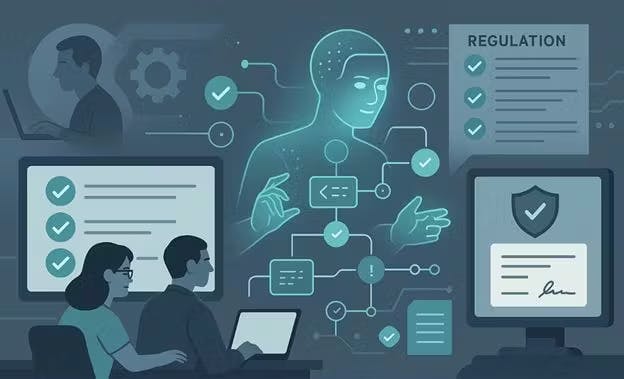
Three years ago, I sat in a validation review room surrounded by binders, printouts, and fluorescent sticky tabs. Quality approvers were debating clause interpretations. Engineers were waiting for signatures. Production was on hold until documentation caught up.
This wasn’t a failure of talent. It was a failure of process a system designed for a paper world operating in a digital one.
This shift matters because regulated industries are hitting a breaking point: digital systems now move faster than traditional compliance models can keep up.
Today, that same room looks very different. Validation artifacts are drafted automatically. Test evidence is logged in real time. AI flags missing traceability links before QA even opens the review screen. What used to take weeks now happens inside a single afternoon.
Something fundamental is changing in how regulated industries assure compliance.
Validation is no longer being written it is being coded.
The Shift: From Documented Compliance to Computational Compliance
For decades, validation meant proving that a system works as intended through documents test protocols, trace matrices, deviation reports, signoff sheets.
But digital manufacturing has introduced a problem:
- Software changes fast.
- Documents do not.
DevOps teams deploy updates daily. Validation teams traditionally move in cycles of weeks or months. The gap is unsustainable.
The answer is not more documentation.
It is systems that enforce compliance logic as code.
Generative AI and low-code platforms are now enabling this shift.
What the New Model Looks Like
Instead of humans writing everything manually:
- Requirements are expressed in structured natural language.
- Generative AI converts them into validation logic.
- Low-code platforms compile that logic into workflows, test cases, and evidence trails.
- Humans review, approve, and override where needed.
This doesn’t remove rigor.
Itindustrializes it.
Think of it as “Policy-as-Code meets Validation-as-Code.”
A Real Example (Anonymized, but Based on Actual Deployment)
A biologics manufacturer was preparing to roll out a new batch management application. Historically, drafting the qualification package took four to six weeks.
This time, they used an AI-assisted validation platform.
- The system analyzed 200+ legacy protocols
- It generated draft OQ test steps aligned to prior validated logic
- Engineers adjusted parameters, not paragraphs
- QA approved digital signatures in a single collaborative workspace
Total time: 10 days instead of 40+.
Deviation rates dropped. Traceability was automatic.
The shift didn’t reduce compliance it made it repeatable and defensible.
Why Low-Code Matters
Low-code isn’t just convenience tooling.
In GxP environments, it is a governance equalizer.
Process SMEs — not only software developers can now:
- Encode regulatory rules directly into workflows
- Reuse validated components via version-controlled libraries
- Scale validation knowledge across sites instantly
It moves validation from reactive documentation to proactive system design.
This is where generative AI plays its most strategic role not as an automation engine, but as a compliance reasoning partner.
The Validation Co-Pilot
Generative AI is not here to automate validation away; it is here to transform validation into a collaborative reasoning process.
Trained on historical protocols, audit outcomes, SOP language, and deviation patterns, the model functions as a compliance co-pilot that supports the validation engineer’s judgment rather than substituting for it.
A well-designed system can draft IQ/OQ/PQ protocols in minutes by adapting previously validated logic to a new system’s context. It can highlight ambiguity in requirements before testing begins, identify missing acceptance criteria, and detect traceability gaps long before QA review.
In pilot implementations, the AI even surfaced subtle inconsistencies across product lines the kind of patterns that rarely emerge in manual, document-by-document reviews.
The key insight is this:
The AI does not make the decision.
It illuminates the decision.
When paired with strong data hygiene and clearly structured requirements, the Validation Co-Pilot becomes a pattern-recognition engine that anticipates compliance risk early.
It ensures validation outcomes are repeatable, explainable, and defensible regardless of who drafts the protocol, who performs the execution, or which facility the system is deployed in.
In other words, generative AI doesn’t replace the validation engineer.
It elevates them from document preparer to compliance architect.
Yes — Guardrails Still Matter
AI does not eliminate responsibility.
Regulatory expectations for human accountability remain non-negotiable. In regulated industries, accountability can never be automated away it must be engineered into the system.
Organizations must:
- Validate model behavior and drift
- Track model training data
- Maintain transparent override logic
- Keep SMEs in the approval loop for high-impact changes
This is not “AI takes over validation.”
This is AI augments judgment.
The Future: Self-Validating Systems
We are heading toward platforms that:
- Detect process drift autonomously
- Trigger requalification workflows automatically
- Generate evidence as a byproduct of operation not a separate activity
Validation becomes continuous and adaptive.
And the validation engineer?
They evolve into the designer of the compliance intelligence layer itself.
As these systems mature, validation will no longer be a periodic checkpoint it will operate as a live feedback loop embedded into everyday production workflows.
Compliance evidence will be continuously generated, continuously verified, and continuously audit-ready not assembled retroactively.
This transforms validation from a reactive activity into a real-time quality intelligence function, aligning regulatory assurance with the actual speed of digital manufacturing.
Closing Thought
Generative AI and low-code platforms are not removing the rigor of GMP validation they are reprogramming how rigor is achieved.
The organizations that adopt this shift early won’t just move faster; they will shape what compliance means in the digital era.
Validation is no longer the end of the process it is becoming part of the system’s living logic.
Compliance will not be something we produce; it will be something the system continuously maintains.
This means validation engineers will shift from writing documents to designing the governing intelligence layer that ensures trust, traceability, and regulatory confidence.
Those who learn to architect this new compliance fabric will not only lead transformation inside their companies they will set the industry standard others follow.
In the next decade, the most influential validation engineers won’t be the best document writers they’ll be the architects of compliance intelligence.
base64 images have been removed. Instead, use an URL or a file from your device
[story continues]
tags