


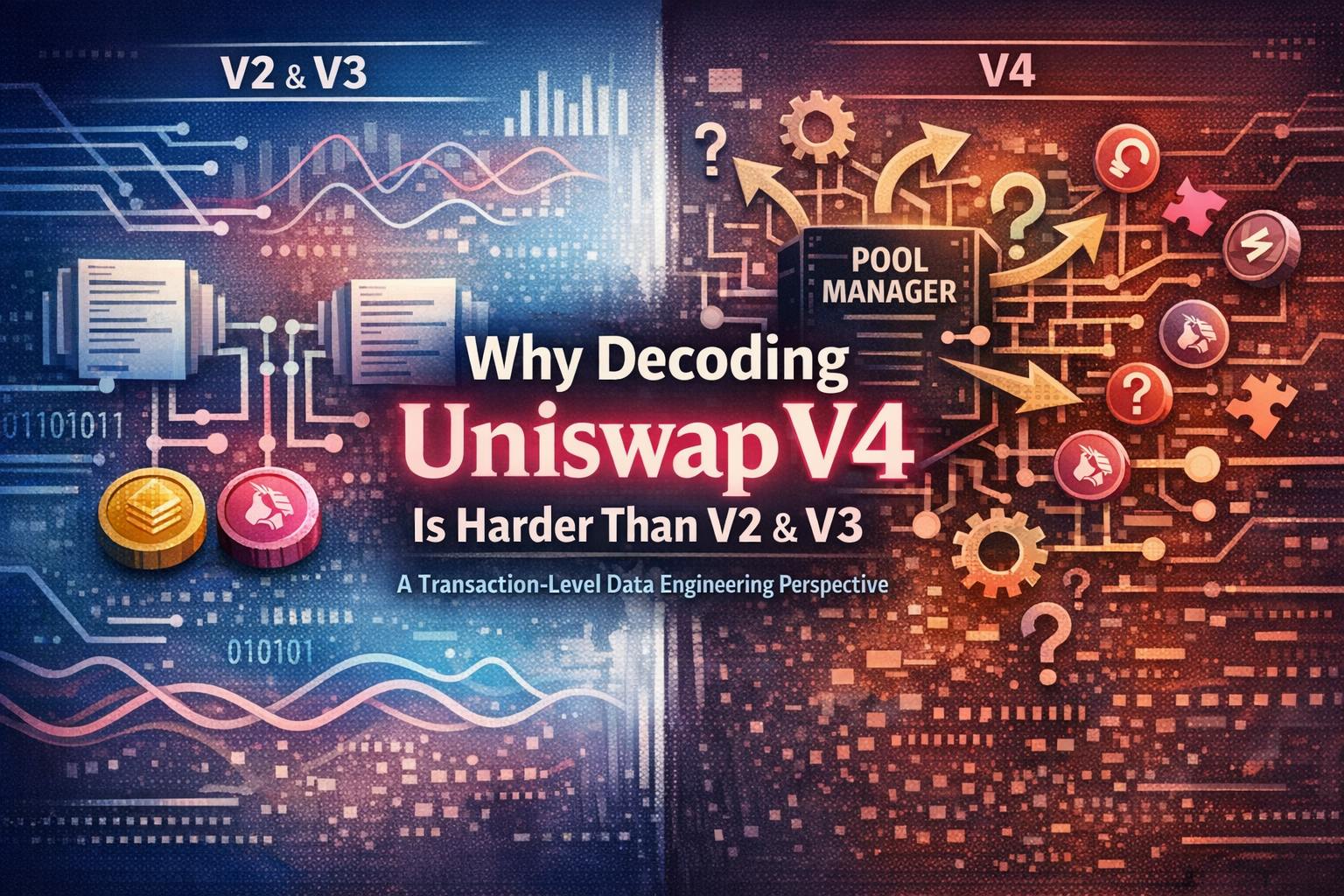
A transaction-level, data-engineering perspective
When people say “Uniswap V4 is just another AMM version”, that’s only true at the UX level.
From a transaction decoding and on-chain data perspective, V4 is a very different beast.
If you’ve ever built:
- a tx decoder
- an indexer
- a trade analytics pipeline -or a MEV/monitoring system
You’ll immediately feel the difference.
This post explains why decoding Uniswap V4 is fundamentally harder than V2 and V3, and what changes at the data layer.
1. V2 & V3: Decoding by Pattern Recognition
V2/V3 decoding is almost trivial:
- One pool = one contract -> Liquidity is the balance of the pool contract
- Swap logic is fixed
- Key events:
- Swap
- Mint
- Burn
- A decoder can:
- Identify the pool address
- Parse Swap event
- Infer: token0 / token1 from pool contract
➡️ Event-driven, deterministic, stateless
2. Uniswap V4: Everything Breaks 😅
Uniswap V4 introduces a paradigm shift, not an iteration.
The biggest change:
Pools are no longer contracts.
All pools live inside one singleton contract (PoolManager), and everything is keyed by a PoolId.
That single design choice cascades into multiple decoding problems.
3. PoolId ≠ Pool Address
In Uniswap V4:
- poolId is a bytes32
- Derived from:
- token0
- token1
- fee
- tickSpacing
- hooks
- Problems for decoders:
- No on-chain pool address to index
- No ERC-20 balance per pool
- No direct contract logs per pool
➡️ You must detect event pool initialize; save the pool information to your local database before you start decoding any transactions of the pool.
4. Hooks: Decoding Without Knowing the Rules
Hooks are the real game-changer.
A pool can attach arbitrary logic at:
- beforeSwap
- afterSwap
- beforeModifyPosition
- afterModifyPosition ...
From a decoder’s point of view:
- Swap behavior is no longer deterministic
- Token flows may:
- be modified
- be redirected
- be conditionally executed
- Even worse:
- Hooks are external contracts
- They may emit their own events
- Or emit nothing at all
➡️ You cannot decode V4 swaps correctly by reading PoolManager logs alone.
5. One tx ≠ One Action
- In V2/V3:
- In V4:
➡️ Decoding becomes stateful, not event-local.
6. Event Semantics Are Weaker
Another subtle but painful difference:
V2/V3 events are semantic
→ “This is a swap, this is mint, this is burn.”
V4 logs are often mechanical
→ balance deltas, internal calls, state updates
To reconstruct a “swap”, you may need:
- call trace
- storage reads
- hook-specific logic
- token balance diffs
➡️ You’re rebuilding meaning, not parsing events.
7. Why Generic Decoders Fail on V4
Most existing decoders assume:
- pool = contract
- swap = event
- tokens = known upfront
These assumptions fail in V4.
A V4-capable decoder must:
- Resolve PoolId → PoolKey
- Track pool state off-chain
- Understand hook execution paths
- Aggregate multi-step flows into one semantic action
➡️ This is closer to program analysis than log parsing.
8. Practical Implications for NFRA Teams
If you’re building:
- analytics dashboards
- tax tools
- MEV monitors
- compliance/forensics
- copy-trading systems
Then V4 forces you to rethink:
- indexing strategy
- storage model
- decoding abstractions
“Just listen to events” is no longer enough.
Closing Thoughts
Uniswap V4 isn’t harder because it’s poorly designed.
It’s harder because it’s more expressive.
That expressiveness moves complexity:
from smart contracts
to off-chain decoding and interpretation
For data engineers and infra builders, V4 is not an upgrade — it’s a new problem class.