
Table of Links
-
Clocks at Earth-Moon Lagrance Points
4.1 Clock at Lagrange point L1
Appendix 1: Fermi Coordinates with Origin at the Center of the Moon
Appendix 2: Construction of Freely Falling Center of Mass Frame
Appendix 3: Equations of Motion of Earth and Moon
Appendix 4: Comparing Results in Rotating and Non-Rotating Coordinate Systems
Acknowledgments and References
2. CLOCKS IN ORBIT
An instructive example of establishing a coordinate time on Earth is the GPS time. The constellation clocks are set to beat at the average coordinate rate corresponding to clocks at rest on the surface of the rotating Earth by applying a “factory frequency offset” to the clocks before launch, which is [4]
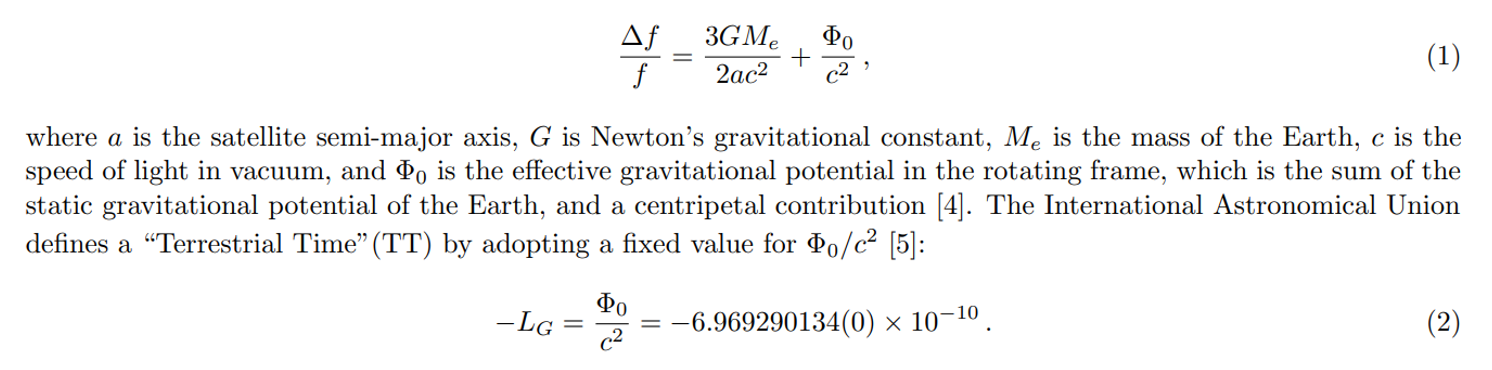
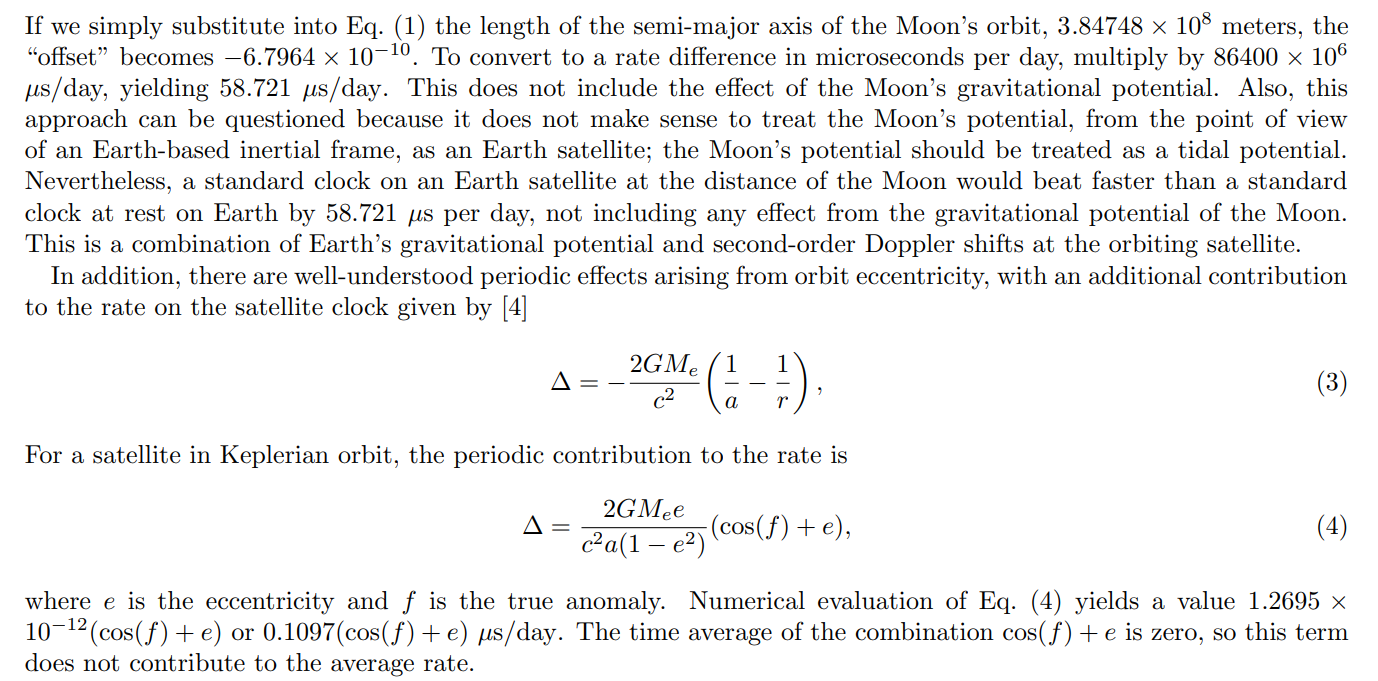
This model is based on using an eccentric Keplerian orbit in the local inertial frame centered on Earth’s center of mass. The center of mass of the Earth and Moon approximately follows a Keplerian orbit. However, for the EarthMoon system, one cannot have a Keplerian orbit in a coordinate system centered on the Earth and a Keplerian orbit in a coordinate system centered on the Earth-Moon center of mass with the same orbit parameters. There are also relativistic effects arising from changes in time and length scales, Lorentz contraction, and changes in tidal effects.

Authors:
(1) Neil Ashby, National Institute of Standards and Technology, Boulder, CO 80305 (Neil.Ashby@Colorado.Edu);
(2) Bijunath R. Patla, National Institute of Standards and Technology, Boulder, CO 80305 (bijunath.patla@nist.gov).
This paper is
[story continues]
tags