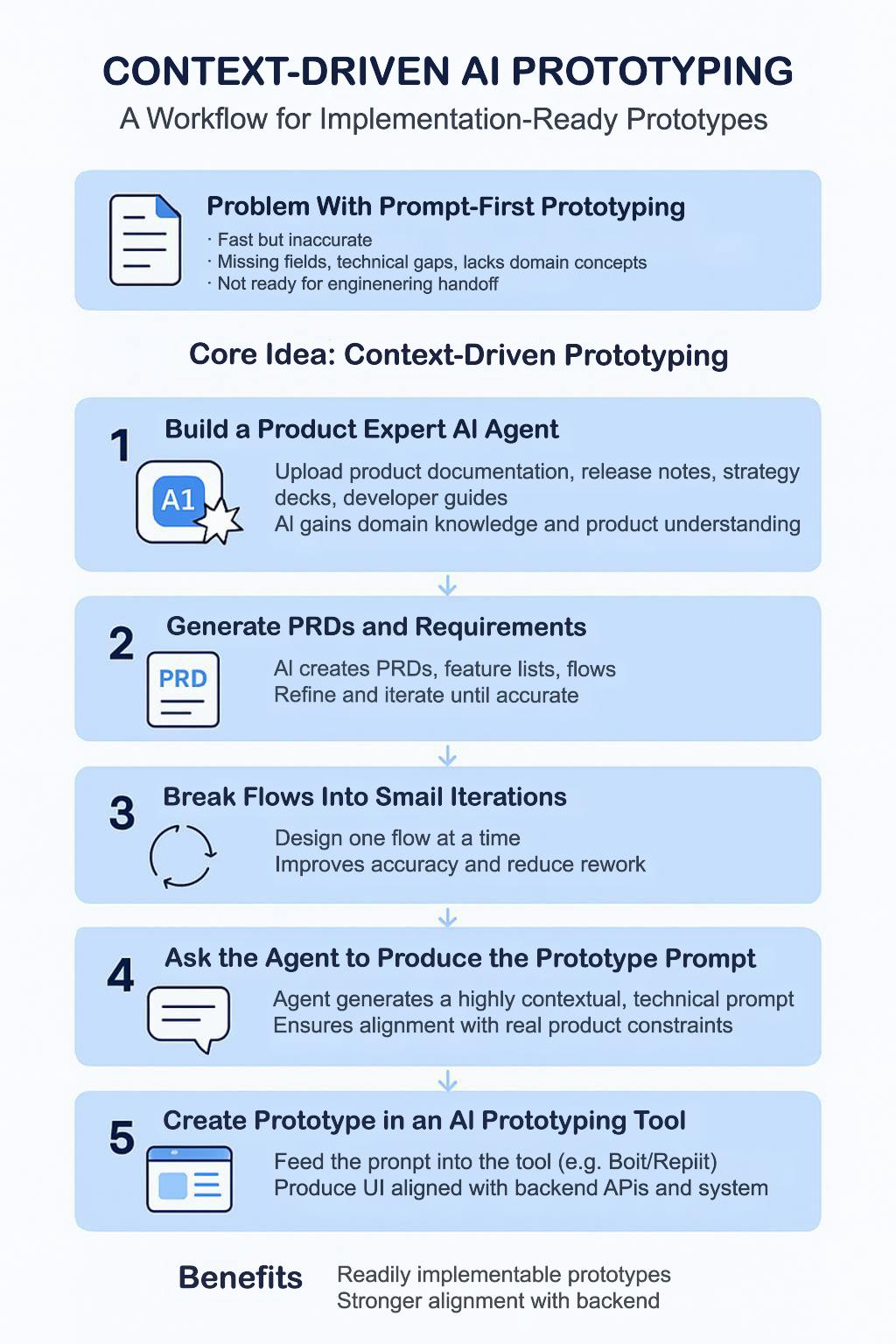
Most AI prototyping tools generate polished UIs that look great but fall apart the moment engineering tries to build them. The problem isn’t the UI—it’s the lack of product context.
My workflow is to build a product‑expert AI agent first, generate a PRD inside it, break the experience into small flows, and then use contextual prompts to create prototypes that actually reflect real system behavior, data models, and constraints.
Many AI product managers use variations of this approach. What follows is the version I’ve refined and found most reliable for turning AI‑generated concepts into implementation‑ready prototypes.
Why Traditional AI Prototype Workflows Break Down
Most AI prototyping tools follow a simple pattern: Prompt → UI mockup
It’s fast, but for anything beyond a simple consumer feature, it quickly fails. You get:
- Incorrect assumptions about system behavior
- Missing or wrong data fields
- Domain logic that doesn’t exist
- Flows that engineering can’t implement
- Pretty UIs with zero architectural grounding
The core issue: AI doesn’t know your product. Without grounding, it produces something imaginative, not buildable.
The Shift: Context‑Driven AI Prototyping
Instead of starting in a prototyping tool, I flipped the workflow:
Build context → Generate a PRD → Define flows → Produce contextual prompts → Generate prototype
The result is a prototype aligned with how the system actually works—not how a model guesses it might work.
1. Build a Product‑Expert AI Agent
Before touching UI, I create an AI agent that deeply understands the product. You can use ChatGPT, Microsoft Copilot, or any agent framework that you prefer.
I load it with:
- Help docs
- Strategy decks & roadmaps
- Release notes
- API references
- Developer guides
- One‑pagers / internal overviews
- Any content I can consolidate into structured PDFs
This single step changes everything.
Once trained, the agent knows:
- Core concepts & data models
- Domain rules & constraints
- Historical decisions
- System behaviors
- Edge cases
- Terminology & internal language
Now I can ask things like:
- “Write a PRD for X.”
- “Generate API samples for this workflow.”
- “List all user actions in this system.”
- “What assumptions am I missing?”
The output becomes significantly more accurate than a generic LLM conversation.
2. Generate and Workshop the PRD Inside the Agent
Next, I use the agent to create a PRD for feature X.
But this PRD is not the final version—it’s a starting point.
I review and workshop it for any incorrect assumptions, missing fields or behaviors, product and domain gaps or architectural conflicts. I iterate inside the agent until the PRD reflects the real system.
This step increases time to the first prototype, but it dramatically accelerates everything after—especially cross‑functional conversations.
3. Break the Experience Into Small, Independent Flows
AI struggles with large, complex requests. So I break the experience into discrete flows, such as (this may be different for your product):
- Landing page
- Create Report
- View insights
- Manage Subscriptions
- View and Download
Small context → Higher accuracy → Less rework
Each flow becomes its own micro‑iteration of project.
4. Have the Agent Generate the Prototype Prompt
Now that the agent understands the PRD and flows, I ask:
“Generate the exact prompt to produce a prototype for this flow.”
The agent produces a prompt like:
✅ Prototype Objective
Design a user interface that enables users to:
Create, customize, and schedule reportsView and download generated reportsManage report subscriptionsFilter and organize data by merchant, product, and transaction attributes
🧩 Step-by-Step Instructions for VIBE Prototype
1. Landing Page – “Reporting Dashboard”
Components:Navigation panel (left): Downloadable Reports, Available Reports, Report Subscription ManagementSummary cards: Total reports generated, active subscriptions, average generation timeCTA buttons: Create Report, View Subscriptions, Download Reports
2. Report Creation Flow – “Create Report” Modal/Page
Trigger: Click Create Report from Dashboard or Available ReportsSections:Account Setup (for partner users):Dropdown: Select Merchant or Group
Basic Report Setup:Text input: Report Name (max 250 characters)Dropdown: Report Type (e.g., Transaction Request, Payment Batch Summary)Dropdown: File Format (CSV or XML)Dropdown: Frequency (One-time, Daily, Weekly, Monthly)
Advanced Report Features (expandable panel):Toggles: Credit Amounts as negative, Naming Convention (camelCase or snake_case)Multi-select filters:Application (e.g., Sales, Refunds)Connection Method (e.g., API, Terminal)Payment Channel (e.g., VisaNet, Mastercard)
Field Selection:Searchable list of fieldsCheckboxes to include/exclude fieldsDrag-and-drop ordering (CSV only)
Actions:Button: Create → triggers report generation or subscription setup
A prompt like this would take hours to fine tune manually— but the agent can do it in seconds with full context.
5. Create the Prototype Using a Contextual Prompt
Now I finally open an AI prototyping tool. But instead of: “Build a UI for batch uploads…” I give it a fully contextualized prompt with domain rules, data structures, field definitions, behaviors, API inputs/responses, error paths, interaction expectations.
This produces something radically closer to implementation reality.
The UI still needs polish, but the logic, fields, and flows are correct, which is what matters for engineering alignment.
6. Validate Early With Design & Engineering
The prototype is not “final UI,” but it’s far enough along that Designers avoid starting from a blank screen and Engineers can validate feasibility immediately.
It becomes a shared artifact for meaningful cross‑functional discussion, not a theoretical mockup.
Benefits of Context‑Driven Prototyping
I have observed that this workflow consistently delivers:
- Prototypes that reflect real behavior, not hallucinated logic
- Faster alignment between product, design, and engineering
- Reduced ambiguity in requirements
- Less rework in later stages
- Better architectural grounding
- Earlier discovery of constraints and dependencies
For complex systems, this is a game‑changer.
Risks & Tradeoffs
Context‑driven prototyping is powerful, but not perfect.
- Longer ‘time to first prototype’.
- Agent drift or bias - Different models can interpret context differently.
- The agent must be updated constantly after new releases, APIs, or architectural changes.
- UI stills need design refinement.
- If you’re blue‑sky brainstorming, this approach may be unnecessarily heavy.
Closing Thoughts
Context‑driven prototyping has completely changed how I build with AI. Instead of relying on generic, surface‑level prompts, I anchor every prototype in real system knowledge, which dramatically improves accuracy and reduces alignment friction.
As AI tools evolve, context-first > prompt-first will be the difference between prototypes that look impressive… and prototypes that engineering teams can actually build.
[story continues]
tags