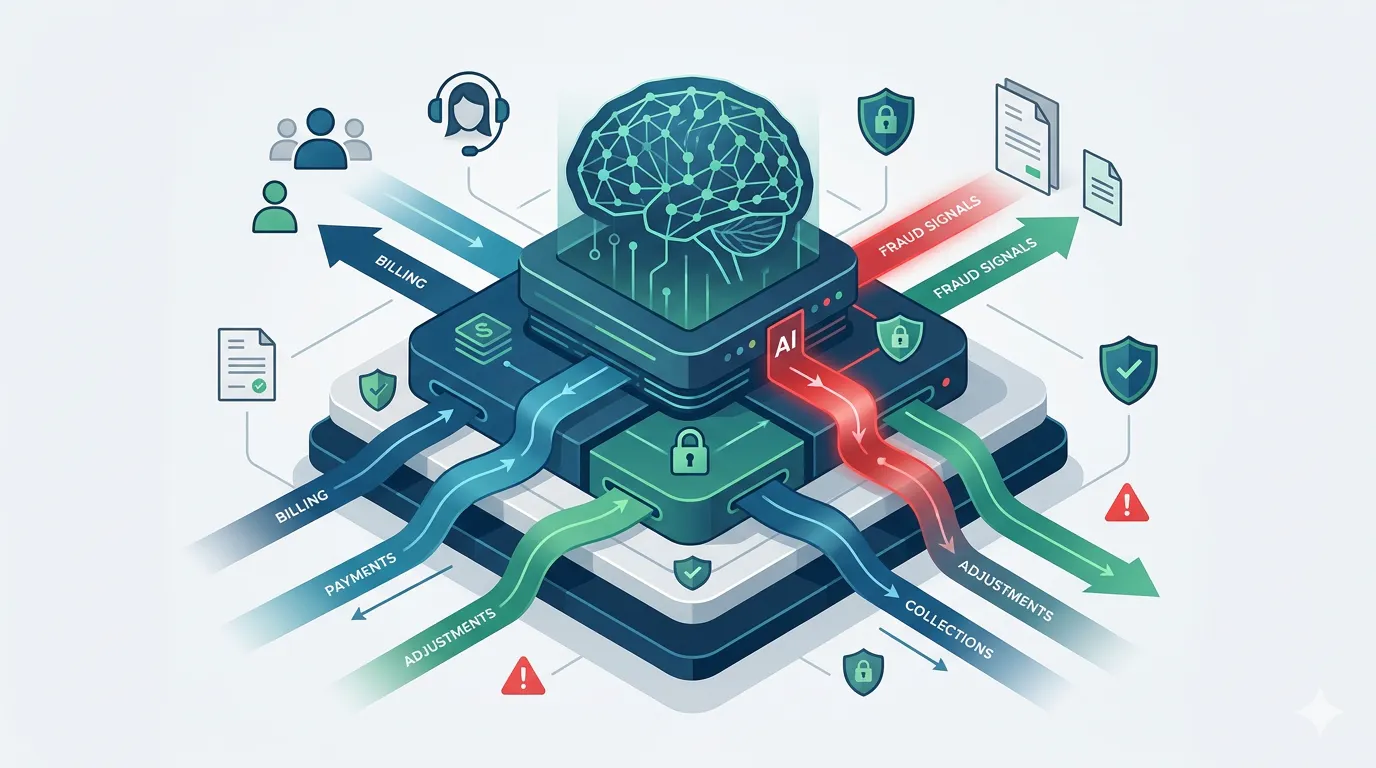
For a long time, telecom billing was treated as a backend system, something that quietly calculated charges and generated invoices. That world doesn’t exist anymore.
Today, billing sits at the center of everything: customer experience, revenue accuracy, operational efficiency, and trust. It connects usage, orders, payments, identity, and customer care into one place. And because of that, it has become the point where problems, especially fraud, finally surface.
Here’s the uncomfortable truth: Fraud may start upstream, but customers experience it in billing.
· A wrong charge.
· A delayed refund.
· An unexplained fee.
That’s when trust breaks. And by that point, the damage is already done.
Why Billing Is the Epicenter of Fraud
From a product perspective, billing is where intent turns into money. Every fraudulent action whether it begins with identity compromise, social engineering, or misuse of services eventually shows up as:
- A charge
- A credit
- A refund
- A payment reversal
- Or even a collections balance
Billing is not just downstream. It’s where financial impact and customer perception collide.
What makes it even more complex is its position in the ecosystem. Billing systems are deeply integrated with CRM, order management, payments, and collections. They are influenced by agent actions, compliance rules, and service-level expectations while remaining highly visible to customers.
That combination makes billing both powerful and vulnerable. When fraud controls are poorly designed, billing doesn’t just fail to stop fraud it amplifies it.
The Real Problem: Fraud Is a Product Design Gap
Most organizations still treat fraud as a security or compliance problem. But in billing, that mindset falls short. Fraud patterns aren’t random. They are signals. Signals that something in the product design is broken:
- Lack of context in workflows
- Rigid or inconsistent controls
- Limited visibility into behavior
- Disconnected systems
If product managers treat these as isolated incidents, they end up fixing symptoms instead of solving root causes. But if they treat them as product gaps, they can redesign the system to prevent issues entirely.
How Fraud Actually Shows Up in Billing
Let’s make this real. Fraud in telecom billing doesn’t always look dramatic. It hides in everyday workflows.
1. Adjustment and Credit Abuse
Adjustments are essential for customer care — but they’re also one of the most exploited areas.
Agents may issue credits without full context. Approval thresholds may vary. Historical behavior is often invisible.
The result?
Small, repeated leaks that add up over time.
2. Unauthorized Charges and “Bill Shock”
Customers rarely see fraud when it happens. They see it when the bill arrives.
By then, the issue has already spread across systems, making it harder to trace and fix.
Billing becomes the “failure point” — even if the root cause was elsewhere.
3. Payment and Refund Manipulation
Refund loops, repeated payment failures, and reversals can be used to manipulate cash flow.
Without behavioral intelligence, systems treat these as normal transactions — not risk signals.
4. Fraud Flowing Into Collections
Undetected fraud doesn’t disappear. It moves downstream. Balances get sent to collections. Customers are forced to prove they’re not at fault. Trust erodes further. At this stage, what could have been prevented becomes expensive and damaging.
Why Traditional Controls Don’t Work Anymore
Most billing systems still rely on:
- Static rules
- Hard thresholds
- After-the-fact audits
These approaches were built for a simpler world.
But fraud today is:
- Behavioral
- Contextual
- Adaptive
Static rules can’t keep up. They either:
- Miss real fraud
- Or block legitimate customers
Both outcomes hurt the business.
This is where many organizations get stuck trying to patch modern problems with outdated tools.
From Reactive Billing to Intelligent Billing
The real transformation happens when AI is embedded directly into billing workflows.
· Not as a separate fraud system.
· Not as an external layer.
· But as part of the product itself.
This changes everything. Instead of reacting after a bad bill is generated, systems can:
- Detect anomalies early
- Understand context and intent
- Prevent issues before they reach the customer
Billing moves from a system of record to a system of judgment.
Where AI Actually Makes a Difference
1. Risk-Aware Billing Flows
Not every action should be treated the same. AI enables systems to respond dynamically:
- Low-risk → seamless experience
- Medium-risk → soft verification
- High-risk → guardrails or review
This protects the business without adding friction for genuine users.
2. Smarter Agent Experiences (CRM Integration)
Fraud prevention isn’t just about detection it’s about execution. This is where CRM platforms (like Salesforce Service Cloud) play a critical role. When fraud intelligence is embedded into agent workflows:
- Agents see risk signals in real time
- Systems explain why something looks suspicious
- Next-best actions are recommended
Instead of reacting blindly, agents make informed decisions. This reduces escalations, improves first-call resolution, and builds confidence both for agents and customers.
3. Adaptive Controls Instead of Static Limits
Static limits are predictable. Predictable systems are easy to exploit.
AI introduces:
- Dynamic thresholds
- Behavior-based risk scoring
- Continuous learning
Now the system evolves with fraud patterns instead of falling behind them.
What Success Looks Like - From a Product Perspective
Fraud prevention in billing isn’t just about saving money. It’s about reducing friction and protecting trust. The metrics that matter include:
- Lower false positives
- Fewer repeat disputes
- Reduced adjustment rework
- Fewer fraud-related calls
- Faster resolution times
These are product outcomes not just security outcomes.
Billing as a Trust Platform
Customers might tolerate service issues. They don’t tolerate billing mistakes. Because billing is where money is involved. And money is where trust is tested. For product managers, this is the real opportunity. AI-driven billing isn’t just about stopping fraud. It’s about:
- Preventing customer harm
- Reducing operational chaos
- Designing systems that understand intent
When done right, billing stops being a liability. It becomes a competitive advantage.
Final Thought
Fraud in telecom billing is no longer just a risk problem. It’s a product problem. And the teams that recognize this and embed intelligence directly into billing workflows will be the ones that:
- Prevent issues before they happen
- Deliver better customer experiences
- And build long-term trust at scale
Because in the end, billing isn’t just where money flows. It’s where trust is earned or lost.
[story continues]
tags